




Three point charges of \[+2Q\], \[+2Q\] and \[-4Q\] are placed at the corners A, B and C on an equilateral triangle ABC of side\[x\]The magnitude of the electric dipole moment of this system is
a.\[2\sqrt{3}Qx\]
b. \[2Qx\]
c. \[3Qx\]
d. \[3\sqrt{2}Qx\]
Answer
 Verified
546.6k+ views
Hint: While solving questions like these, keep in mind the concepts regarding electric dipole. Remember that an electric dipole is defined as a couple of opposite charges separated by a certain distance. Remember that the electric dipole is a measure of the system’s overall polarity.
Complete answer:
When the molecules of a dielectric are placed in the electric field, their negatively charged electrons separate slightly from their positively charged cores. With this separation, referred to as polarization, the molecules acquire an electric dipole moment. A cluster of charges with an electric dipole moment is often called an electric dipole.
Under the influence of the electric field of a charged object, the negatively charged electrons and positively charged nuclei within the atoms and molecules are subjected to forces in opposite directions. As a result, the negative and positive charges separate slightly. Such atoms and molecules are said to be polarized and to have an electric dipole moment.
Electric dipole is defined as a couple of opposite charges separated by a certain distance. Keep in mind that the electric dipole is a measure of the system’s overall polarity The SI units for electric dipole moment are Coulomb-meter (\[C.m\]); however, a commonly used unit in atomic physics and chemistry is the Debye (\[D\]).
As we know, that electric dipole is basically a system of two equal and opposite charges separated by a small distance, so we can consider the charge of \[-4Q\] to be two charges of magnitude \[-2Q\] each, which will enable us to form a system of two dipoles.
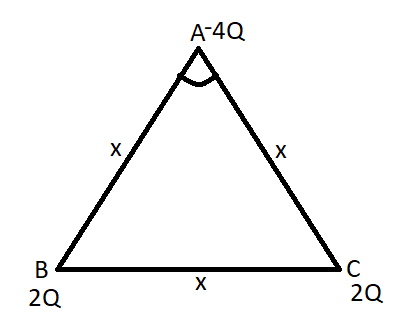
From diagram, we can consider the dipole for side \[AB\] to be \[{{\bar{P}}_{1}}\] and the dipole for side \[AC\] to be \[{{\bar{P}}_{2}}\].
Now since \[{{\bar{P}}_{1}}\] and \[{{\bar{P}}_{2}}\] have equal magnitudes, the horizontal component will be equal and hence cancel each other out and thus it will leave us with only the vertical components of the dipoles. Hence the resultant dipole moment will be the sum of the vertical components of \[{{\bar{P}}_{1}}\] and \[{{\bar{P}}_{2}}\].
It will be ;
\[\Rightarrow P={{P}_{1}}\cos {{30}^{\circ }}+{{P}_{2}}\cos {{30}^{\circ }}\]
\[\Rightarrow P=2Q\times x\cos {{30}^{\circ }}+2Q\times x\cos {{30}^{\circ }}\]
\[\Rightarrow P=2Qx\dfrac{\sqrt{3}}{2}+2Qx\dfrac{\sqrt{3}}{2}\]
\[\therefore P=2\sqrt{3}Qx\].
Hence the magnitude of the electric dipole moment of this system is \[2\sqrt{3}Qx\]
So Correct Option is A.
Note: When we talk about dipoles, sometimes people confuse capacitors to be dipoles too. Which is not true? Capacitors serve as a reservoir for electric charges. It is directly proportional to the active area \[A\] and to the dielectric constant and inversely proportional to the distance between the electrodes.
Complete answer:
When the molecules of a dielectric are placed in the electric field, their negatively charged electrons separate slightly from their positively charged cores. With this separation, referred to as polarization, the molecules acquire an electric dipole moment. A cluster of charges with an electric dipole moment is often called an electric dipole.
Under the influence of the electric field of a charged object, the negatively charged electrons and positively charged nuclei within the atoms and molecules are subjected to forces in opposite directions. As a result, the negative and positive charges separate slightly. Such atoms and molecules are said to be polarized and to have an electric dipole moment.
Electric dipole is defined as a couple of opposite charges separated by a certain distance. Keep in mind that the electric dipole is a measure of the system’s overall polarity The SI units for electric dipole moment are Coulomb-meter (\[C.m\]); however, a commonly used unit in atomic physics and chemistry is the Debye (\[D\]).
As we know, that electric dipole is basically a system of two equal and opposite charges separated by a small distance, so we can consider the charge of \[-4Q\] to be two charges of magnitude \[-2Q\] each, which will enable us to form a system of two dipoles.
From diagram, we can consider the dipole for side \[AB\] to be \[{{\bar{P}}_{1}}\] and the dipole for side \[AC\] to be \[{{\bar{P}}_{2}}\].
Now since \[{{\bar{P}}_{1}}\] and \[{{\bar{P}}_{2}}\] have equal magnitudes, the horizontal component will be equal and hence cancel each other out and thus it will leave us with only the vertical components of the dipoles. Hence the resultant dipole moment will be the sum of the vertical components of \[{{\bar{P}}_{1}}\] and \[{{\bar{P}}_{2}}\].
It will be ;
\[\Rightarrow P={{P}_{1}}\cos {{30}^{\circ }}+{{P}_{2}}\cos {{30}^{\circ }}\]
\[\Rightarrow P=2Q\times x\cos {{30}^{\circ }}+2Q\times x\cos {{30}^{\circ }}\]
\[\Rightarrow P=2Qx\dfrac{\sqrt{3}}{2}+2Qx\dfrac{\sqrt{3}}{2}\]
\[\therefore P=2\sqrt{3}Qx\].
Hence the magnitude of the electric dipole moment of this system is \[2\sqrt{3}Qx\]
So Correct Option is A.
Note: When we talk about dipoles, sometimes people confuse capacitors to be dipoles too. Which is not true? Capacitors serve as a reservoir for electric charges. It is directly proportional to the active area \[A\] and to the dielectric constant and inversely proportional to the distance between the electrodes.
Recently Updated Pages
Master Class 12 Business Studies: Engaging Questions & Answers for Success

Master Class 12 Chemistry: Engaging Questions & Answers for Success
Master Class 12 Biology: Engaging Questions & Answers for Success
Class 12 Question and Answer - Your Ultimate Solutions Guide
Master Class 11 English: Engaging Questions & Answers for Success
Master Class 11 Social Science: Engaging Questions & Answers for Success
Trending doubts
Which are the Top 10 Largest Countries of the World?
Draw a labelled sketch of the human eye class 12 physics CBSE
Differentiate between homogeneous and heterogeneous class 12 chemistry CBSE
Differentiate between Pyramid of energy and pyramid class 12 biology CBSE
Why is the cell called the structural and functional class 12 biology CBSE
Draw the diagram of the pyramid of energy Explain In class 12 biology CBSE