




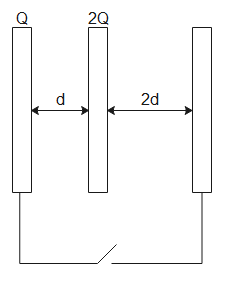
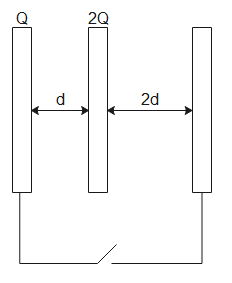
Three large plates are arranged as shown. How much charge will flow through the key K if it is closed?
(A). $\dfrac{5Q}{3}$
(B). $\dfrac{4Q}{3}$
(C). $\dfrac{3Q}{2}$
(D). None of these
Answer
 Verified
623.4k+ views
Hint:The figure shows three plates connected together which can be broken into two capacitors. The plates of the capacitors are connected with each other; this means that they are connected in parallel. In parallel, the potential drop on the capacitors is the same. Using formula for capacitance we can find a relation between change and capacitance and from the distance between plates, we can determine the relation between both capacitors and then calculate charge.
Formulas used:
$C=\dfrac{Q}{V}$
$\dfrac{{{q}_{1}}}{{{C}_{1}}}=\dfrac{{{q}_{2}}}{{{C}_{2}}}$
$C=\dfrac{{{\varepsilon }_{0}}A}{d}$
$\dfrac{{{C}_{1}}}{{{C}_{2}}}=\dfrac{{{d}_{2}}}{{{d}_{1}}}$
Complete answer:
Capacitors are devices which store charge on them. Their ability to store charge is represented by capacitance. It is calculated as
$C=\dfrac{Q}{V}$ - (1)
Here, $C$ is the capacitance
$Q$ is the charge
$V$ is the potential difference
The above plates can be divided into two capacitors as shown
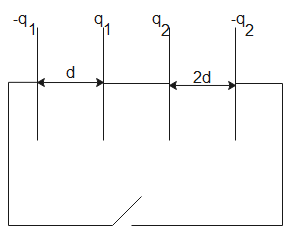
As we can see, both plates of the two capacitors are connected together; this means that they are connected in parallel. The potential difference is the same in parallel combination. Therefore,
${{V}_{1}}={{V}_{2}}$
From eq (1),
$\dfrac{{{q}_{1}}}{{{C}_{1}}}=\dfrac{{{q}_{2}}}{{{C}_{2}}}$ - (2)
The capacitance of a parallel plate capacitor depends on the dimensions of the capacitor as-
$C=\dfrac{{{\varepsilon }_{0}}A}{d}$ - (3)
Here, ${{\varepsilon }_{0}}$ is the permittivity of free space
$A$ is the area of cross section between the plates
$d$ is the distance between the plates
${{\varepsilon }_{0}}$ and $A$ are constants, therefore, form eq (3),
$\dfrac{{{C}_{1}}}{{{C}_{2}}}=\dfrac{{{d}_{2}}}{{{d}_{1}}}$
Substituting values from the figure in the above equation, we get,
$\dfrac{{{C}_{1}}}{{{C}_{2}}}=\dfrac{2d}{d}$
$\Rightarrow {{C}_{1}}=2{{C}_{2}}$ - (4)
Substituting eq (4) in eq (2), we get,
$\begin{align}
& \dfrac{{{q}_{1}}}{{{C}_{1}}}=\dfrac{{{q}_{2}}}{{{C}_{2}}} \\
& \Rightarrow \dfrac{{{q}_{1}}}{2{{C}_{2}}}=\dfrac{{{q}_{2}}}{{{C}_{2}}} \\
& \therefore {{q}_{1}}=2{{q}_{2}} \\
\end{align}$
We know that,
$\begin{align}
& {{q}_{1}}+{{q}_{2}}=2Q \\
& \Rightarrow 2{{q}_{2}}+{{q}_{2}}=2Q \\
& \Rightarrow 3{{q}_{2}}=2Q \\
& \therefore {{q}_{2}}=\dfrac{2Q}{3} \\
\end{align}$
${{q}_{2}}$has the value ${{q}_{2}}=\dfrac{2Q}{3}$, therefore, ${{q}_{1}}$ will have the value-
$\begin{align}
& {{q}_{1}}=2{{q}_{2}} \\
& \Rightarrow {{q}_{1}}=2\times \dfrac{2Q}{3} \\
& \therefore {{q}_{1}}=\dfrac{4Q}{3} \\
\end{align}$
Therefore, the charge on the first capacitor is $\dfrac{2Q}{3}$ and the charge on the second capacitor is $\dfrac{4Q}{3}$.
The charge that flows through the wire can key is closed is
$\begin{align}
& -{{q}_{2}}-(-{{q}_{1}}) \\
& \Rightarrow \dfrac{-4Q}{3}+\dfrac{2Q}{3}=-\dfrac{2Q}{3} \\
\end{align}$
Therefore, the charge that flows through the wire is $\dfrac{2Q}{3}$.
Hence, the correct option is (D).
Note:
The negative charge on the charge that flows through the circuit indicates that this charge flows opposite to the flow of current. In series, the charge is the same on the capacitors, while in parallel, the potential drop on capacitors is the same. The permittivity of a material is its ability to store electrical energy in an electric field.
Formulas used:
$C=\dfrac{Q}{V}$
$\dfrac{{{q}_{1}}}{{{C}_{1}}}=\dfrac{{{q}_{2}}}{{{C}_{2}}}$
$C=\dfrac{{{\varepsilon }_{0}}A}{d}$
$\dfrac{{{C}_{1}}}{{{C}_{2}}}=\dfrac{{{d}_{2}}}{{{d}_{1}}}$
Complete answer:
Capacitors are devices which store charge on them. Their ability to store charge is represented by capacitance. It is calculated as
$C=\dfrac{Q}{V}$ - (1)
Here, $C$ is the capacitance
$Q$ is the charge
$V$ is the potential difference
The above plates can be divided into two capacitors as shown
As we can see, both plates of the two capacitors are connected together; this means that they are connected in parallel. The potential difference is the same in parallel combination. Therefore,
${{V}_{1}}={{V}_{2}}$
From eq (1),
$\dfrac{{{q}_{1}}}{{{C}_{1}}}=\dfrac{{{q}_{2}}}{{{C}_{2}}}$ - (2)
The capacitance of a parallel plate capacitor depends on the dimensions of the capacitor as-
$C=\dfrac{{{\varepsilon }_{0}}A}{d}$ - (3)
Here, ${{\varepsilon }_{0}}$ is the permittivity of free space
$A$ is the area of cross section between the plates
$d$ is the distance between the plates
${{\varepsilon }_{0}}$ and $A$ are constants, therefore, form eq (3),
$\dfrac{{{C}_{1}}}{{{C}_{2}}}=\dfrac{{{d}_{2}}}{{{d}_{1}}}$
Substituting values from the figure in the above equation, we get,
$\dfrac{{{C}_{1}}}{{{C}_{2}}}=\dfrac{2d}{d}$
$\Rightarrow {{C}_{1}}=2{{C}_{2}}$ - (4)
Substituting eq (4) in eq (2), we get,
$\begin{align}
& \dfrac{{{q}_{1}}}{{{C}_{1}}}=\dfrac{{{q}_{2}}}{{{C}_{2}}} \\
& \Rightarrow \dfrac{{{q}_{1}}}{2{{C}_{2}}}=\dfrac{{{q}_{2}}}{{{C}_{2}}} \\
& \therefore {{q}_{1}}=2{{q}_{2}} \\
\end{align}$
We know that,
$\begin{align}
& {{q}_{1}}+{{q}_{2}}=2Q \\
& \Rightarrow 2{{q}_{2}}+{{q}_{2}}=2Q \\
& \Rightarrow 3{{q}_{2}}=2Q \\
& \therefore {{q}_{2}}=\dfrac{2Q}{3} \\
\end{align}$
${{q}_{2}}$has the value ${{q}_{2}}=\dfrac{2Q}{3}$, therefore, ${{q}_{1}}$ will have the value-
$\begin{align}
& {{q}_{1}}=2{{q}_{2}} \\
& \Rightarrow {{q}_{1}}=2\times \dfrac{2Q}{3} \\
& \therefore {{q}_{1}}=\dfrac{4Q}{3} \\
\end{align}$
Therefore, the charge on the first capacitor is $\dfrac{2Q}{3}$ and the charge on the second capacitor is $\dfrac{4Q}{3}$.
The charge that flows through the wire can key is closed is
$\begin{align}
& -{{q}_{2}}-(-{{q}_{1}}) \\
& \Rightarrow \dfrac{-4Q}{3}+\dfrac{2Q}{3}=-\dfrac{2Q}{3} \\
\end{align}$
Therefore, the charge that flows through the wire is $\dfrac{2Q}{3}$.
Hence, the correct option is (D).
Note:
The negative charge on the charge that flows through the circuit indicates that this charge flows opposite to the flow of current. In series, the charge is the same on the capacitors, while in parallel, the potential drop on capacitors is the same. The permittivity of a material is its ability to store electrical energy in an electric field.
Recently Updated Pages
Which of the following graphs shows the variation of class 12 physics CBSE

Draw a labelled diagram of the human male reproductive class 12 biology CBSE
Describe the experiment to compare the emf of two cells class 12 physics CBSE
What is standard hydrogen electrode
What is conventional current and electric current class 12 physics CBSE
2Bromopentane is treated with an alcoholic KOH solution class 12 chemistry CBSE
Trending doubts
Draw a labelled sketch of the human eye class 12 physics CBSE
Which are the Top 10 Largest Countries of the World?
Differentiate between homogeneous and heterogeneous class 12 chemistry CBSE
Draw ray diagrams each showing i myopic eye and ii class 12 physics CBSE
Which is the correct genotypic ratio of mendel dihybrid class 12 biology CBSE
What is the Full Form of PVC, PET, HDPE, LDPE, PP and PS ?