




Three incandescent bulbs of 100W each are connected in series in an electric circuit. In another circuit, another set of three bulbs of the same wattage are connected in parallel to the same source.
(a) Will the bulb in the two circuits glow with the same brightness? Justify your answer.
(b) Now, let one bulb in both the circuits get fused. Will the rest of the bulbs continue to glow in each circuit? Give reason.
Answer
 Verified
609k+ views
Hint: In the question, they’ve given us two connections of three 100W bulbs. To know if the bulbs will glow with the same intensity, we must know the current through each circuit. Using ohm’s law we can find this. The circuit in which the bulb draws more current will have more intensity. Thus, it will glow brighter.
Formula used:
$V = IR$
Complete step-by-step solution:
Let us consider the circuit where the incandescent bulbs are connected in series.
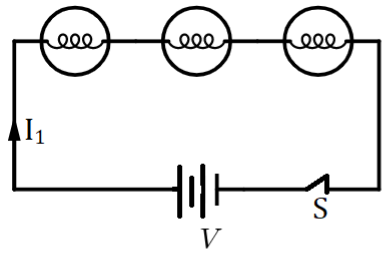
Here, the current flowing through all the bulbs is the same, in series. As all the bulbs are of the same kind the source voltage will be equally divided by each other. Then the power P of the bulb will be given by
$\eqalign{
& {I_1} = \dfrac{V}{3} \times \dfrac{1}{R} \cr
& \Rightarrow {I_1} = \dfrac{V}{{3R}} \cr} $
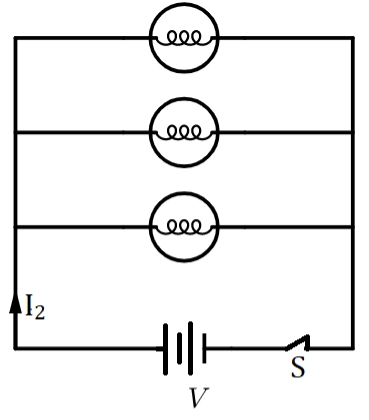
Similarly, for a parallel connection of incandescent bulbs, the potential drop across all the bulbs is the same.
So, the current through each bulb will be
${I_2} = \dfrac{V}{R}$
The intensity of a bulb is directly proportional to the current passing through the bulb. Comparing both the values of current in series and parallel, we have ${I_2} > {I_1}$ i.e., the current in a parallel circuit is more than that of a series circuit. Therefore, the bulbs in the parallel circuit glow brighter than that of the bulbs in the series circuit.
If one of the bulbs is fused in a series circuit, the connection will be interrupted as it becomes an open circuit. Thus, no current will be flowing. In contrast to this, if one of the bulbs is fused in the parallel circuit, the other two will still form a closed circuit. So, the current will keep flowing.
Note: In a parallel connection, even when one connection is interrupted it does not affect the other connections of the circuit. The intensity is comparatively more for a parallel circuit. This is the reason why home appliances are connected in parallel. The current drawn by each appliance will still be the same even if one of them malfunctions.
Formula used:
$V = IR$
Complete step-by-step solution:
Let us consider the circuit where the incandescent bulbs are connected in series.
Here, the current flowing through all the bulbs is the same, in series. As all the bulbs are of the same kind the source voltage will be equally divided by each other. Then the power P of the bulb will be given by
$\eqalign{
& {I_1} = \dfrac{V}{3} \times \dfrac{1}{R} \cr
& \Rightarrow {I_1} = \dfrac{V}{{3R}} \cr} $
Similarly, for a parallel connection of incandescent bulbs, the potential drop across all the bulbs is the same.
So, the current through each bulb will be
${I_2} = \dfrac{V}{R}$
The intensity of a bulb is directly proportional to the current passing through the bulb. Comparing both the values of current in series and parallel, we have ${I_2} > {I_1}$ i.e., the current in a parallel circuit is more than that of a series circuit. Therefore, the bulbs in the parallel circuit glow brighter than that of the bulbs in the series circuit.
If one of the bulbs is fused in a series circuit, the connection will be interrupted as it becomes an open circuit. Thus, no current will be flowing. In contrast to this, if one of the bulbs is fused in the parallel circuit, the other two will still form a closed circuit. So, the current will keep flowing.
Note: In a parallel connection, even when one connection is interrupted it does not affect the other connections of the circuit. The intensity is comparatively more for a parallel circuit. This is the reason why home appliances are connected in parallel. The current drawn by each appliance will still be the same even if one of them malfunctions.
Recently Updated Pages
Master Class 12 Business Studies: Engaging Questions & Answers for Success

Master Class 12 Biology: Engaging Questions & Answers for Success
Master Class 12 Chemistry: Engaging Questions & Answers for Success
Class 12 Question and Answer - Your Ultimate Solutions Guide
Master Class 11 Social Science: Engaging Questions & Answers for Success
Master Class 11 English: Engaging Questions & Answers for Success
Trending doubts
Which is more stable and why class 12 chemistry CBSE
Which are the Top 10 Largest Countries of the World?
Draw a labelled sketch of the human eye class 12 physics CBSE
Differentiate between homogeneous and heterogeneous class 12 chemistry CBSE
What are the major means of transport Explain each class 12 social science CBSE
Sulphuric acid is known as the king of acids State class 12 chemistry CBSE