




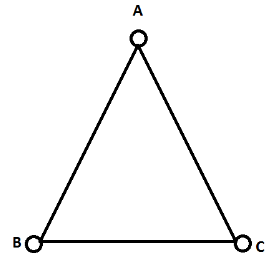
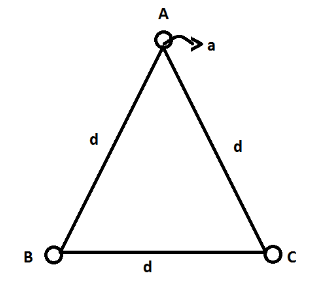
Three identical metallic uncharged spheres \[A,{\text{ }}B,{\text{ }}and{\text{ }}C\] each of the radius a, kept at the corners of an equilateral triangle of side \[d(d \gg a)\] as shown in the figure. The fourth sphere (of radius\[a\]), which has a change in\[q\], touches A and then moves to a position far away. Bis earthed and then the earth connection is removed C is then earthed. The charge on C is:
(A) \[\dfrac{{qa}}{{2d}}(\dfrac{{2d - a}}{{2d}})\]
(B) \[\dfrac{{qa}}{{2d}}(\dfrac{{2d - a}}{d})\]
(C) \[ - \dfrac{{qa}}{{2d}}(\dfrac{{d - a}}{d})\]
(D) \[\dfrac{{qa}}{{2d}}(\dfrac{{d - a}}{{2d}})\]
Answer
 Verified
586.5k+ views
Hint:If a charged metallic sphere contacts the same size of metallic sphere, then half of the charge is transferred to another one.If a metallic sphere is earthed, then the net potential on that sphere has become zero. There is a charge dislocation in the earthed sphere by the influence of other charges nearby.
Complete step by step answer:
Initially, there are no charges in A, B, C, spheres. So-net charge \[{q_{net}} = 0\]
Then there is a fourth sphere comes in contact with sphere A
So the charge is transferred to A by an amount of \[q/2\]
\[{q_A} = q/2\]
Then removed the fourth sphere and earthed the B sphere. (Indicates figure B)
Because of earthed net Potential at B, \[{V_{net}} = 0\] and there is a charge \[q'\] on B.
\[{V_{net}} = {V_A} + {V_B}\]
\[{V_{net}} = \dfrac{{k{q_A}}}{{{r_A}}} + \dfrac{{k{q_B}}}{{{r_B}}}\]
\[{r_A}\] Distance between centre of the sphere A and centre of the sphere B, \[{r_A} = a + d + a = d + 2a\] but \[d \gg a\] so \[{r_A} = d + 2a = d\].
\[{V_A}\] Is the potential due to the sphere A.
\[{V_B}\] Is the potential due to the charge dislocation in B.
\[k\] is a constant.
\[{V_{net}} = \dfrac{{k(q/2)}}{d} + \dfrac{{kq'}}{a} = 0\]
\[\dfrac{{kq}}{{2d}} = \dfrac{{ - kq'}}{a}\], then \[q' = \dfrac{{ - qa}}{{2d}}\]this is the charge on B.
Now, earth connection removed from B and earthed C
So, net potential on C =0 \[V{'_{net}} = 0\]
\[V{'_{net}} = {V_A} + {V_B} + {V_C} = 0\]
We already know \[{V_A}\]and \[{V_B}\] and substitute values.
\[0 = \dfrac{{k{q_{}}}}{{2d}} + \dfrac{{ - kqa}}{{2{d^2}}} + \dfrac{{k{q_C}'}}{a}\]
Cancel all \[k\]
\[\dfrac{{k{q_{}}}}{{2d}} + \dfrac{{ - kqa}}{{2{d^2}}} = - \dfrac{{k{q_C}'}}{a}\]
\[\dfrac{{{q_{}}}}{{2d}} + \dfrac{{ - qa}}{{2{d^2}}} = - \dfrac{{{q_C}'}}{a}\]
\[(\dfrac{{{q_{}}}}{{2d}} + \dfrac{{ - qa}}{{2{d^2}}})a = - {q_C}'\]
The charge on C is
\[{q_C}' = - \dfrac{{qa}}{{2d}}[\dfrac{{d - a}}{d}]\]
So the answer is (C) \[ - \dfrac{{qa}}{{2d}}(\dfrac{{d - a}}{d})\]
Note:Earthed means is the grounding of the metallic sphere. We should count this term \[2a\] in \[d + 2a\], if this \[d \gg a\] is not given. Earthling is used in electrical appliances to prevent electric shock by providing a path of unwanted charge flow.
Complete step by step answer:
Initially, there are no charges in A, B, C, spheres. So-net charge \[{q_{net}} = 0\]
Then there is a fourth sphere comes in contact with sphere A
So the charge is transferred to A by an amount of \[q/2\]
\[{q_A} = q/2\]
Then removed the fourth sphere and earthed the B sphere. (Indicates figure B)
Because of earthed net Potential at B, \[{V_{net}} = 0\] and there is a charge \[q'\] on B.
\[{V_{net}} = {V_A} + {V_B}\]
\[{V_{net}} = \dfrac{{k{q_A}}}{{{r_A}}} + \dfrac{{k{q_B}}}{{{r_B}}}\]
\[{r_A}\] Distance between centre of the sphere A and centre of the sphere B, \[{r_A} = a + d + a = d + 2a\] but \[d \gg a\] so \[{r_A} = d + 2a = d\].
\[{V_A}\] Is the potential due to the sphere A.
\[{V_B}\] Is the potential due to the charge dislocation in B.
\[k\] is a constant.
\[{V_{net}} = \dfrac{{k(q/2)}}{d} + \dfrac{{kq'}}{a} = 0\]
\[\dfrac{{kq}}{{2d}} = \dfrac{{ - kq'}}{a}\], then \[q' = \dfrac{{ - qa}}{{2d}}\]this is the charge on B.
Now, earth connection removed from B and earthed C
So, net potential on C =0 \[V{'_{net}} = 0\]
\[V{'_{net}} = {V_A} + {V_B} + {V_C} = 0\]
We already know \[{V_A}\]and \[{V_B}\] and substitute values.
\[0 = \dfrac{{k{q_{}}}}{{2d}} + \dfrac{{ - kqa}}{{2{d^2}}} + \dfrac{{k{q_C}'}}{a}\]
Cancel all \[k\]
\[\dfrac{{k{q_{}}}}{{2d}} + \dfrac{{ - kqa}}{{2{d^2}}} = - \dfrac{{k{q_C}'}}{a}\]
\[\dfrac{{{q_{}}}}{{2d}} + \dfrac{{ - qa}}{{2{d^2}}} = - \dfrac{{{q_C}'}}{a}\]
\[(\dfrac{{{q_{}}}}{{2d}} + \dfrac{{ - qa}}{{2{d^2}}})a = - {q_C}'\]
The charge on C is
\[{q_C}' = - \dfrac{{qa}}{{2d}}[\dfrac{{d - a}}{d}]\]
So the answer is (C) \[ - \dfrac{{qa}}{{2d}}(\dfrac{{d - a}}{d})\]
Note:Earthed means is the grounding of the metallic sphere. We should count this term \[2a\] in \[d + 2a\], if this \[d \gg a\] is not given. Earthling is used in electrical appliances to prevent electric shock by providing a path of unwanted charge flow.
Recently Updated Pages
Master Class 12 Economics: Engaging Questions & Answers for Success

Master Class 12 Physics: Engaging Questions & Answers for Success
Master Class 12 English: Engaging Questions & Answers for Success
Master Class 12 Social Science: Engaging Questions & Answers for Success
Master Class 12 Maths: Engaging Questions & Answers for Success
Master Class 12 Business Studies: Engaging Questions & Answers for Success
Trending doubts
Which are the Top 10 Largest Countries of the World?
What are the major means of transport Explain each class 12 social science CBSE
Draw a labelled sketch of the human eye class 12 physics CBSE
Why cannot DNA pass through cell membranes class 12 biology CBSE
Differentiate between insitu conservation and exsitu class 12 biology CBSE
Draw a neat and well labeled diagram of TS of ovary class 12 biology CBSE