




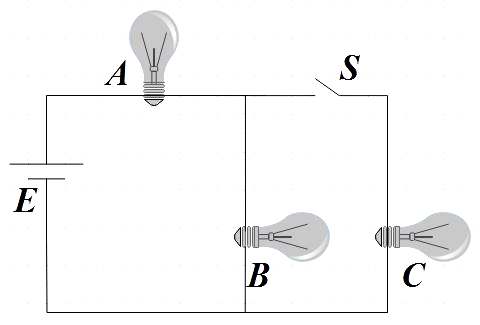
Three identical bulbs are connected as shown in the figure. When switch S is closed, the power consumed in bulb B is P. What will be the power consumed by the same bulb when switch S is opened?
A. $\dfrac{9P}{4}$
B. $\dfrac{16P}{9}$
C. $\dfrac{9P}{16}$
D. $\dfrac{4P}{9}$
Answer
 Verified
590.7k+ views
Hint: Find the voltage distributed across each bulb by using voltage division rule and also, recall the expression for power in terms of R and V and thus get the expression for R. Find the effective resistance across B and C and then again apply voltage division rule to find the voltage across B. Now substitute this voltage and resistance found above in the expression for power to get the power dissipated by B.
Formula used:
Expression for power,
$P=\dfrac{{{V}^{2}}}{R}$
Voltage divider rule,
${{V}_{1}}=\dfrac{{{R}_{1}}}{{{R}_{total}}}V$
Complete step-by-step answer:
From the circuit we see that bulbs B and C are parallel to each other and bulb A is in series with both B and C.
In the first case where the switch is put on, source voltage E is equally divided between A and parallel connection of B and C. That is, voltage across each bulb can be given by,
${{E}_{A}}={{E}_{B}}={{E}_{C}}=\dfrac{E}{2}$ ……………………………………… (1)
Since we are said that all the three given bulbs are identical, we could say that their resistances are also the same R.
We know that the power is given by,
$P=\dfrac{{{V}^{2}}}{R}$ ………………………………………. (2)
$\Rightarrow R=\dfrac{{{\left( \dfrac{E}{2} \right)}^{2}}}{P}=\dfrac{{{E}^{2}}}{4P}$ ………………………………… (3)
Effective resistance across B and C when switch is closed is given by,
${{R}_{eff}}=\dfrac{R\times R}{R+R}=\dfrac{R}{2}$ …………………………… (4)
By voltage division rule,
${{V}_{B}}=\dfrac{\dfrac{R}{2}}{\left( \dfrac{R}{2}+R \right)}E$
$\Rightarrow {{V}_{B}}=\dfrac{\dfrac{R}{2}}{\dfrac{3R}{2}}E=\dfrac{E}{3}$
Now that we got the voltage across B by voltage division rule, we could find the power dissipated by B is given by,
${{P}_{B}}=\dfrac{{{\left( \dfrac{E}{3} \right)}^{2}}}{R}$
Substituting (3) we get,
${{P}_{B}}={{\dfrac{\left( \dfrac{E}{3} \right)}{\dfrac{{{E}^{2}}}{4P}}}^{2}}$
$\Rightarrow {{P}_{B}}=\dfrac{4P}{9}$
Hence, we get the power consumed by the same bulb when switch S is opened as $\dfrac{4P}{9}$
Hence, option D is the correct answer.
So, the correct answer is “Option D”.
Note: We also have current divider circuits that are parallel circuits in which the source or supply current divides into a number of parallel paths. So, the currents will have different values through each component. Here we have the current divider rule to calculate the current flowing through each parallel resistive branch as a percentage of the total current.
Formula used:
Expression for power,
$P=\dfrac{{{V}^{2}}}{R}$
Voltage divider rule,
${{V}_{1}}=\dfrac{{{R}_{1}}}{{{R}_{total}}}V$
Complete step-by-step answer:
From the circuit we see that bulbs B and C are parallel to each other and bulb A is in series with both B and C.
In the first case where the switch is put on, source voltage E is equally divided between A and parallel connection of B and C. That is, voltage across each bulb can be given by,
${{E}_{A}}={{E}_{B}}={{E}_{C}}=\dfrac{E}{2}$ ……………………………………… (1)
Since we are said that all the three given bulbs are identical, we could say that their resistances are also the same R.
We know that the power is given by,
$P=\dfrac{{{V}^{2}}}{R}$ ………………………………………. (2)
$\Rightarrow R=\dfrac{{{\left( \dfrac{E}{2} \right)}^{2}}}{P}=\dfrac{{{E}^{2}}}{4P}$ ………………………………… (3)
Effective resistance across B and C when switch is closed is given by,
${{R}_{eff}}=\dfrac{R\times R}{R+R}=\dfrac{R}{2}$ …………………………… (4)
By voltage division rule,
${{V}_{B}}=\dfrac{\dfrac{R}{2}}{\left( \dfrac{R}{2}+R \right)}E$
$\Rightarrow {{V}_{B}}=\dfrac{\dfrac{R}{2}}{\dfrac{3R}{2}}E=\dfrac{E}{3}$
Now that we got the voltage across B by voltage division rule, we could find the power dissipated by B is given by,
${{P}_{B}}=\dfrac{{{\left( \dfrac{E}{3} \right)}^{2}}}{R}$
Substituting (3) we get,
${{P}_{B}}={{\dfrac{\left( \dfrac{E}{3} \right)}{\dfrac{{{E}^{2}}}{4P}}}^{2}}$
$\Rightarrow {{P}_{B}}=\dfrac{4P}{9}$
Hence, we get the power consumed by the same bulb when switch S is opened as $\dfrac{4P}{9}$
Hence, option D is the correct answer.
So, the correct answer is “Option D”.
Note: We also have current divider circuits that are parallel circuits in which the source or supply current divides into a number of parallel paths. So, the currents will have different values through each component. Here we have the current divider rule to calculate the current flowing through each parallel resistive branch as a percentage of the total current.
Recently Updated Pages
Master Class 12 Social Science: Engaging Questions & Answers for Success

Master Class 12 Physics: Engaging Questions & Answers for Success
Master Class 12 Maths: Engaging Questions & Answers for Success
Master Class 12 Economics: Engaging Questions & Answers for Success
Master Class 12 Chemistry: Engaging Questions & Answers for Success
Master Class 12 Business Studies: Engaging Questions & Answers for Success
Trending doubts
Which are the Top 10 Largest Countries of the World?
Draw a labelled sketch of the human eye class 12 physics CBSE
Explain the structure of megasporangium class 12 biology CBSE
What are the major means of transport Explain each class 12 social science CBSE
How many chromosomes are found in human ovum a 46 b class 12 biology CBSE
The diagram of the section of a maize grain is given class 12 biology CBSE