




Three charges, each equal to $q$ , are placed at the three corners of a square a side $a$, find the electric field at the fourth corner
A. $\left( {\sqrt 2 + 1} \right)\dfrac{q}{{8\pi {\varepsilon _0}{a^2}}}$
B. $\left( {2\sqrt 2 + 1} \right)\dfrac{q}{{8\pi {\varepsilon _0}{a^2}}}$
C. $\left( {2\sqrt 2 + 1} \right)\dfrac{q}{{4\pi {\varepsilon _0}{a^2}}}$
D. $0$
Answer
 Verified
610.2k+ views
Hint:We will calculate the electric field at the point D by calculating the net magnetic of the electric fields ${\vec E_1}$ , ${\vec E_2}$ and ${\vec E_3}$. Firstly we will calculate the magnitude of the vectors of electric fields ${E_1}$ and ${E_2}$, and then we will add it to the electric field of ${\vec E_3}$.
Complete step by step answer:
Here, we will consider a square whose each side is $a$and a charge $q$ is placed on the three corners of the square.
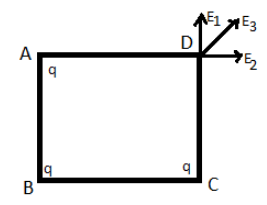
Here, charge $q$ is placed at the corners A, B and C. As we know that a positive charge induces an electric field away from it. Therefore, ${E_1}$ is the electric field induced by the charge placed at C, ${E_2}$ is the electric field induced by the charge placed at A and ${E_3}$ is the charge induced by the charge placed at B.
Now, electric field induced by the charge at C,
${E_1} = \dfrac{q}{{4\pi {\varepsilon _0}{a^2}}}$
Where $K$ is the proportionality constant, $q$ is the charge and $a$ is the side.
Also, electric field induced by charge placed at A,
${E_2} = \dfrac{q}{{4\pi {\varepsilon _0}{a^2}}}$
And, electric field induced by charge placed at B,
${E_3} = \dfrac{q}{{8\pi {\varepsilon _0}{a^2}}}$
Here, the area in case of ${E_3}$ is taken as $\sqrt 2 a$ because the charge is making a diagonal with the electric field.
Now, the net electric field at point D is given by
${E_{net}} = \left( {{{\vec E}_1} + {{\vec E}_2}} \right) + {E_3}$
Here, $\left( {{{\vec E}_1} + {{\vec E}_2}} \right)$ means that we are taking the magnitude of the vectors of electric fields ${E_1}$ and ${E_2}$ and is shown below
$\left| {{{\vec E}_1} + {{\vec E}_2}} \right| = \sqrt {{{\left( {{E_1} + {E_2}} \right)}^2}} $
$ \Rightarrow \,{\vec E_1} + {\vec E_2} = \sqrt {E_1^2 + E_2^2 + 2{E_1}{E_2}\cos \theta } $
Here, ${E_1}$ and ${E_2}$ are the same, therefore, ${E_1} = {E_2} = E$ .
Also, here $\theta = 90^\circ $ because the angle made by the electric fields ${E_1}$ and ${E_2}$ is $90^\circ $.
Therefore, the above equation becomes
${\vec E_1} + {\vec E_2} = \sqrt {{E^2} + {E^2} + 2E.E\cos 90^\circ } $
$ \Rightarrow {\vec E_1} + {\vec E_2} = \sqrt {2{E^2}} $
$ \Rightarrow \,{\vec E_1} + {\vec E_2} = \sqrt 2 E$
$ \Rightarrow \,{\vec E_1} + {\vec E_2} = \sqrt 2 \dfrac{q}{{4\pi {\varepsilon _0}{a^2}}}$
Therefore, putting this value in ${E_{net}}$ , we get
${E_{net}} = \sqrt 2 \dfrac{q}{{4\pi {\varepsilon _0}{a^2}}} + \dfrac{q}{{8\pi {\varepsilon _0}{a^2}}}$
$ \Rightarrow \,{E_{net}} = \dfrac{q}{{\pi {\varepsilon _0}}}\left( {\dfrac{{\sqrt 2 }}{{4{a^2}}} + \dfrac{1}{{8{a^2}}}} \right)$
$ \Rightarrow \,{E_{net}} = \dfrac{q}{{\pi {\varepsilon _0}}}\left( {\dfrac{{2\sqrt 2 + 1}}{{8{a^2}}}} \right)$
$ \therefore E = \left( {2\sqrt 2 + 1} \right)\dfrac{q}{{8\pi {\varepsilon _0}{a^2}}}$
Hence, the electric field at the forth corner D is $\left( {2\sqrt 2 + 1} \right)\dfrac{q}{{8\pi {\varepsilon _0}{a^2}}}$.
Hence, option B is the correct option.
Note:As we know that the positive charge will induce the electric field away from it, therefore, the charge $q$ placed at C will induce the electric field in the direction of the diagonal of the square. Therefore, in the case of the electric field ${\vec E_3}$ , we will take the distance as $\sqrt 2 a$.
Complete step by step answer:
Here, we will consider a square whose each side is $a$and a charge $q$ is placed on the three corners of the square.
Here, charge $q$ is placed at the corners A, B and C. As we know that a positive charge induces an electric field away from it. Therefore, ${E_1}$ is the electric field induced by the charge placed at C, ${E_2}$ is the electric field induced by the charge placed at A and ${E_3}$ is the charge induced by the charge placed at B.
Now, electric field induced by the charge at C,
${E_1} = \dfrac{q}{{4\pi {\varepsilon _0}{a^2}}}$
Where $K$ is the proportionality constant, $q$ is the charge and $a$ is the side.
Also, electric field induced by charge placed at A,
${E_2} = \dfrac{q}{{4\pi {\varepsilon _0}{a^2}}}$
And, electric field induced by charge placed at B,
${E_3} = \dfrac{q}{{8\pi {\varepsilon _0}{a^2}}}$
Here, the area in case of ${E_3}$ is taken as $\sqrt 2 a$ because the charge is making a diagonal with the electric field.
Now, the net electric field at point D is given by
${E_{net}} = \left( {{{\vec E}_1} + {{\vec E}_2}} \right) + {E_3}$
Here, $\left( {{{\vec E}_1} + {{\vec E}_2}} \right)$ means that we are taking the magnitude of the vectors of electric fields ${E_1}$ and ${E_2}$ and is shown below
$\left| {{{\vec E}_1} + {{\vec E}_2}} \right| = \sqrt {{{\left( {{E_1} + {E_2}} \right)}^2}} $
$ \Rightarrow \,{\vec E_1} + {\vec E_2} = \sqrt {E_1^2 + E_2^2 + 2{E_1}{E_2}\cos \theta } $
Here, ${E_1}$ and ${E_2}$ are the same, therefore, ${E_1} = {E_2} = E$ .
Also, here $\theta = 90^\circ $ because the angle made by the electric fields ${E_1}$ and ${E_2}$ is $90^\circ $.
Therefore, the above equation becomes
${\vec E_1} + {\vec E_2} = \sqrt {{E^2} + {E^2} + 2E.E\cos 90^\circ } $
$ \Rightarrow {\vec E_1} + {\vec E_2} = \sqrt {2{E^2}} $
$ \Rightarrow \,{\vec E_1} + {\vec E_2} = \sqrt 2 E$
$ \Rightarrow \,{\vec E_1} + {\vec E_2} = \sqrt 2 \dfrac{q}{{4\pi {\varepsilon _0}{a^2}}}$
Therefore, putting this value in ${E_{net}}$ , we get
${E_{net}} = \sqrt 2 \dfrac{q}{{4\pi {\varepsilon _0}{a^2}}} + \dfrac{q}{{8\pi {\varepsilon _0}{a^2}}}$
$ \Rightarrow \,{E_{net}} = \dfrac{q}{{\pi {\varepsilon _0}}}\left( {\dfrac{{\sqrt 2 }}{{4{a^2}}} + \dfrac{1}{{8{a^2}}}} \right)$
$ \Rightarrow \,{E_{net}} = \dfrac{q}{{\pi {\varepsilon _0}}}\left( {\dfrac{{2\sqrt 2 + 1}}{{8{a^2}}}} \right)$
$ \therefore E = \left( {2\sqrt 2 + 1} \right)\dfrac{q}{{8\pi {\varepsilon _0}{a^2}}}$
Hence, the electric field at the forth corner D is $\left( {2\sqrt 2 + 1} \right)\dfrac{q}{{8\pi {\varepsilon _0}{a^2}}}$.
Hence, option B is the correct option.
Note:As we know that the positive charge will induce the electric field away from it, therefore, the charge $q$ placed at C will induce the electric field in the direction of the diagonal of the square. Therefore, in the case of the electric field ${\vec E_3}$ , we will take the distance as $\sqrt 2 a$.
Recently Updated Pages
Master Class 12 Business Studies: Engaging Questions & Answers for Success

Master Class 12 Chemistry: Engaging Questions & Answers for Success
Master Class 12 Biology: Engaging Questions & Answers for Success
Class 12 Question and Answer - Your Ultimate Solutions Guide
Master Class 11 English: Engaging Questions & Answers for Success
Master Class 11 Social Science: Engaging Questions & Answers for Success
Trending doubts
Which are the Top 10 Largest Countries of the World?
Draw a labelled sketch of the human eye class 12 physics CBSE
Differentiate between homogeneous and heterogeneous class 12 chemistry CBSE
Differentiate between Pyramid of energy and pyramid class 12 biology CBSE
Why is the cell called the structural and functional class 12 biology CBSE
Draw the diagram of the pyramid of energy Explain In class 12 biology CBSE