




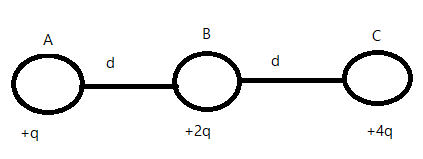
Three charges $+q$, $+2q$ and $+4q$ are connected by strings as shown in the figure. What is the ratio of tension in the strings AB and BC?
\[\begin{align}
& A.1:2 \\
& B.1:3 \\
& C.2:1 \\
& D.3:1 \\
\end{align}\]
Answer
 Verified
581.7k+ views
Hint: Consider the given diagram in the question as a system. Then are two forces that act on the system. One is the tension on the string, and the other is the electric force exerted by the charges. We know that the electric force between the charges is given by Coulomb's law.
Formula used:
$F=k\dfrac{q_{1}q_{2}}{r^{2}}$
Complete step-by-step answer:
We know that the electric force experienced due to a pair charges is given by Coulomb's force. Clearly, the electric force depends on the charge q and inversely proportional to the square of the distance between them.
We know that, the electrical force $F$ between two charges $q_{1}$ and $q_{2}$ which is separated at a distance $r$ is given as $F=k\dfrac{q_{1}q_{2}}{r^{2}}$,where $k=\dfrac{1}{4\pi\epsilon_{0}}$ which is constant with a value $9\times 10^{9}$.
Here we have three positive charges, $q_{1}=+q$, $q_{2}=+2q$ and $q_{3}=+4q$ which are a distance $r=d$ from each other as shown below:
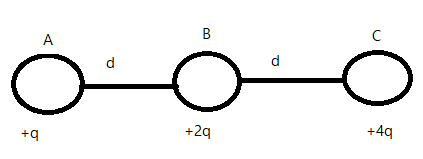
Let us assume that the system is in equilibrium. Then we can say that the tension on charge A $T_{AB}$ is equal to the electrical force on the charge A $E_{A}$.
$\implies T_{AB}=E_{A}$
Then the electrical force on the charge A $E_{A}$, is given as $E_{A}=k\left[\dfrac{2q^{2}}{d^{2}}+\dfrac{4q^{2}}{4d^{2}}\right]=\dfrac{3kq^{2}}{d^{2}}$
$\implies T_{AB}=\dfrac{3kq^{2}}{d^{2}}$
Similarly, we can say that the tension on charge C $T_{BC}$ is equal to the electrical force on the charge C $E_{C}$.
$\implies T_{BC}=E_{C}$
Then the electrical force on the charge C $E_{C}$, is given as $E_{C}=k\left[\dfrac{8q^{2}}{d^{2}}+\dfrac{4q^{2}}{4d^{2}}\right]=\dfrac{9kq^{2}}{d^{2}}$
$\implies T_{BC}=\dfrac{9kq^{2}}{d^{2}}$
Taking the ratio, we get, $\dfrac{T_{AB}}{T_{BC}}=\dfrac{\dfrac{9kq^{2}}{d^{2}}}{\dfrac{3kq^{2}}{d^{2}}}=\dfrac{1}{3}$
Hence the answer is \[B.1:3\]
So, the correct answer is “Option B”.
Note: We know that the electric force due to a pair of charges is given by Coulomb's law. This force can be attractive or repelling depending on the nature of the charges. An electric field can be produced by a time-varying electric field or an electrical charge. These can be either attracting or repelling in nature.
Formula used:
$F=k\dfrac{q_{1}q_{2}}{r^{2}}$
Complete step-by-step answer:
We know that the electric force experienced due to a pair charges is given by Coulomb's force. Clearly, the electric force depends on the charge q and inversely proportional to the square of the distance between them.
We know that, the electrical force $F$ between two charges $q_{1}$ and $q_{2}$ which is separated at a distance $r$ is given as $F=k\dfrac{q_{1}q_{2}}{r^{2}}$,where $k=\dfrac{1}{4\pi\epsilon_{0}}$ which is constant with a value $9\times 10^{9}$.
Here we have three positive charges, $q_{1}=+q$, $q_{2}=+2q$ and $q_{3}=+4q$ which are a distance $r=d$ from each other as shown below:
Let us assume that the system is in equilibrium. Then we can say that the tension on charge A $T_{AB}$ is equal to the electrical force on the charge A $E_{A}$.
$\implies T_{AB}=E_{A}$
Then the electrical force on the charge A $E_{A}$, is given as $E_{A}=k\left[\dfrac{2q^{2}}{d^{2}}+\dfrac{4q^{2}}{4d^{2}}\right]=\dfrac{3kq^{2}}{d^{2}}$
$\implies T_{AB}=\dfrac{3kq^{2}}{d^{2}}$
Similarly, we can say that the tension on charge C $T_{BC}$ is equal to the electrical force on the charge C $E_{C}$.
$\implies T_{BC}=E_{C}$
Then the electrical force on the charge C $E_{C}$, is given as $E_{C}=k\left[\dfrac{8q^{2}}{d^{2}}+\dfrac{4q^{2}}{4d^{2}}\right]=\dfrac{9kq^{2}}{d^{2}}$
$\implies T_{BC}=\dfrac{9kq^{2}}{d^{2}}$
Taking the ratio, we get, $\dfrac{T_{AB}}{T_{BC}}=\dfrac{\dfrac{9kq^{2}}{d^{2}}}{\dfrac{3kq^{2}}{d^{2}}}=\dfrac{1}{3}$
Hence the answer is \[B.1:3\]
So, the correct answer is “Option B”.
Note: We know that the electric force due to a pair of charges is given by Coulomb's law. This force can be attractive or repelling depending on the nature of the charges. An electric field can be produced by a time-varying electric field or an electrical charge. These can be either attracting or repelling in nature.
Recently Updated Pages
Master Class 12 Economics: Engaging Questions & Answers for Success

Master Class 12 Physics: Engaging Questions & Answers for Success
Master Class 12 English: Engaging Questions & Answers for Success
Master Class 12 Social Science: Engaging Questions & Answers for Success
Master Class 12 Maths: Engaging Questions & Answers for Success
Master Class 12 Business Studies: Engaging Questions & Answers for Success
Trending doubts
Which are the Top 10 Largest Countries of the World?
What are the major means of transport Explain each class 12 social science CBSE
Draw a labelled sketch of the human eye class 12 physics CBSE
Why cannot DNA pass through cell membranes class 12 biology CBSE
Differentiate between insitu conservation and exsitu class 12 biology CBSE
Draw a neat and well labeled diagram of TS of ovary class 12 biology CBSE