




Three charges$ + 4q$, $Q$ and $q$ are placed in the straight line of $l$ at the point of distances at $0$, $\dfrac{1}{2}$, $1$ respectively. What should be $Q$ in order to make the net force on $q$ to be zero
a. $ - q$
b. $ - 2q$
c. $ - \dfrac{q}{2}$
d. $4q$
Answer
 Verified
634.5k+ views
Hint: To solve the given problem first, we need to calculate the force between $ + 4q$ and $q$, then we need to calculate the force between $Q$ and $q$. If we add the answers, we will get the resultant force.
Formula used:
$\dfrac{1}{{4\pi {\varepsilon _0}}} \times \dfrac{{{q_1}{q_2}}}{{{d^2}}}$
Where ${q_1},{q_2}$are two forces, $d$is the distance.
Complete step by step answer:
The values of the three charges are given that is three charges $ + 4q$, $Q$ and $q$ are placed in the straight line of $l$ at the point of distances at $0$, $\dfrac{1}{2}$, $1$. We can represent the given data in the diagram.
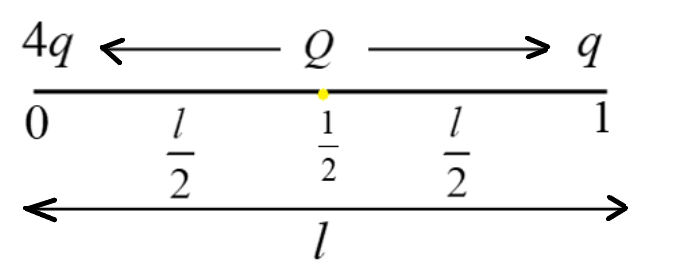
We have three charges$ + 4q$, $Q$ and $q$ that are placed in the distance of $0$,$\dfrac{1}{2}$, $1$ in a straight line.
We can solve the given problem with the help of Coulomb's law. According to Coulomb's law the force or attraction or repulsion between two charged bodies is directly proportional to the product of the charges and inversely proportional to the square of the distance between them. That is,
$ \Rightarrow \dfrac{1}{{4\pi {\varepsilon _0}}} \times \dfrac{{{q_1}{q_2}}}{{{d^2}}}$
Where ${q_1},{q_2}$are two forces, $d$ is the distance.
To solve the given problem we need to calculate the force between $ + 4q$ and $q$, then we need to calculate the force between $Q$ and $q$. If we add the answers, we will get the resultant force.
Calculate${F_1}$, that is the force between the $ + 4q$ and $q$. That is,
$ \Rightarrow \dfrac{1}{{4\pi {\varepsilon _0}}} \times \dfrac{{{q_1}{q_2}}}{{{d^2}}}$
$ \Rightarrow {F_1} = \dfrac{1}{{4\pi {\varepsilon _0}}} \times \dfrac{{4q \times q}}{{{l^2}}}$
Calculate ${F_1}$, that is the force between $Q$ and $q$. That is,
$ \Rightarrow \dfrac{1}{{4\pi {\varepsilon _0}}} \times \dfrac{{{q_1}{q_2}}}{{{d^2}}}$
$ \Rightarrow {F_2} = \dfrac{1}{{4\pi {\varepsilon _0}}} \times \dfrac{{Q \times q}}{{\dfrac{l}{2}}}$
Add the two forces we get,
$ \Rightarrow {F_1} + {F_2} = \dfrac{1}{{4\pi {\varepsilon _0}}} \times \dfrac{{4q \times q}}{{{l^2}}} + \dfrac{1}{{4\pi {\varepsilon _0}}} \times \dfrac{{Q \times q}}{{\dfrac{l}{2}}}$
Simplify the given equation as,
$ \Rightarrow \dfrac{{4{q^2}}}{{{l^2}}} = \dfrac{{4Qq}}{{{l^2}}}$
We can even simplify the equation to get the answer.
$ \Rightarrow q = Q$
We need $Q$ in order to make the net force $q$ to be zero.
$\therefore Q = - q$
Hence, the correct answer is option (A).
Note: There are some limitations of the coulomb’s law. It is difficult to implement where the law charges in arbitrary shape because we cannot determine the distance between the charges in such cases.
Formula used:
$\dfrac{1}{{4\pi {\varepsilon _0}}} \times \dfrac{{{q_1}{q_2}}}{{{d^2}}}$
Where ${q_1},{q_2}$are two forces, $d$is the distance.
Complete step by step answer:
The values of the three charges are given that is three charges $ + 4q$, $Q$ and $q$ are placed in the straight line of $l$ at the point of distances at $0$, $\dfrac{1}{2}$, $1$. We can represent the given data in the diagram.
We have three charges$ + 4q$, $Q$ and $q$ that are placed in the distance of $0$,$\dfrac{1}{2}$, $1$ in a straight line.
We can solve the given problem with the help of Coulomb's law. According to Coulomb's law the force or attraction or repulsion between two charged bodies is directly proportional to the product of the charges and inversely proportional to the square of the distance between them. That is,
$ \Rightarrow \dfrac{1}{{4\pi {\varepsilon _0}}} \times \dfrac{{{q_1}{q_2}}}{{{d^2}}}$
Where ${q_1},{q_2}$are two forces, $d$ is the distance.
To solve the given problem we need to calculate the force between $ + 4q$ and $q$, then we need to calculate the force between $Q$ and $q$. If we add the answers, we will get the resultant force.
Calculate${F_1}$, that is the force between the $ + 4q$ and $q$. That is,
$ \Rightarrow \dfrac{1}{{4\pi {\varepsilon _0}}} \times \dfrac{{{q_1}{q_2}}}{{{d^2}}}$
$ \Rightarrow {F_1} = \dfrac{1}{{4\pi {\varepsilon _0}}} \times \dfrac{{4q \times q}}{{{l^2}}}$
Calculate ${F_1}$, that is the force between $Q$ and $q$. That is,
$ \Rightarrow \dfrac{1}{{4\pi {\varepsilon _0}}} \times \dfrac{{{q_1}{q_2}}}{{{d^2}}}$
$ \Rightarrow {F_2} = \dfrac{1}{{4\pi {\varepsilon _0}}} \times \dfrac{{Q \times q}}{{\dfrac{l}{2}}}$
Add the two forces we get,
$ \Rightarrow {F_1} + {F_2} = \dfrac{1}{{4\pi {\varepsilon _0}}} \times \dfrac{{4q \times q}}{{{l^2}}} + \dfrac{1}{{4\pi {\varepsilon _0}}} \times \dfrac{{Q \times q}}{{\dfrac{l}{2}}}$
Simplify the given equation as,
$ \Rightarrow \dfrac{{4{q^2}}}{{{l^2}}} = \dfrac{{4Qq}}{{{l^2}}}$
We can even simplify the equation to get the answer.
$ \Rightarrow q = Q$
We need $Q$ in order to make the net force $q$ to be zero.
$\therefore Q = - q$
Hence, the correct answer is option (A).
Note: There are some limitations of the coulomb’s law. It is difficult to implement where the law charges in arbitrary shape because we cannot determine the distance between the charges in such cases.
Recently Updated Pages
Which of the following graphs shows the variation of class 12 physics CBSE

Draw a labelled diagram of the human male reproductive class 12 biology CBSE
Describe the experiment to compare the emf of two cells class 12 physics CBSE
What is standard hydrogen electrode
What is conventional current and electric current class 12 physics CBSE
2Bromopentane is treated with an alcoholic KOH solution class 12 chemistry CBSE
Trending doubts
Draw a labelled sketch of the human eye class 12 physics CBSE
Which are the Top 10 Largest Countries of the World?
Differentiate between homogeneous and heterogeneous class 12 chemistry CBSE
Draw ray diagrams each showing i myopic eye and ii class 12 physics CBSE
Which is the correct genotypic ratio of mendel dihybrid class 12 biology CBSE
What is the Full Form of PVC, PET, HDPE, LDPE, PP and PS ?