




Three charged particles are collinear and are in equilibrium, then:
A. All the charged particles have the same polarity.
B. The equilibrium is unstable
C. All the charged particles cannot have the same polarity
D. Both (b) and (c) are correct.
Answer
 Verified
585.3k+ views
Hint:Since, it is given that all three particles are in equilibrium, then net force in every particle should be zero. It means, one way of attaining this is force on one particle due to the second particle should be cancelled by the third one in any order otherwise we would not have zero net force on some particle.
Complete step-by-step solution:
Let all particles of same polarity-
In this case we can realize that if all charges are collinear(in the same line) and distance between (A,B) and (B, C) is same then there will be a repulsive force on B due to A which will be equal in magnitude of the repulsive force on B due to C but they will be opposite in direction. So net force on B will be 0.
In particle A, total repulsive force will be in the left direction due to B and C due to which, A will move in the left direction. Same is the case with particle C, the net force on it will be in the right direction due to A and B and it will move in the right direction. A and C will move, but B will not in this given condition of all charges being of the same polarity, because the net force on it will always be 0.
Hence this case cannot end with equilibrium and this option is wrong.
Same if all the charges are negative.
Hence option (A) is wrong.
One of the best cases for the given condition in question is to make charge of particle B negative.
Explanation-
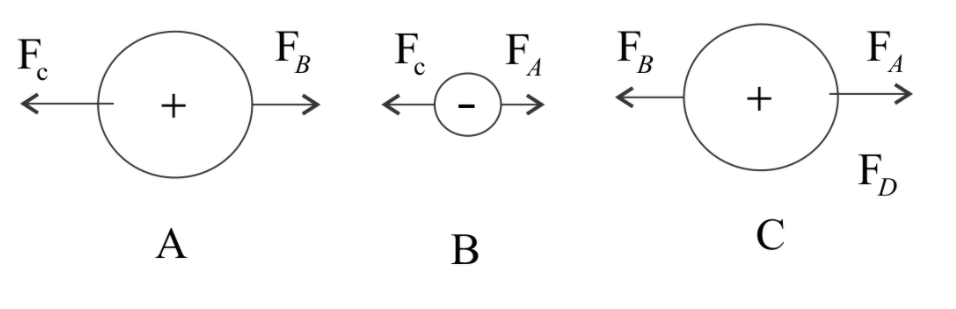
In this case, if we take appropriate distance between charges and magnitude of charges, then
Attractive force on A can be cancelled by repulsive force of C.
Repulsive force on C due to A can be cancelled by attractive force of B.
Attractive force on B due to A can be cancelled by attractive force on it due to C.
Hence option (C) is correct.
Now if we move any of the charges from its place, say we moved B towards A, then A and will be attracted together due to increase in their attractive force ( because electrostatic force, .$F \propto \dfrac{1}{{{r^2}}}$. where r is distance between charges and F is electrostatic force between them) and C will be repelled out to the right direction due to decrease in attractive force between B and C which will be not enough to cancel the repulsive force on it due to A. Hence this equilibrium is unstable equilibrium.
Hence option (B) is correct.
So the correct option is (D).
Note:- We can never attain stable equilibrium using electrostatic force and in equilibrium condition, net force over every particle will be zero. So to attain this type of unstable equilibrium and conditions between charges as mentioned in question, we have to take at least one opposite charged particle.
Complete step-by-step solution:
Let all particles of same polarity-
In this case we can realize that if all charges are collinear(in the same line) and distance between (A,B) and (B, C) is same then there will be a repulsive force on B due to A which will be equal in magnitude of the repulsive force on B due to C but they will be opposite in direction. So net force on B will be 0.
In particle A, total repulsive force will be in the left direction due to B and C due to which, A will move in the left direction. Same is the case with particle C, the net force on it will be in the right direction due to A and B and it will move in the right direction. A and C will move, but B will not in this given condition of all charges being of the same polarity, because the net force on it will always be 0.
Hence this case cannot end with equilibrium and this option is wrong.
Same if all the charges are negative.
Hence option (A) is wrong.
One of the best cases for the given condition in question is to make charge of particle B negative.
Explanation-
In this case, if we take appropriate distance between charges and magnitude of charges, then
Attractive force on A can be cancelled by repulsive force of C.
Repulsive force on C due to A can be cancelled by attractive force of B.
Attractive force on B due to A can be cancelled by attractive force on it due to C.
Hence option (C) is correct.
Now if we move any of the charges from its place, say we moved B towards A, then A and will be attracted together due to increase in their attractive force ( because electrostatic force, .$F \propto \dfrac{1}{{{r^2}}}$. where r is distance between charges and F is electrostatic force between them) and C will be repelled out to the right direction due to decrease in attractive force between B and C which will be not enough to cancel the repulsive force on it due to A. Hence this equilibrium is unstable equilibrium.
Hence option (B) is correct.
So the correct option is (D).
Note:- We can never attain stable equilibrium using electrostatic force and in equilibrium condition, net force over every particle will be zero. So to attain this type of unstable equilibrium and conditions between charges as mentioned in question, we have to take at least one opposite charged particle.
Recently Updated Pages
Master Class 12 Economics: Engaging Questions & Answers for Success

Master Class 12 Physics: Engaging Questions & Answers for Success
Master Class 12 English: Engaging Questions & Answers for Success
Master Class 12 Social Science: Engaging Questions & Answers for Success
Master Class 12 Maths: Engaging Questions & Answers for Success
Master Class 12 Business Studies: Engaging Questions & Answers for Success
Trending doubts
Which are the Top 10 Largest Countries of the World?
What are the major means of transport Explain each class 12 social science CBSE
Draw a labelled sketch of the human eye class 12 physics CBSE
Why cannot DNA pass through cell membranes class 12 biology CBSE
Differentiate between insitu conservation and exsitu class 12 biology CBSE
Draw a neat and well labeled diagram of TS of ovary class 12 biology CBSE