



 Watch Video


Three capacitors each of capacitance \[9pF\] are connected in series as shown in figure.
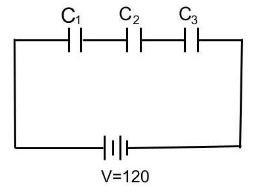
(a) What is the total capacitance of the combination?
(b) What is the potential difference across each capacitor, if the combination is connected to a \[120\,volt\] supply?
Answer
 Verified
528.3k+ views
Hint: To answer the question, we must first determine the capacitance, which we can do by using the formula for determining capacitance when two or more capacitors are connected in series. Summing the reciprocals of the individual capacitances and calculating the reciprocal of the sum can be used to compute the total capacitance of capacitors in series. Then, because the capacitance is equal and connected in series so voltage divides to find voltage across each capacitor.
Complete step by step answer:
It is given to us that three capacitors each of capacitance \[9pF\] are connected in series.Therefore,
${C_1} = {C_2} = {C_3} = 9pF = 9 \times {10^{ - 12}}F $
(a) Since the capacitor are connected in series
$\dfrac{1}{C} = \dfrac{1}{{{C_1}}} + \dfrac{1}{{{C_2}}} + \dfrac{1}{{{C_3}}}$
Now, putting the values in ${C_1}$ , ${C_2}$ and ${C_3}$
$\dfrac{1}{C} = \dfrac{1}{{9 \times {{10}^{ - 12}}}} + \dfrac{1}{{9 \times {{10}^{ - 12}}}} + \dfrac{1}{{9 \times {{10}^{ - 12}}}}$
Now, we will take ${10^{ - 12}}$ as common
$\dfrac{1}{C} = \dfrac{1}{{{{10}^{ - 12}}}}\left[ {\dfrac{1}{9} + \dfrac{1}{9} + \dfrac{1}{9}} \right]$
Now we will add up
$\dfrac{1}{C} = \dfrac{1}{{{{10}^{ - 12}}}} \times \dfrac{3}{9} \\
\Rightarrow \dfrac{1}{C} = \dfrac{1}{{{{10}^{ - 12}}}} \times \dfrac{1}{3}$
$\Rightarrow \dfrac{1}{C} = \dfrac{1}{{3 \times {{10}^{ - 12}}}}$
So, from here the value of $C$
$\therefore C = 3 \times {10^{ - 12}} = 3pF$
Hence, total capacitance of the combination is $3pF$.
(b) Potential difference across each capacitor, if the combination is connected to a \[120\,volt\] supply.It is given to us that combination is connected to a \[120\,volt\] supply.
Therefore, $V = {V_1} + {V_2} + {V_3}$
And as the capacitance are equal
${V_1} = {V_2} = {V_3} = V'$(Let)
Therefore, $V = 3V'$. Now, from here we will find out the $V'$ by putting the known values
$V' = \dfrac{V}{3}$
Putting the value of $V$ which is given \[120\,volt\]
$\therefore V' = \dfrac{{120}}{3} = 40V\,\,\,\,\,\,\,\,\,\,\left( {\because {C_1} = {C_2} = {C_3}} \right)$
Hence, potential difference across each capacitor is $40V$.
Note: It's important to note that connecting capacitors in series is done to boost the effective circuit voltage handling capability. Capacitors have a breakdown voltage rating that, if exceeded, increases their risk of failure dramatically. The voltage across two identical capacitors will be divided in half.
Complete step by step answer:
It is given to us that three capacitors each of capacitance \[9pF\] are connected in series.Therefore,
${C_1} = {C_2} = {C_3} = 9pF = 9 \times {10^{ - 12}}F $
(a) Since the capacitor are connected in series
$\dfrac{1}{C} = \dfrac{1}{{{C_1}}} + \dfrac{1}{{{C_2}}} + \dfrac{1}{{{C_3}}}$
Now, putting the values in ${C_1}$ , ${C_2}$ and ${C_3}$
$\dfrac{1}{C} = \dfrac{1}{{9 \times {{10}^{ - 12}}}} + \dfrac{1}{{9 \times {{10}^{ - 12}}}} + \dfrac{1}{{9 \times {{10}^{ - 12}}}}$
Now, we will take ${10^{ - 12}}$ as common
$\dfrac{1}{C} = \dfrac{1}{{{{10}^{ - 12}}}}\left[ {\dfrac{1}{9} + \dfrac{1}{9} + \dfrac{1}{9}} \right]$
Now we will add up
$\dfrac{1}{C} = \dfrac{1}{{{{10}^{ - 12}}}} \times \dfrac{3}{9} \\
\Rightarrow \dfrac{1}{C} = \dfrac{1}{{{{10}^{ - 12}}}} \times \dfrac{1}{3}$
$\Rightarrow \dfrac{1}{C} = \dfrac{1}{{3 \times {{10}^{ - 12}}}}$
So, from here the value of $C$
$\therefore C = 3 \times {10^{ - 12}} = 3pF$
Hence, total capacitance of the combination is $3pF$.
(b) Potential difference across each capacitor, if the combination is connected to a \[120\,volt\] supply.It is given to us that combination is connected to a \[120\,volt\] supply.
Therefore, $V = {V_1} + {V_2} + {V_3}$
And as the capacitance are equal
${V_1} = {V_2} = {V_3} = V'$(Let)
Therefore, $V = 3V'$. Now, from here we will find out the $V'$ by putting the known values
$V' = \dfrac{V}{3}$
Putting the value of $V$ which is given \[120\,volt\]
$\therefore V' = \dfrac{{120}}{3} = 40V\,\,\,\,\,\,\,\,\,\,\left( {\because {C_1} = {C_2} = {C_3}} \right)$
Hence, potential difference across each capacitor is $40V$.
Note: It's important to note that connecting capacitors in series is done to boost the effective circuit voltage handling capability. Capacitors have a breakdown voltage rating that, if exceeded, increases their risk of failure dramatically. The voltage across two identical capacitors will be divided in half.
Watch videos on
Three capacitors each of capacitance \[9pF\] are connected in series as shown in figure.
(a) What is the total capacitance of the combination?
(b) What is the potential difference across each capacitor, if the combination is connected to a \[120\,volt\] supply?
(a) What is the total capacitance of the combination?
(b) What is the potential difference across each capacitor, if the combination is connected to a \[120\,volt\] supply?

Electrostatic Potential and Capacitance Class 12 Physics - NCERT EXERCISE 2.6| Vishal Kumar Sir
Subscribe
 Share
Share likes
314 Views
2 years ago
Recently Updated Pages
Master Class 12 Economics: Engaging Questions & Answers for Success

Master Class 12 English: Engaging Questions & Answers for Success
Master Class 12 Social Science: Engaging Questions & Answers for Success
Master Class 12 Maths: Engaging Questions & Answers for Success
Master Class 12 Physics: Engaging Questions & Answers for Success
Master Class 12 Business Studies: Engaging Questions & Answers for Success
Trending doubts
Which are the Top 10 Largest Countries of the World?
Draw a labelled sketch of the human eye class 12 physics CBSE
Differentiate between homogeneous and heterogeneous class 12 chemistry CBSE
Why is the cell called the structural and functional class 12 biology CBSE
Draw ray diagrams each showing i myopic eye and ii class 12 physics CBSE
Which is the correct genotypic ratio of mendel dihybrid class 12 biology CBSE