



Three angles of a seven sided polygon are ${132^ \circ }$ each and the remaining four angles are equal. Find the value of each equal angle.
$
A){126^ \circ } \\
B){116^ \circ } \\
C){120^ \circ } \\
D){146^ \circ } \\
$
Answer
 Verified
665.7k+ views
Hint- Here in this question first we will apply the formula of sum of interior angles of a polygon i.e. $\left( {2n - 4} \right){90^ \circ }$ then we apply the conditions given in the question.
Complete step-by-step answer:
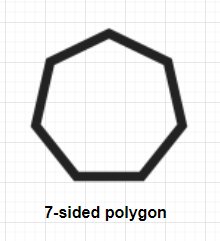
Here, given that the polygon is a seven sided and three angles of which are ${132^ \circ }$each
Also it is given that the remaining four angles are equal.
Now we have to find the value of each equal angle.
We know that,
The sum of interior angles of a n sided polygon $ = \left( {2n - 4} \right){90^ \circ }$ where n is the number of sides.
And for this polygon, n=7
Now, sum of interior angles $ = \left( {2 \times 7 - 4} \right){90^ \circ }$
$ = \left( {14 - 4} \right){90^ \circ }$
Or sum of interior angles$ = {900^ \circ }$
Also it is given that three angles are each ${132^ \circ }$
$ \Rightarrow $ 3 angles $ = 3 \times {132^ \circ } = {396^ \circ }$
Thus, the remaining 4 angles $ = {900^ \circ } - {396^ \circ }$
$ = {504^ \circ }$
Also it is given in the question that the remaining four angles are equal.
Thus, each of the 4 angles $ = \dfrac{{{{504}^ \circ }}}{4}$
$ = {126^ \circ }$
Thus, the correct option is (A).
Note- In order to solve this question one must know the concept of polygon. A polygon is any 2-Dimensional closed shape formed with straight lines. It is of two types i.e. regular and irregular polygon.
Complete step-by-step answer:
Here, given that the polygon is a seven sided and three angles of which are ${132^ \circ }$each
Also it is given that the remaining four angles are equal.
Now we have to find the value of each equal angle.
We know that,
The sum of interior angles of a n sided polygon $ = \left( {2n - 4} \right){90^ \circ }$ where n is the number of sides.
And for this polygon, n=7
Now, sum of interior angles $ = \left( {2 \times 7 - 4} \right){90^ \circ }$
$ = \left( {14 - 4} \right){90^ \circ }$
Or sum of interior angles$ = {900^ \circ }$
Also it is given that three angles are each ${132^ \circ }$
$ \Rightarrow $ 3 angles $ = 3 \times {132^ \circ } = {396^ \circ }$
Thus, the remaining 4 angles $ = {900^ \circ } - {396^ \circ }$
$ = {504^ \circ }$
Also it is given in the question that the remaining four angles are equal.
Thus, each of the 4 angles $ = \dfrac{{{{504}^ \circ }}}{4}$
$ = {126^ \circ }$
Thus, the correct option is (A).
Note- In order to solve this question one must know the concept of polygon. A polygon is any 2-Dimensional closed shape formed with straight lines. It is of two types i.e. regular and irregular polygon.
Recently Updated Pages
Basicity of sulphurous acid and sulphuric acid are

Master Class 12 Economics: Engaging Questions & Answers for Success
Master Class 12 Biology: Engaging Questions & Answers for Success
Master Class 11 English: Engaging Questions & Answers for Success
Master Class 11 Physics: Engaging Questions & Answers for Success
Master Class 11 Computer Science: Engaging Questions & Answers for Success
Trending doubts
Difference Between Plant Cell and Animal Cell
Fill the blanks with the suitable prepositions 1 The class 9 english CBSE
What is pollution? How many types of pollution? Define it
What is the full form of pH?
What is the Full Form of ICSE, CBSE and SSC
On an outline map of India show its neighbouring c class 9 social science CBSE