




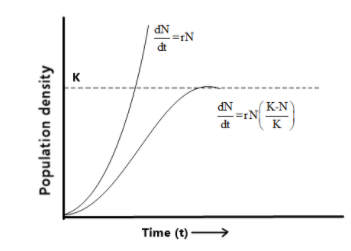
This is the typical Verhulst-Pearl population growth curve. Observe this and answer what for the letters, N, r, and K stand?
A) N- carrying capacity, r- intrinsic rate of natural increase in population and K- Population density at the given time.
B) N- Population density at the given time, r- intrinsic rate of natural increase in population and K- carrying capacity.
C) N- Population growth at the given time, r- intrinsic rate of natural increase in population and K- carrying capacity.
D) N- Limiting factors, r- intrinsic rate of natural increase in population and K- carrying capacity.
Answer
 Verified
617.7k+ views
Hint: In the given graph there are two plots. When responses are not limiting the growth one plot is exponential. When responses are limiting the growth the other plot is logistic.
Complete answer:
The population number of any ecosystem is not a set parameter. It tends to change over time, based on different factors, including food supply, predation pressure and extreme weather conditions. In fact, it is these shifts in population growth that give us a sense of what is going on with the population – whether it is thriving or decreasing. Whatever the final factors may be, the density of a population in a given ecosystem over a given time fluctuates due to changes in four fundamental processes, while birth and immigration lead to a rise in population growth, while death and emigration decrease.
Initially, the population increasing in a habitat with minimal resources displays a lag period, followed by acceleration and deceleration stages and eventually an asymptote whenever the population level exceeds the carrying capacity. This kind of population growth is named as Verhulst-Pearl Logistic Growth. The Verhulst-Pearl Logistic Growth is described by the following equation:
\[{\rm{dN/dt}}\;{\rm{ = }}\;{\rm{rN}}\left( {\frac{{{\rm{K - N}}}}{{\rm{K}}}} \right)\]
Where,
N = Population density at a given time
r = Intrinsic rate of natural increase
K = Carrying capacity
Thus, the correct answer is option B. i.e., N- Population density at the given time, r- intrinsic rate of natural increase in population and K- carrying capacity.
Note: No organism of any species in nature has infinite capacity at its disposal to allow for exponential growth. This leads to competition for scarce resources between individuals. Eventually, the fittest organism can live and replicate.
Complete answer:
The population number of any ecosystem is not a set parameter. It tends to change over time, based on different factors, including food supply, predation pressure and extreme weather conditions. In fact, it is these shifts in population growth that give us a sense of what is going on with the population – whether it is thriving or decreasing. Whatever the final factors may be, the density of a population in a given ecosystem over a given time fluctuates due to changes in four fundamental processes, while birth and immigration lead to a rise in population growth, while death and emigration decrease.
Initially, the population increasing in a habitat with minimal resources displays a lag period, followed by acceleration and deceleration stages and eventually an asymptote whenever the population level exceeds the carrying capacity. This kind of population growth is named as Verhulst-Pearl Logistic Growth. The Verhulst-Pearl Logistic Growth is described by the following equation:
\[{\rm{dN/dt}}\;{\rm{ = }}\;{\rm{rN}}\left( {\frac{{{\rm{K - N}}}}{{\rm{K}}}} \right)\]
Where,
N = Population density at a given time
r = Intrinsic rate of natural increase
K = Carrying capacity
Thus, the correct answer is option B. i.e., N- Population density at the given time, r- intrinsic rate of natural increase in population and K- carrying capacity.
Note: No organism of any species in nature has infinite capacity at its disposal to allow for exponential growth. This leads to competition for scarce resources between individuals. Eventually, the fittest organism can live and replicate.
Recently Updated Pages
Master Class 12 Business Studies: Engaging Questions & Answers for Success

Master Class 12 Chemistry: Engaging Questions & Answers for Success
Master Class 12 Biology: Engaging Questions & Answers for Success
Class 12 Question and Answer - Your Ultimate Solutions Guide
Master Class 11 English: Engaging Questions & Answers for Success
Master Class 11 Social Science: Engaging Questions & Answers for Success
Trending doubts
Which are the Top 10 Largest Countries of the World?
Draw a labelled sketch of the human eye class 12 physics CBSE
Differentiate between homogeneous and heterogeneous class 12 chemistry CBSE
Why is the cell called the structural and functional class 12 biology CBSE
Draw ray diagrams each showing i myopic eye and ii class 12 physics CBSE
Which is the correct genotypic ratio of mendel dihybrid class 12 biology CBSE