




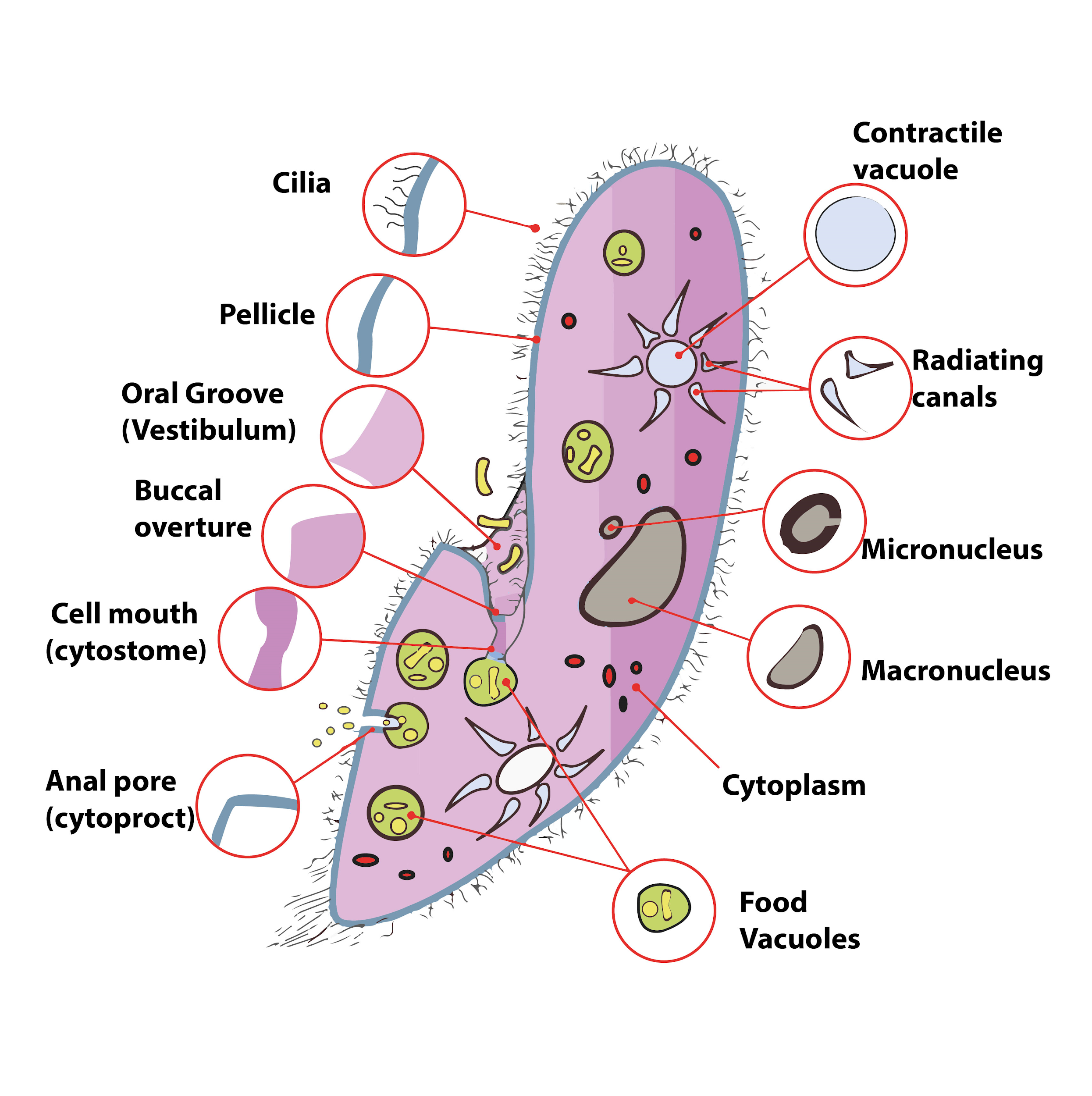
This diagram belongs to a protozoan. This organism belongs to a class
(a)Sporozoa
(b)Sarcodina
(c)Flagellata
(d)Ciliata
Answer
 Verified
664.2k+ views
Hint: This unicellular organism lives in mainly freshwater. The whole body is covered with a short hairy structure called cilia. They are single-celled, free-living organisms.
Complete step-by-step answer:
Paramecium is a protozoan that belongs to class ciliata. It exhibits a high-level cellular differentiation with several complex organelles that perform a specific function to make its survival possible. It is made up of two membranes, the outer membrane is a layer of flattened membrane-bound sacs and the inner membrane is epiplasm. The body of the cell is surrounded by a rigid but elastic structure called the pellicle. It has an anal pore located on the ventral surface.
General characters of paramecium:
-It is generally found in freshwater bodies like pools, ditches, streams, rivers, lakes, etc. but it is abundantly found in stagnant water, where decaying organic matter is in plenty.
-It feeds on microorganisms like bacteria, algae, and yeasts and shows holozoic nutrition.
-The locomotion occurs with the help of cilia, which also helps in food capture.
-Digestion is intracellular because food gathered into vacuoles.
-Respiration occurs by the body surface through the diffusion process.
-Excretion takes place by contractile vacuole and cytoproct.
-It reproduces asexually by transverse binary fission and sexually by conjugation.
So, the correct answer is ‘ciliata’.
Note: -Cytostome is a fine aperture in the cell membrane of Paramecium by which food particles enter into the cell.
-Cytoproct is an anal opening in the unicellular organisms that involves food vacuole egestion (excretion).
Complete step-by-step answer:
Paramecium is a protozoan that belongs to class ciliata. It exhibits a high-level cellular differentiation with several complex organelles that perform a specific function to make its survival possible. It is made up of two membranes, the outer membrane is a layer of flattened membrane-bound sacs and the inner membrane is epiplasm. The body of the cell is surrounded by a rigid but elastic structure called the pellicle. It has an anal pore located on the ventral surface.
General characters of paramecium:
-It is generally found in freshwater bodies like pools, ditches, streams, rivers, lakes, etc. but it is abundantly found in stagnant water, where decaying organic matter is in plenty.
-It feeds on microorganisms like bacteria, algae, and yeasts and shows holozoic nutrition.
-The locomotion occurs with the help of cilia, which also helps in food capture.
-Digestion is intracellular because food gathered into vacuoles.
-Respiration occurs by the body surface through the diffusion process.
-Excretion takes place by contractile vacuole and cytoproct.
-It reproduces asexually by transverse binary fission and sexually by conjugation.
So, the correct answer is ‘ciliata’.
Note: -Cytostome is a fine aperture in the cell membrane of Paramecium by which food particles enter into the cell.
-Cytoproct is an anal opening in the unicellular organisms that involves food vacuole egestion (excretion).
Recently Updated Pages
Write structures of the following compounds i 2 Chloro3methylpentane class 11 chemistry CBSE

What is BLO What is the full form of BLO class 8 social science CBSE
Explain the Treaty of Vienna of 1815 class 10 social science CBSE
A Paragraph on Pollution in about 100-150 Words
XIX+XXX A 49 B 51 C 55 D 44 class 5 maths CBSE
If x a + bt + ct2 where x is in meters and t is in class 11 physics CBSE
Trending doubts
One Metric ton is equal to kg A 10000 B 1000 C 100 class 11 physics CBSE
Find the value of the expression given below sin 30circ class 11 maths CBSE
What do you mean by retardation What is its SI uni class 11 physics CBSE
Draw a diagram of nephron and explain its structur class 11 biology CBSE
10 examples of friction in our daily life
Difference between physical and chemical change class 11 chemistry CBSE