




They give birth to two young ones
A. Kangaroo, Hedgehog, Dolphin, Loris
B. Lion, Bat, Whale, Ostrich
C. Platypus, penguin, Bat, Hippopotamus
D. Shrew, Bat, Cat, Kiwi
Answer
 Verified
599.1k+ views
Hint:Oviparous animals are animals that lay their eggs, with little or no other embryonic development within the mother. Whereas viviparous animals give birth to young ones by the development of embryos. All birds are oviparous and all mammals are mostly viviparous.
Complete answer:The reproductive system in mammals:
Fertilization is internal. Mammals are mostly viviparous (live-bearing). Eggs are generally minute with little yolk and no shell. Development takes place in the uterus of the female.
The embryo has layers which are amnion, allantois, and chorion.
A placenta attaches the fetus to the uterine wall of the mother for nourishment, respiration, and excretion.
Development is direct.
Vivipary enables the mammalian mother to remain mobile while incubating embryos, this is an advantage over birds.
Young ones are nourished on milk for some time after birth and are brought up with great care and love.
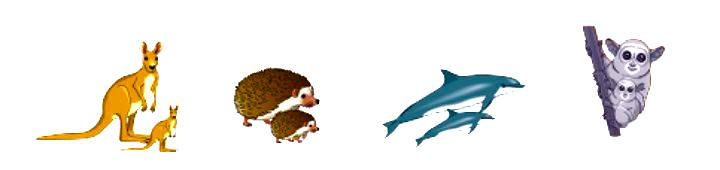
So the correct answer is option A. Kangaroo, Hedgehog, Dolphin, Loris.
Additional information:
All birds are oviparous. Eggs are large with much yolk and hard, calcareous shells, and need incubation at a constant body temperature by the parents. Development is direct.
Embryonic membranes (amnion, chorion, allantois yolk sac) are formed as in reptiles.
Chances of survival are less because egg-laying occurs in the external environment
The feature of egg-laying animals is referred to as oviparity.
Note: In option A. All the animals mentioned belonging to class mammals. In option, B. ostrich is an example of class aves which is oviparous similarly in option C and D penguin and kiwi are examples of class aves and are oviparous.
Complete answer:The reproductive system in mammals:
Fertilization is internal. Mammals are mostly viviparous (live-bearing). Eggs are generally minute with little yolk and no shell. Development takes place in the uterus of the female.
The embryo has layers which are amnion, allantois, and chorion.
A placenta attaches the fetus to the uterine wall of the mother for nourishment, respiration, and excretion.
Development is direct.
Vivipary enables the mammalian mother to remain mobile while incubating embryos, this is an advantage over birds.
Young ones are nourished on milk for some time after birth and are brought up with great care and love.
So the correct answer is option A. Kangaroo, Hedgehog, Dolphin, Loris.
Additional information:
All birds are oviparous. Eggs are large with much yolk and hard, calcareous shells, and need incubation at a constant body temperature by the parents. Development is direct.
Embryonic membranes (amnion, chorion, allantois yolk sac) are formed as in reptiles.
Chances of survival are less because egg-laying occurs in the external environment
The feature of egg-laying animals is referred to as oviparity.
Note: In option A. All the animals mentioned belonging to class mammals. In option, B. ostrich is an example of class aves which is oviparous similarly in option C and D penguin and kiwi are examples of class aves and are oviparous.
Recently Updated Pages
Master Class 12 Economics: Engaging Questions & Answers for Success

Master Class 12 English: Engaging Questions & Answers for Success
Master Class 12 Social Science: Engaging Questions & Answers for Success
Master Class 12 Maths: Engaging Questions & Answers for Success
Master Class 12 Physics: Engaging Questions & Answers for Success
Master Class 12 Business Studies: Engaging Questions & Answers for Success
Trending doubts
Which are the Top 10 Largest Countries of the World?
Draw a labelled sketch of the human eye class 12 physics CBSE
Differentiate between homogeneous and heterogeneous class 12 chemistry CBSE
Why is the cell called the structural and functional class 12 biology CBSE
Draw ray diagrams each showing i myopic eye and ii class 12 physics CBSE
Which is the correct genotypic ratio of mendel dihybrid class 12 biology CBSE