




There is no cell division involved in
A. Spermatogenesis
B. Oogenesis
C. Embryogenesis
D. Spermiogenesis
Answer
 Verified
529.8k+ views
Hint: Cell division is the process by which a parent cell or a mother cell is divided into two or more daughter cells. The daughter cells are genetically identical with the mother or parent cell. In the cell division process a single cell divides into two cells and then each of these two cells further divides into two cells and in this manner the process goes on.
Complete explanation
Option A. Spermatogenesis: Spermatogenesis is the process of developing sperms in male reproductive organs called testis. In this process haploid spermatozoa mature from germ cells in the Seminiferous tubules of the testis. It starts with the mitotic division of the stem cells located close to the undercroft membrane or layer of the Seminiferous tubules.
So, Option A is not correct.
Option B. Oogenesis: Oogenesis is the growth process in which a primary egg cell or ovum in a human female reproductive organ becomes a mature ovum. These cells are called primary ova. They remain dormant until just before the ovulation time when an egg or ovum releases from the ovary. This process doesn’t contain any cell division, it is a simple cell maturity process.
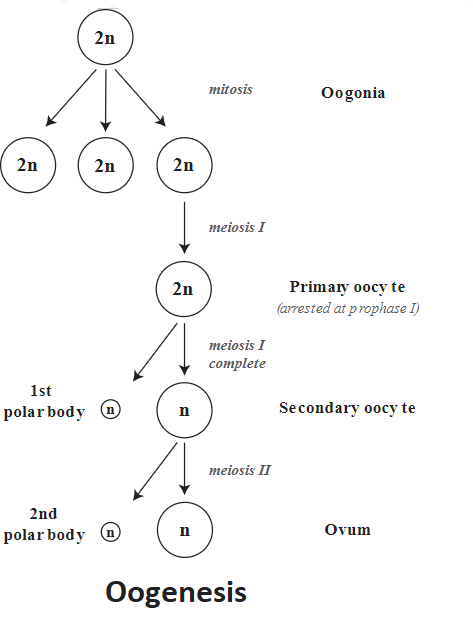
So, Option B is correct.
Option C. Embryogenesis : Embryogenesis also known as Embryonic Development is the process of the initiation and the development of an Embryo from a Zygote. Embryo evolution occurs through an extraordinarily organized sequence of cell division, expansion and differentiation.
So, Option C is not correct.
Option D. Spermiogenesis : The final stage of the Spermatogenesis is described as Spermiogenesis. This is the process of the development of spermatids into the mature spermatozoa. As it occurs after the cell division of Spermatogenesis, we can say that this also involves a cell division process.
So, Option D is not correct.
Hence, Option B. Oogenesis is the correct answer..
Note:
Spermatogenesis is the process of the formation of sperm cells through the cell division process. Embryogenesis is the process where a single cell Zygote (mother cell) divides into two, then two to four and so on and becomes a full grown baby. As, the spermiogenesis is the final stage of spermatogenesis, thus it also involves cell division in the prior stage called spermatogenesis. So, the only process in which a cell division doesn’t occur is Oogenesis, in which an immature ovum becomes a mature ovum during the ovulation period.
Complete explanation
Option A. Spermatogenesis: Spermatogenesis is the process of developing sperms in male reproductive organs called testis. In this process haploid spermatozoa mature from germ cells in the Seminiferous tubules of the testis. It starts with the mitotic division of the stem cells located close to the undercroft membrane or layer of the Seminiferous tubules.
So, Option A is not correct.
Option B. Oogenesis: Oogenesis is the growth process in which a primary egg cell or ovum in a human female reproductive organ becomes a mature ovum. These cells are called primary ova. They remain dormant until just before the ovulation time when an egg or ovum releases from the ovary. This process doesn’t contain any cell division, it is a simple cell maturity process.
So, Option B is correct.
Option C. Embryogenesis : Embryogenesis also known as Embryonic Development is the process of the initiation and the development of an Embryo from a Zygote. Embryo evolution occurs through an extraordinarily organized sequence of cell division, expansion and differentiation.
So, Option C is not correct.
Option D. Spermiogenesis : The final stage of the Spermatogenesis is described as Spermiogenesis. This is the process of the development of spermatids into the mature spermatozoa. As it occurs after the cell division of Spermatogenesis, we can say that this also involves a cell division process.
So, Option D is not correct.
Hence, Option B. Oogenesis is the correct answer..
Note:
Spermatogenesis is the process of the formation of sperm cells through the cell division process. Embryogenesis is the process where a single cell Zygote (mother cell) divides into two, then two to four and so on and becomes a full grown baby. As, the spermiogenesis is the final stage of spermatogenesis, thus it also involves cell division in the prior stage called spermatogenesis. So, the only process in which a cell division doesn’t occur is Oogenesis, in which an immature ovum becomes a mature ovum during the ovulation period.
Recently Updated Pages
Master Class 12 Economics: Engaging Questions & Answers for Success

Master Class 12 English: Engaging Questions & Answers for Success
Master Class 12 Social Science: Engaging Questions & Answers for Success
Master Class 12 Maths: Engaging Questions & Answers for Success
Master Class 12 Physics: Engaging Questions & Answers for Success
Master Class 12 Business Studies: Engaging Questions & Answers for Success
Trending doubts
Which are the Top 10 Largest Countries of the World?
Draw a labelled sketch of the human eye class 12 physics CBSE
Differentiate between homogeneous and heterogeneous class 12 chemistry CBSE
Why is the cell called the structural and functional class 12 biology CBSE
Draw ray diagrams each showing i myopic eye and ii class 12 physics CBSE
Which is the correct genotypic ratio of mendel dihybrid class 12 biology CBSE