




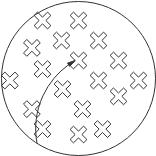
There is a magnetic field acting in a plane perpendicular to the sheet of paper downward into the paper as shown in the figure, a particle in a vacuum moves in the plane of paper from left to right as shown in the figure. The path inclined by the arrow could be travelled by
A. Proton
B. Neutron
C. Electron
D. Alpha particle
Answer
 Verified
535.5k+ views
Hint: In the case of the proton, the direction of the path traced should be outside the direction of the paper. Similarly, in the case of the electron, the direction of the path traced should be inside the direction of the paper. As the neutron is neutral, then, the curve traced by the neutron will be a linear curve.
Complete step-by-step solution:
From the given information, we have the data as follows.
The direction of the magnetic field is inside the circle, that is, inside the paper. Then, the direction of the velocity should be perpendicular to the direction of the magnetic field, that is, outside the paper.
The neutron is neutral, the proton is positively charged and the electron is negatively charged. The direction of the curve or the path traced by the particle depends on the type of the charged particle, that is, the direction of the path traversed by the proton will be upward directing arrow, the direction of the path traversed by the electron will be downward directing arrow, the direction of the path traversed by the neutron will be a straight directing arrow.
\[\therefore \] The path inclined by the arrow could be travelled by electron, thus, option (C) is correct.
Note: In the case of the electric field, the force on the charged particle will be acting parallel to the electric field vector in the case of a positive charge and antiparallel in the case of negative charge and does not depend on the velocity of the particle. In the case of the magnetic field, the force on the charged particle will be acting perpendicular to the magnetic field. Using the right-hand rule, the direction of the force can be determined.
Complete step-by-step solution:
From the given information, we have the data as follows.
The direction of the magnetic field is inside the circle, that is, inside the paper. Then, the direction of the velocity should be perpendicular to the direction of the magnetic field, that is, outside the paper.
The neutron is neutral, the proton is positively charged and the electron is negatively charged. The direction of the curve or the path traced by the particle depends on the type of the charged particle, that is, the direction of the path traversed by the proton will be upward directing arrow, the direction of the path traversed by the electron will be downward directing arrow, the direction of the path traversed by the neutron will be a straight directing arrow.
\[\therefore \] The path inclined by the arrow could be travelled by electron, thus, option (C) is correct.
Note: In the case of the electric field, the force on the charged particle will be acting parallel to the electric field vector in the case of a positive charge and antiparallel in the case of negative charge and does not depend on the velocity of the particle. In the case of the magnetic field, the force on the charged particle will be acting perpendicular to the magnetic field. Using the right-hand rule, the direction of the force can be determined.
Recently Updated Pages
Master Class 12 Economics: Engaging Questions & Answers for Success

Master Class 12 Physics: Engaging Questions & Answers for Success
Master Class 12 English: Engaging Questions & Answers for Success
Master Class 12 Social Science: Engaging Questions & Answers for Success
Master Class 12 Maths: Engaging Questions & Answers for Success
Master Class 12 Business Studies: Engaging Questions & Answers for Success
Trending doubts
Which are the Top 10 Largest Countries of the World?
What are the major means of transport Explain each class 12 social science CBSE
Draw a labelled sketch of the human eye class 12 physics CBSE
Why cannot DNA pass through cell membranes class 12 biology CBSE
Differentiate between insitu conservation and exsitu class 12 biology CBSE
Draw a neat and well labeled diagram of TS of ovary class 12 biology CBSE