




There are two different forms of cell division – Mitosis and meiosis. Why do we need two forms? Do all cells use both forms? Why do you think that this is true? What are the advantages and disadvantages of each form of cell division?
Answer
 Verified
549.3k+ views
Hint: When a cell splits also known as the cell division, it produces two or more daughter cells. Numerous species rely on this mechanism for survival. Multicellular organisms utilise it in order to develop, restore (repair), and reproduce themselves.
Complete answer:
Mitosis and meiosis are the two forms of cell division. It is the process of mitosis that produces new body cells, whereas meiosis produces egg and sperm cells. Mitosis is a vital mechanism for life to function. At the end of the mitosis, a cell produces two identical daughter cells by duplicating all of its contents, including its chromosomes. Because mitosis is such a vital process, particular genes are responsible for carefully regulating each stage. With the meiotic cell division, people inherit the same amount of genes from generation to generation. A two-step process reduces the number of chromosomes in half.
Image showing two forms of cell-division
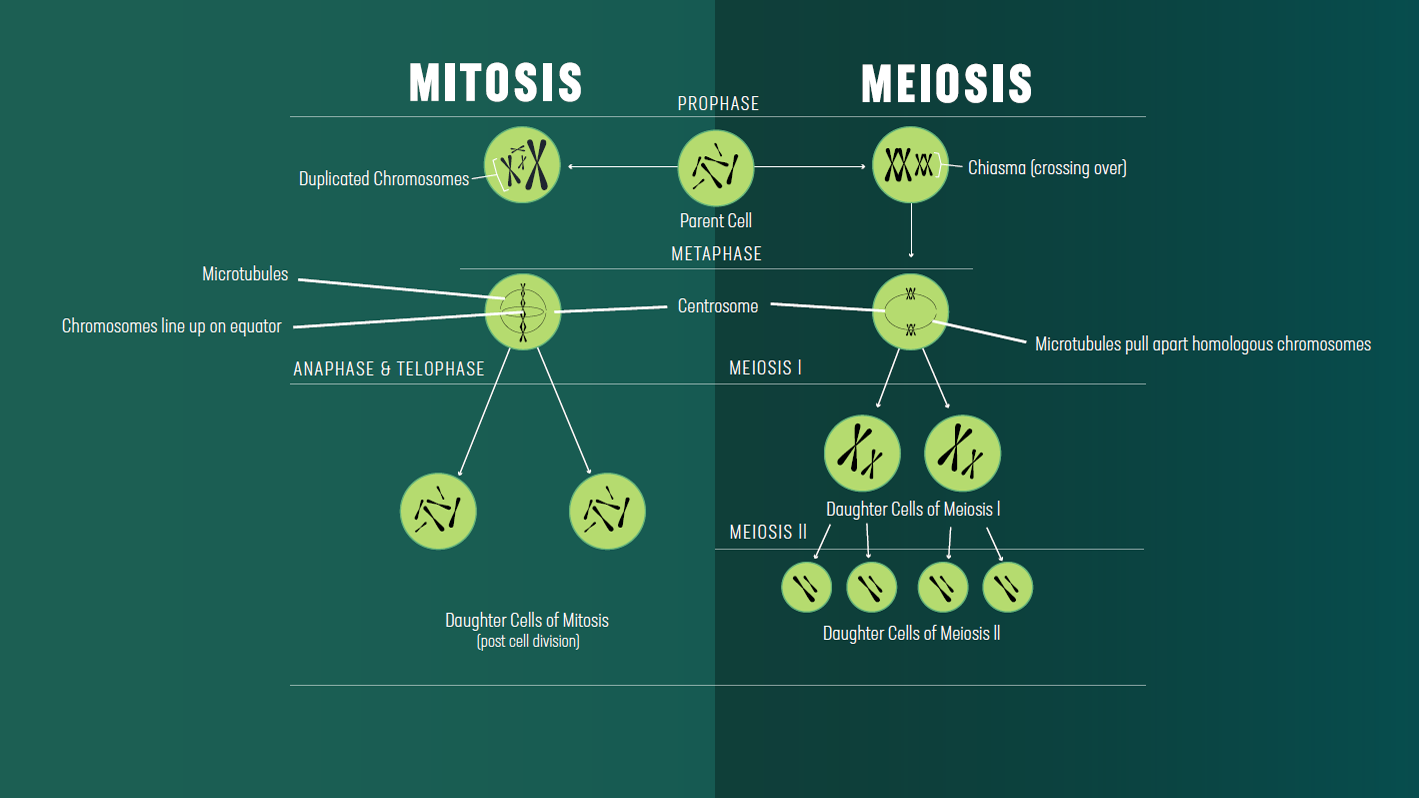
Two forms of cell divisions are required as both these forms have various functions. Mitosis is a body repairing form of cell division, which helps in replacing damaged or dead cells. Meiosis on the other hand, helps in maintaining the same number of chromosomes from one generation to another generation.
All cells do not use both these forms of cell divisions, and this factor depends upon the type of cell. For example, mitosis occurs in somatic cells (the cell which forms the body of a multicellular organism) whereas meiosis takes place in germ cells which are biological cells which contribute in sexual reproduction through gametes.
Both methods of cell division have their advantages and disadvantages. Meiosis and meiosis are compared in the following table:
Note:
When German botanist Hugo von Mohl examined the green alga Cladophora glomerata in 1835, he discovered the first cell division under the microscope. For the first time, Kurt Michel used a phase-contrast microscope to film cell division in the year 1943.
Complete answer:
Mitosis and meiosis are the two forms of cell division. It is the process of mitosis that produces new body cells, whereas meiosis produces egg and sperm cells. Mitosis is a vital mechanism for life to function. At the end of the mitosis, a cell produces two identical daughter cells by duplicating all of its contents, including its chromosomes. Because mitosis is such a vital process, particular genes are responsible for carefully regulating each stage. With the meiotic cell division, people inherit the same amount of genes from generation to generation. A two-step process reduces the number of chromosomes in half.
Image showing two forms of cell-division
Two forms of cell divisions are required as both these forms have various functions. Mitosis is a body repairing form of cell division, which helps in replacing damaged or dead cells. Meiosis on the other hand, helps in maintaining the same number of chromosomes from one generation to another generation.
All cells do not use both these forms of cell divisions, and this factor depends upon the type of cell. For example, mitosis occurs in somatic cells (the cell which forms the body of a multicellular organism) whereas meiosis takes place in germ cells which are biological cells which contribute in sexual reproduction through gametes.
Both methods of cell division have their advantages and disadvantages. Meiosis and meiosis are compared in the following table:
| Cell Division | Advantage | Disadvantage |
| Mitosis | Helps in easily replicating the cells and also produces sister chromosomes. | Due to the lack of genetic diversity, mitosis poses a danger for the same diseases/disorders from generation to generation. |
| Meiosis | It creates genetic diversity in the body. | Meiosis has the drawback of requiring two gametes. |
Note:
When German botanist Hugo von Mohl examined the green alga Cladophora glomerata in 1835, he discovered the first cell division under the microscope. For the first time, Kurt Michel used a phase-contrast microscope to film cell division in the year 1943.
Recently Updated Pages
If x a + bt + ct2 where x is in meters and t is in class 11 physics CBSE

A car covers the first half distance between two places class 11 physics CBSE
The resultant of two vectors overrightarrow P and overrightarrow class 11 physics CBSE
Find the value of cos 135 class 11 maths CBSE
A mass M is held in place by an applied force F and class 11 physics CBSE
A solution of glucose in water is labelled as 10 dfracwv class 11 chemistry CBSE
Trending doubts
One Metric ton is equal to kg A 10000 B 1000 C 100 class 11 physics CBSE
Find the value of the expression given below sin 30circ class 11 maths CBSE
What do you mean by retardation What is its SI uni class 11 physics CBSE
Draw a diagram of nephron and explain its structur class 11 biology CBSE
10 examples of friction in our daily life
Difference between physical and chemical change class 11 chemistry CBSE