




There are three clubs $A,B,C$ in a town with $40,50,60$ members respectively. Ten people are members of all the three clubs. $70$ members belong to only one club. A member is randomly selected. Find the probability that he has membership of exactly two clubs.
Answer
 Verified
590.7k+ views
Hint: We can solve this problem using set theory and probability. We can analyse the given data and express it using a venn diagram. Then we can solve for the favourable number. Using favourable number and total number we get the probability.
Formula used:
Probability of an event is obtained by dividing favourable number of outcomes by total number of outcomes.
Complete step-by-step answer:
Given $A,B,C$ clubs have members $40,50,60$ respectively.
Let it be $n(A),n(B),n(C)$.
$ \Rightarrow n(A) = 40,n(B) = 50,n(C) = 60$
Also given ten people are members of all the three clubs.
$ \Rightarrow n(A \cap B \cap C) = 10$
Also we have, $70$ members belong to only one club.
We can use a Venn diagram to express these data.
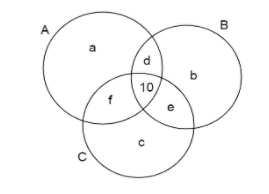
Here the three circles represent clubs $A,B,C$.
The small letters represent the number of members in each section.
Since we have $70$ members belong to only one club, we can write
$a + b + c = 70 - - - (i)$
Also we get from the diagram,
$ \Rightarrow n(A) = a + d + f + 10,n(B) = b + d + e + 10,n(C) = c + e + f + 10$
Substituting we get,
$a + d + f + 10 = 40$
$b + d + e + 10 = 50$
$c + e + f + 10 = 60$
Simplifying we get,
$a + d + f = 30$
$b + d + e = 40$
$c + e + f = 50$
Adding these three equations we get,
$a + d + f + b + d + e + c + e + f = 30 + 40 + 50$
$ \Rightarrow a + b + c + 2(d + e + f) = 120 - - - (ii)$
But from $(i)$ we have, $a + b + c = 70$
Substituting we get,
$ \Rightarrow 70 + 2(d + e + f) = 120$
Subtracting $70$ from both sides we get,
$ \Rightarrow 70 + 2(d + e + f) - 70 = 120 - 70$
$ \Rightarrow 2(d + e + f) = 50$
Dividing both sides by $2$ we get,
$ \Rightarrow \dfrac{2}{2}(d + e + f) = \dfrac{{50}}{2}$
Simplifying we get,
$ \Rightarrow d + e + f = 25 - - - (iii)$
We can see from the diagram that this number represents the number of members exactly belong to two clubs,
So the favourable number here is $d + e + f = 25$
At the same time total number is represented by the sum $a + b + c + d + e + f + 10$
From $(i),(iii)$ we have, $a + b + c + d + e + f + 10 = 70 + 25 + 10 = 105$
$ \Rightarrow {\text{Total number of persons = 105}}$
Now the probability is a favourable number divided by total number.
So we have $probability = \dfrac{{25}}{{105}}$
Cancelling $5$ from the numerator and denominator we get the required probability as $\dfrac{5}{{21}}$.
Therefore, the probability of members belong to exactly two clubs is $\dfrac{5}{{21}}$.
Note: Here it is important to interpret the given data. Using the diagram we could express the data and identify the required one. So we could easily calculate the probability.
Formula used:
Probability of an event is obtained by dividing favourable number of outcomes by total number of outcomes.
Complete step-by-step answer:
Given $A,B,C$ clubs have members $40,50,60$ respectively.
Let it be $n(A),n(B),n(C)$.
$ \Rightarrow n(A) = 40,n(B) = 50,n(C) = 60$
Also given ten people are members of all the three clubs.
$ \Rightarrow n(A \cap B \cap C) = 10$
Also we have, $70$ members belong to only one club.
We can use a Venn diagram to express these data.
Here the three circles represent clubs $A,B,C$.
The small letters represent the number of members in each section.
Since we have $70$ members belong to only one club, we can write
$a + b + c = 70 - - - (i)$
Also we get from the diagram,
$ \Rightarrow n(A) = a + d + f + 10,n(B) = b + d + e + 10,n(C) = c + e + f + 10$
Substituting we get,
$a + d + f + 10 = 40$
$b + d + e + 10 = 50$
$c + e + f + 10 = 60$
Simplifying we get,
$a + d + f = 30$
$b + d + e = 40$
$c + e + f = 50$
Adding these three equations we get,
$a + d + f + b + d + e + c + e + f = 30 + 40 + 50$
$ \Rightarrow a + b + c + 2(d + e + f) = 120 - - - (ii)$
But from $(i)$ we have, $a + b + c = 70$
Substituting we get,
$ \Rightarrow 70 + 2(d + e + f) = 120$
Subtracting $70$ from both sides we get,
$ \Rightarrow 70 + 2(d + e + f) - 70 = 120 - 70$
$ \Rightarrow 2(d + e + f) = 50$
Dividing both sides by $2$ we get,
$ \Rightarrow \dfrac{2}{2}(d + e + f) = \dfrac{{50}}{2}$
Simplifying we get,
$ \Rightarrow d + e + f = 25 - - - (iii)$
We can see from the diagram that this number represents the number of members exactly belong to two clubs,
So the favourable number here is $d + e + f = 25$
At the same time total number is represented by the sum $a + b + c + d + e + f + 10$
From $(i),(iii)$ we have, $a + b + c + d + e + f + 10 = 70 + 25 + 10 = 105$
$ \Rightarrow {\text{Total number of persons = 105}}$
Now the probability is a favourable number divided by total number.
So we have $probability = \dfrac{{25}}{{105}}$
Cancelling $5$ from the numerator and denominator we get the required probability as $\dfrac{5}{{21}}$.
Therefore, the probability of members belong to exactly two clubs is $\dfrac{5}{{21}}$.
Note: Here it is important to interpret the given data. Using the diagram we could express the data and identify the required one. So we could easily calculate the probability.
Recently Updated Pages
Basicity of sulphurous acid and sulphuric acid are

Master Class 12 English: Engaging Questions & Answers for Success
Master Class 12 Social Science: Engaging Questions & Answers for Success
Master Class 12 Maths: Engaging Questions & Answers for Success
Master Class 12 Economics: Engaging Questions & Answers for Success
Master Class 12 Physics: Engaging Questions & Answers for Success
Trending doubts
Which are the Top 10 Largest Countries of the World?
Draw a labelled sketch of the human eye class 12 physics CBSE
Which country did Danny Casey play for class 12 english CBSE
Give 10 examples of unisexual and bisexual flowers
Coming together federation is practiced in A India class 12 social science CBSE
Write the formula to find the shortest distance between class 12 maths CBSE