




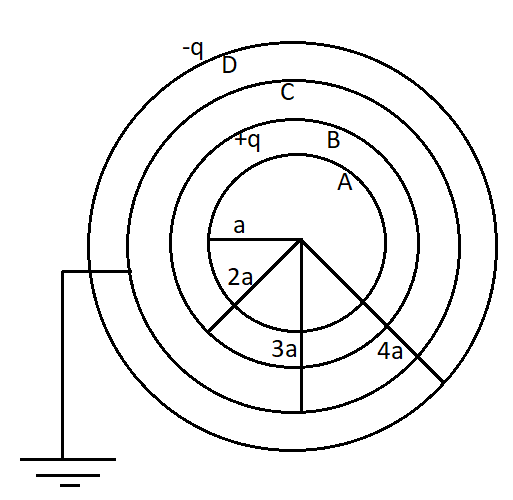
There are four concentric shells A, B, C and D of radii $a$, $2a$, $3a$ and $4a$ respectively. Shell B and D are given charges $ + q$ and $ - q$ respectively. Shell C is now earthed. The potential difference ${V_A} - {V_C}$ is $k = \dfrac{1}{{4\pi {\varepsilon _o}}}$:
(A) $\dfrac{{kq}}{{2a}}$
(B) $\dfrac{{kq}}{{3a}}$
(C) $\dfrac{{kq}}{{4a}}$
(D) $\dfrac{{kq}}{{6a}}$
Answer
 Verified
586.8k+ views
Hint
We need to find the potential at shell C and then equate that value to zero. From there we can find the charge induced on C. Therefore, by calculating the value of the potential at the shells A and C and we can find the difference in their potential.
Formula Used: In this solution, we will be using the following formula
$V = \dfrac{{kq}}{d}$
where $V$ is the potential
$k = \dfrac{1}{{4\pi {\varepsilon _o}}}$ where ${\varepsilon _o}$ is the permittivity in free space, $q$ is the charge and $d$ is the distance.
Complete step by step answer
In this case there are 4 concentric shells A, B, C, and D of radius $a$, $2a$, $3a$ and $4a$. A charge $q$ is placed on shell B and $ - q$ is placed on the shell D. So we can draw the figure as,
The electric potential due to a charge can be given by the formula,
$V = \dfrac{{kq}}{d}$
Now the potential on the shell C due to the charges placed on the shells D end B is,
${V_c} = \dfrac{{kq}}{{3a}} + \dfrac{{kq'}}{{3a}} - \dfrac{{kq}}{{4a}}$
where $q'$ is the charge induced on C.
And the potential on the surface of A is,
${V_A} = \dfrac{{kq}}{{2a}} + \dfrac{{kq'}}{{3a}} - \dfrac{{kq}}{{4a}}$
Now the shell C is grounded. So the potential on C will be 0. That is, ${V_c} = 0$.
So equating the equation we get,
$0 = \dfrac{{kq}}{{3a}} + \dfrac{{kq'}}{{3a}} - \dfrac{{kq}}{{4a}}$
We can cancel the $k$ and $a$ from the numerator and denominator of all the terms.
So we get,
$0 = \dfrac{q}{3} + \dfrac{{q'}}{3} - \dfrac{q}{4}$
Therefore taking the term containing $q'$ to one side,
$\dfrac{{q'}}{3} = \dfrac{q}{4} - \dfrac{q}{3}$
On the R.H.S taking LCM, we find $q'$ as,
$q' = \dfrac{{\left( {3 - 4} \right)}}{{12}}3q$
On doing the calculation we get
$ \Rightarrow q' = - \dfrac{q}{4}$
Now putting this value of $q'$ in the equation for ${V_A}$ we get
${V_A} = \dfrac{{kq}}{{2a}} - \dfrac{{k\dfrac{q}{4}}}{{3a}} - \dfrac{{kq}}{{4a}}$
$ \Rightarrow {V_A} = \dfrac{{kq}}{{2a}} - \dfrac{{kq}}{{12a}} - \dfrac{{kq}}{{4a}}$
On doing the LCM and calculating further we get3
${V_A} = \dfrac{{6kq - kq - 3kq}}{{12a}} = \dfrac{{2kq}}{{12a}}$
Hence we get the value of the potential at the surface of A as,
${V_A} = \dfrac{{kq}}{{6a}}$
Since ${V_C} = 0$
Therefore ${V_A} - {V_C} = \dfrac{{kq}}{{6a}}$
This is the difference in potential. So the correct option is D.
Note
The electric potential at a point in an electric field is the amount of work that is done in bringing a unit positive charge from infinity to that point. And when a body is charged it can attract and repulse an oppositely charged body. This shows the ability of a charged body to do work. This ability is called the potential of that body.
We need to find the potential at shell C and then equate that value to zero. From there we can find the charge induced on C. Therefore, by calculating the value of the potential at the shells A and C and we can find the difference in their potential.
Formula Used: In this solution, we will be using the following formula
$V = \dfrac{{kq}}{d}$
where $V$ is the potential
$k = \dfrac{1}{{4\pi {\varepsilon _o}}}$ where ${\varepsilon _o}$ is the permittivity in free space, $q$ is the charge and $d$ is the distance.
Complete step by step answer
In this case there are 4 concentric shells A, B, C, and D of radius $a$, $2a$, $3a$ and $4a$. A charge $q$ is placed on shell B and $ - q$ is placed on the shell D. So we can draw the figure as,
The electric potential due to a charge can be given by the formula,
$V = \dfrac{{kq}}{d}$
Now the potential on the shell C due to the charges placed on the shells D end B is,
${V_c} = \dfrac{{kq}}{{3a}} + \dfrac{{kq'}}{{3a}} - \dfrac{{kq}}{{4a}}$
where $q'$ is the charge induced on C.
And the potential on the surface of A is,
${V_A} = \dfrac{{kq}}{{2a}} + \dfrac{{kq'}}{{3a}} - \dfrac{{kq}}{{4a}}$
Now the shell C is grounded. So the potential on C will be 0. That is, ${V_c} = 0$.
So equating the equation we get,
$0 = \dfrac{{kq}}{{3a}} + \dfrac{{kq'}}{{3a}} - \dfrac{{kq}}{{4a}}$
We can cancel the $k$ and $a$ from the numerator and denominator of all the terms.
So we get,
$0 = \dfrac{q}{3} + \dfrac{{q'}}{3} - \dfrac{q}{4}$
Therefore taking the term containing $q'$ to one side,
$\dfrac{{q'}}{3} = \dfrac{q}{4} - \dfrac{q}{3}$
On the R.H.S taking LCM, we find $q'$ as,
$q' = \dfrac{{\left( {3 - 4} \right)}}{{12}}3q$
On doing the calculation we get
$ \Rightarrow q' = - \dfrac{q}{4}$
Now putting this value of $q'$ in the equation for ${V_A}$ we get
${V_A} = \dfrac{{kq}}{{2a}} - \dfrac{{k\dfrac{q}{4}}}{{3a}} - \dfrac{{kq}}{{4a}}$
$ \Rightarrow {V_A} = \dfrac{{kq}}{{2a}} - \dfrac{{kq}}{{12a}} - \dfrac{{kq}}{{4a}}$
On doing the LCM and calculating further we get3
${V_A} = \dfrac{{6kq - kq - 3kq}}{{12a}} = \dfrac{{2kq}}{{12a}}$
Hence we get the value of the potential at the surface of A as,
${V_A} = \dfrac{{kq}}{{6a}}$
Since ${V_C} = 0$
Therefore ${V_A} - {V_C} = \dfrac{{kq}}{{6a}}$
This is the difference in potential. So the correct option is D.
Note
The electric potential at a point in an electric field is the amount of work that is done in bringing a unit positive charge from infinity to that point. And when a body is charged it can attract and repulse an oppositely charged body. This shows the ability of a charged body to do work. This ability is called the potential of that body.
Recently Updated Pages
Three beakers labelled as A B and C each containing 25 mL of water were taken A small amount of NaOH anhydrous CuSO4 and NaCl were added to the beakers A B and C respectively It was observed that there was an increase in the temperature of the solutions contained in beakers A and B whereas in case of beaker C the temperature of the solution falls Which one of the following statements isarecorrect i In beakers A and B exothermic process has occurred ii In beakers A and B endothermic process has occurred iii In beaker C exothermic process has occurred iv In beaker C endothermic process has occurred

Master Class 12 Social Science: Engaging Questions & Answers for Success
Master Class 12 Physics: Engaging Questions & Answers for Success
Master Class 12 Maths: Engaging Questions & Answers for Success
Master Class 12 Economics: Engaging Questions & Answers for Success
Master Class 12 Chemistry: Engaging Questions & Answers for Success
Three beakers labelled as A B and C each containing 25 mL of water were taken A small amount of NaOH anhydrous CuSO4 and NaCl were added to the beakers A B and C respectively It was observed that there was an increase in the temperature of the solutions contained in beakers A and B whereas in case of beaker C the temperature of the solution falls Which one of the following statements isarecorrect i In beakers A and B exothermic process has occurred ii In beakers A and B endothermic process has occurred iii In beaker C exothermic process has occurred iv In beaker C endothermic process has occurred
Master Class 12 Social Science: Engaging Questions & Answers for Success
Master Class 12 Physics: Engaging Questions & Answers for Success
Trending doubts
Which are the Top 10 Largest Countries of the World?
Draw a labelled sketch of the human eye class 12 physics CBSE
Explain the structure of megasporangium class 12 biology CBSE
What are the major means of transport Explain each class 12 social science CBSE
Differentiate between homogeneous and heterogeneous class 12 chemistry CBSE
Sulphuric acid is known as the king of acids State class 12 chemistry CBSE