




The white light is a monochromatic light. The above statement is:
TRUE
FALSE
Answer
 Verified
655.2k+ views
Hint: A monochromatic light is one that contains only a single colour. This means the light contains only one wavelength. This makes monochromatic light useful in many experiments. Sunlight consists of many colours. They can be separated using prisms based on their differences in wavelength.
Formula used
$\mu=A + \dfrac{B}{{\lambda}^2}+\cdot\cdot\cdot$
Complete step-by-step answer:
The above statement is false.
Colours like red or violet contain only a single wavelength light. But unlike them, white light contains all wavelengths of light. That means white is a mixture of all visible colours.
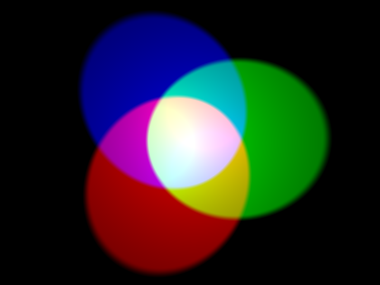
We can believe this because there are experiments which verified this. First, let's see if mixing all the colours gives white. The below diagram shows the three primary colours (Red, Yellow, Blue) being shined together onto a wall. After reflection from the wall, all three of these lights come to our eyes, and surprisingly, it appears white. Thus we can see that mixing all colours gives white colour.
But still, we can question - Are all the whites formed this way, or could there be a different white containing only a single wavelength? So now we are asking to un-mix the white light and prove that it contains many colours. This was proved using prisms.
A prism bends lights of different colours differently. This is because the refractive index of a prism (or any material) is dependent on the wavelength of light that is passing through. The law governing this says: \[\mu=A + \dfrac{B}{{\lambda}^2}+\cdot\cdot\cdot\] where $\mu$ is the refractive index and $A$, $B$ are constants.
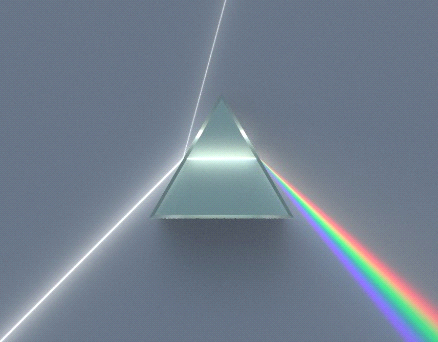
We know as a ray travels through a prism, it deviates due to refraction. Since the refractive index of a prism is different for different wavelengths, A higher wavelength light suffers least deviation than a lower wavelength light. So when white light was shined upon a prism, violet light that was present within the white deviated much more because it had the lowest wavelength and the red light deviated much less. So at the other end, we could obtain all the colours separated. This concludes why white light is not a single wavelength, but a mixture of many.
Note: You may think about the case where we get black when we mix the primary colours. What happens there is subtractive colour mixing, which occurs usually in the cases of paints, dyes etc. Here, each colour absorbs its complementary colours. So if all colours are mixed, each colour absorbs it’s complementary and in the end, no wavelength is left, making the mixture black.
Formula used
$\mu=A + \dfrac{B}{{\lambda}^2}+\cdot\cdot\cdot$
Complete step-by-step answer:
The above statement is false.
Colours like red or violet contain only a single wavelength light. But unlike them, white light contains all wavelengths of light. That means white is a mixture of all visible colours.
We can believe this because there are experiments which verified this. First, let's see if mixing all the colours gives white. The below diagram shows the three primary colours (Red, Yellow, Blue) being shined together onto a wall. After reflection from the wall, all three of these lights come to our eyes, and surprisingly, it appears white. Thus we can see that mixing all colours gives white colour.
But still, we can question - Are all the whites formed this way, or could there be a different white containing only a single wavelength? So now we are asking to un-mix the white light and prove that it contains many colours. This was proved using prisms.
A prism bends lights of different colours differently. This is because the refractive index of a prism (or any material) is dependent on the wavelength of light that is passing through. The law governing this says: \[\mu=A + \dfrac{B}{{\lambda}^2}+\cdot\cdot\cdot\] where $\mu$ is the refractive index and $A$, $B$ are constants.
We know as a ray travels through a prism, it deviates due to refraction. Since the refractive index of a prism is different for different wavelengths, A higher wavelength light suffers least deviation than a lower wavelength light. So when white light was shined upon a prism, violet light that was present within the white deviated much more because it had the lowest wavelength and the red light deviated much less. So at the other end, we could obtain all the colours separated. This concludes why white light is not a single wavelength, but a mixture of many.
Note: You may think about the case where we get black when we mix the primary colours. What happens there is subtractive colour mixing, which occurs usually in the cases of paints, dyes etc. Here, each colour absorbs its complementary colours. So if all colours are mixed, each colour absorbs it’s complementary and in the end, no wavelength is left, making the mixture black.
Recently Updated Pages
Master Class 12 Economics: Engaging Questions & Answers for Success

Master Class 12 Social Science: Engaging Questions & Answers for Success
Master Class 12 English: Engaging Questions & Answers for Success
Master Class 12 Maths: Engaging Questions & Answers for Success
Master Class 12 Physics: Engaging Questions & Answers for Success
Master Class 12 Biology: Engaging Questions & Answers for Success
Trending doubts
Draw a labelled sketch of the human eye class 12 physics CBSE
Which are the Top 10 Largest Countries of the World?
Draw ray diagrams each showing i myopic eye and ii class 12 physics CBSE
Which is the correct genotypic ratio of mendel dihybrid class 12 biology CBSE
Differentiate between homogeneous and heterogeneous class 12 chemistry CBSE
Which animal never drinks water in its entire life class 12 biology CBSE