




The volume of the tetrahedron formed by the points \[\left( {{\rm{1}},{\rm{1}},{\rm{1}}} \right),\left( {{\rm{2}},{\rm{1,3}}} \right),\left( {{\rm{3}},{\rm{2}},{\rm{2}}} \right)\] and \[\left( {{\rm{3}},{\rm{3}},{\rm{4}}} \right)\] in cubic units is
\[\begin{array}{l}A.\,\,\dfrac{5}{6}\\B.\,\,\dfrac{6}{5}\\C.\,\,5\\D.\,\,\dfrac{2}{3}\end{array}\]
Answer
 Verified
624k+ views
Hint: First assume 4 variables to give 4 points in the question. Now by difference between pairs of points, repeat it with keeping the first point in common. Find the 3 possible sides. Now you have 3 vectors from one point which form a tetrahedron. Now find the base area and height of this tetrahedron. Then substitute them into the formula of volume of tetrahedron in terms of base area B, height h, given by V: \[V{\rm{ = }}\dfrac{1}{3} \times B \times h\]
Complete step by step solution:
The 4 points given in the question, can be written in the form:
(1,1,1), (2,1,3), (3,2,2) and (3,3,4)
Let us assume first point to be denoted by A, we get it as \[{\rm{A}} = \left( {{\rm{1}},{\rm{1}},{\rm{1}}} \right)\]
Let us assume first point to be denoted by B, we get it as \[{\rm{B}} = \left( {{\rm{2}},{\rm{1}},{\rm{3}}} \right)\]
Let us assume first point to be denoted by C, we get it as \[{\rm{C}} = \left( {{\rm{3}},{\rm{2}},{\rm{2}}} \right)\]
Let us assume first point to be denoted by D, we get it as \[{\rm{D}} = \left( {{\rm{3}},{\rm{3}},{\rm{4}}} \right)\]
Now drawing tetrahedron with ABCD vertices we get it as
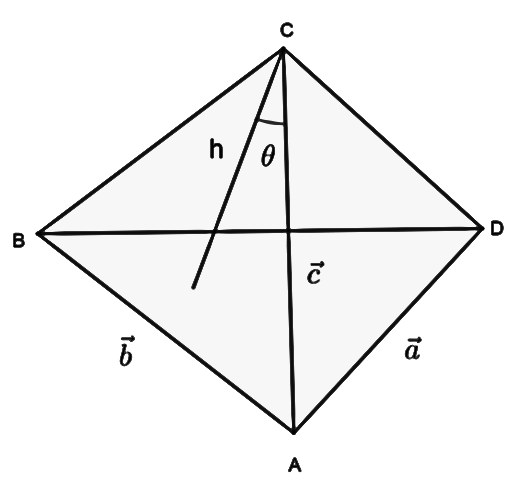
Let us assume vector \[\vec b\] is the side AB.
Let us assume vector \[\vec a\] is the side AD.
Let us assume the vector \[\vec c\] is the side AC.
Let us assume h is the height of the tetrahedron and also assume that height makes angle \[\theta \] with \[\vec c\].
By the above assumption, we can say height is written as:
\[\vec h{\rm{ = \vec c cos}}\theta \]
As the base is triangle ABD, we can write base area as:
\[Base{\rm{ area = }}\dfrac{1}{2}\left| {\vec a \times \vec b} \right|\]
By basic geometry knowledge, we know that the volume (V) is:
\[V{\rm{ = }}\dfrac{1}{3}\left( {base{\rm{ area}}} \right) \times \left( {height} \right)\]
By substituting values of base area and height, we get
\[Volume{\rm{ = }}\dfrac{1}{6}{\rm{ }}\left| {\vec a \times \vec b} \right|{\rm{ }}{\rm{. }}\left| {\vec c} \right|{\rm{ }}Cos\theta \]
The form of \[\left| a \right|{\rm{ }}\left| b \right|{\rm{ Cos}}\theta {\rm{ }}\]is written as \[\vec a{\rm{ }}{\rm{. }}\vec b\]. So, we get
\[Volume{\rm{ = }}\dfrac{1}{6}\left[ {\left( {\vec a \times \vec b} \right){\rm{ }}{\rm{. }}\vec c} \right]\]
In our question we can find sides AB, AC, AD as follows:
Side AB is found by (denote it as \[\vec b\]), we get it as:
AB = B-A
By substituting points, we get the equation as follows:
\[\vec b{\rm{ = }}\left( {2,1,3} \right) - \left( {1,1,1} \right){\rm{ = }}\left( {1,0,2} \right)\]
Similarly we know the side AC as C-A, by substituting
\[\vec c{\rm{ = }}\left( {3,2,2} \right) - \left( {1,1,1} \right){\rm{ = }}\left( {2,1,1} \right)\]
Similarly we know the side AD as D-A, by substituting
\[\vec a{\rm{ = }}\left( {3,3,4} \right) - \left( {1,1,1} \right){\rm{ = }}\left( {2,2,3} \right)\]
By substituting this into volume formula, we get it as:
\[V{\rm{ = }}\dfrac{1}{6}\left( {\left( {\bar a \times \bar b} \right){\rm{ }}{\rm{. \bar c}}} \right)\]
The above can be written as scalar triple product, we get:
\[V{\rm{ = }}\dfrac{1}{6}\left( {\begin{array}{*{20}{c}}1&0&2\\2&1&1\\2&2&3\end{array}} \right)\]
\[V = {\rm{ }}\dfrac{1}{6}\left( {1\left( {3 - 2} \right) + 0 + 2\left( {4 - 2} \right)} \right)\]
By simplifying the above, we get: \[V{\rm{ = }}\dfrac{1}{6}\left( {1 + 4} \right){\rm{ = }}\dfrac{5}{6}\]
Volume is \[\dfrac{5}{6}\] cubic units.
Therefore, option (a) is correct.
Note: Be careful while substituting the points, as that is the only main step to reach to answer. The idea of converting the given into a scalar triple product makes it a single step or else you should do a cross product and then again a dot product which is a long method. Anyways you get the same result.
Complete step by step solution:
The 4 points given in the question, can be written in the form:
(1,1,1), (2,1,3), (3,2,2) and (3,3,4)
Let us assume first point to be denoted by A, we get it as \[{\rm{A}} = \left( {{\rm{1}},{\rm{1}},{\rm{1}}} \right)\]
Let us assume first point to be denoted by B, we get it as \[{\rm{B}} = \left( {{\rm{2}},{\rm{1}},{\rm{3}}} \right)\]
Let us assume first point to be denoted by C, we get it as \[{\rm{C}} = \left( {{\rm{3}},{\rm{2}},{\rm{2}}} \right)\]
Let us assume first point to be denoted by D, we get it as \[{\rm{D}} = \left( {{\rm{3}},{\rm{3}},{\rm{4}}} \right)\]
Now drawing tetrahedron with ABCD vertices we get it as
Let us assume vector \[\vec b\] is the side AB.
Let us assume vector \[\vec a\] is the side AD.
Let us assume the vector \[\vec c\] is the side AC.
Let us assume h is the height of the tetrahedron and also assume that height makes angle \[\theta \] with \[\vec c\].
By the above assumption, we can say height is written as:
\[\vec h{\rm{ = \vec c cos}}\theta \]
As the base is triangle ABD, we can write base area as:
\[Base{\rm{ area = }}\dfrac{1}{2}\left| {\vec a \times \vec b} \right|\]
By basic geometry knowledge, we know that the volume (V) is:
\[V{\rm{ = }}\dfrac{1}{3}\left( {base{\rm{ area}}} \right) \times \left( {height} \right)\]
By substituting values of base area and height, we get
\[Volume{\rm{ = }}\dfrac{1}{6}{\rm{ }}\left| {\vec a \times \vec b} \right|{\rm{ }}{\rm{. }}\left| {\vec c} \right|{\rm{ }}Cos\theta \]
The form of \[\left| a \right|{\rm{ }}\left| b \right|{\rm{ Cos}}\theta {\rm{ }}\]is written as \[\vec a{\rm{ }}{\rm{. }}\vec b\]. So, we get
\[Volume{\rm{ = }}\dfrac{1}{6}\left[ {\left( {\vec a \times \vec b} \right){\rm{ }}{\rm{. }}\vec c} \right]\]
In our question we can find sides AB, AC, AD as follows:
Side AB is found by (denote it as \[\vec b\]), we get it as:
AB = B-A
By substituting points, we get the equation as follows:
\[\vec b{\rm{ = }}\left( {2,1,3} \right) - \left( {1,1,1} \right){\rm{ = }}\left( {1,0,2} \right)\]
Similarly we know the side AC as C-A, by substituting
\[\vec c{\rm{ = }}\left( {3,2,2} \right) - \left( {1,1,1} \right){\rm{ = }}\left( {2,1,1} \right)\]
Similarly we know the side AD as D-A, by substituting
\[\vec a{\rm{ = }}\left( {3,3,4} \right) - \left( {1,1,1} \right){\rm{ = }}\left( {2,2,3} \right)\]
By substituting this into volume formula, we get it as:
\[V{\rm{ = }}\dfrac{1}{6}\left( {\left( {\bar a \times \bar b} \right){\rm{ }}{\rm{. \bar c}}} \right)\]
The above can be written as scalar triple product, we get:
\[V{\rm{ = }}\dfrac{1}{6}\left( {\begin{array}{*{20}{c}}1&0&2\\2&1&1\\2&2&3\end{array}} \right)\]
\[V = {\rm{ }}\dfrac{1}{6}\left( {1\left( {3 - 2} \right) + 0 + 2\left( {4 - 2} \right)} \right)\]
By simplifying the above, we get: \[V{\rm{ = }}\dfrac{1}{6}\left( {1 + 4} \right){\rm{ = }}\dfrac{5}{6}\]
Volume is \[\dfrac{5}{6}\] cubic units.
Therefore, option (a) is correct.
Note: Be careful while substituting the points, as that is the only main step to reach to answer. The idea of converting the given into a scalar triple product makes it a single step or else you should do a cross product and then again a dot product which is a long method. Anyways you get the same result.
Recently Updated Pages
Master Class 12 Business Studies: Engaging Questions & Answers for Success

Master Class 12 Biology: Engaging Questions & Answers for Success
Master Class 12 Chemistry: Engaging Questions & Answers for Success
Class 12 Question and Answer - Your Ultimate Solutions Guide
Master Class 11 Social Science: Engaging Questions & Answers for Success
Master Class 11 English: Engaging Questions & Answers for Success
Trending doubts
Which are the Top 10 Largest Countries of the World?
Draw a labelled sketch of the human eye class 12 physics CBSE
Differentiate between homogeneous and heterogeneous class 12 chemistry CBSE
Sulphuric acid is known as the king of acids State class 12 chemistry CBSE
Why is the cell called the structural and functional class 12 biology CBSE
Which is the correct genotypic ratio of mendel dihybrid class 12 biology CBSE