




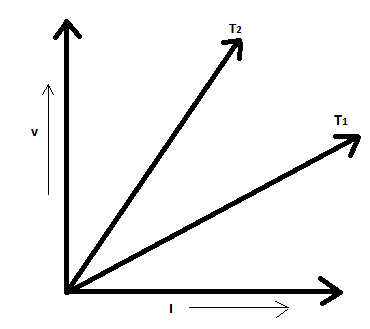
The voltage-current $ \left( {V - I} \right) $ graph of a metallic conductor at two different temperatures $ {T_1} $ and $ {T_2} $ is shown below. At which temperature is the resistance higher?
Answer
 Verified
599.4k+ views
Hint: We need to state Ohm’s Law along with its formula. Using the formula for the Ohm’s law, we can find the line which has a greater slope to solve this problem.
Formula used: The following formulas are used to solve this question.
$ R = \dfrac{V}{I} $ where $ R $ is the resistance, $ V $ is the potential difference and $ I $ is the current.
Complete step by step solution:
According to Ohm’s Law, potential difference across a metallic conductor is proportional to the current flowing through it. This statement requires all physical conditions and temperature to remain constant.
$ V\alpha I $ where $ V $ is the potential difference and $ I $ is the current.
It can be written that, $ V = IR $ where $ R $ is the resistance, $ V $ is the potential difference and $ I $ is the current.
$ \Rightarrow R = \dfrac{V}{I} $ .
Now the graph for $ V $ against $ I $ shall be a straight line since they are directly proportional, but the proportionality constant $ R $ is different for the same conductors at the same temperature.
For a straight line in the X-Y coordinate axis, the slope of the line is given by,
Slope $ m = \dfrac{{\Delta y}}{{\Delta x}} = \dfrac{{{y_2} - {y_1}}}{{{x_2} - {x_1}}} $ where $ {{\text{y}}_{\text{2}}} $ and $ {{\text{y}}_{\text{1}}} $ are two points on the $ y $ -axis while, $ {x_2} $ and $ {x_1} $ are two points on the $ x $ -axis.
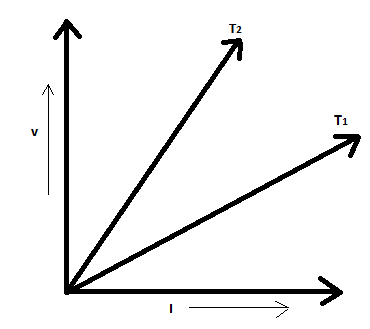
In the given figure, the voltage $ V $ and current $ I $ graph for a conductor at two different temperatures $ {T_1} $ and $ {T_2} $ are shown.
The value of slope of the lines will be given the formula,
$ m = \dfrac{{\Delta V}}{{\Delta I}} $ .
As said earlier, according to Ohm’s Law,
$ \dfrac{{\Delta V}}{{\Delta I}} = R $ where $ R $ is the resistance.
Thus, the slope of the line is equal to its resistance.
$ \therefore $ The resistance of the conductor will be higher for the curve which has a greater slope. Since the $ {T_1} $ curve has a greater slope, it has greater resistance.
Note:
Ohm's law is an empirical relation which accurately describes the conductivity of the vast majority of electrically conductive materials over many orders of magnitude of current.
However some materials, such as computers, telephones, do not obey Ohm's law, these are called non-Ohmic.
Formula used: The following formulas are used to solve this question.
$ R = \dfrac{V}{I} $ where $ R $ is the resistance, $ V $ is the potential difference and $ I $ is the current.
Complete step by step solution:
According to Ohm’s Law, potential difference across a metallic conductor is proportional to the current flowing through it. This statement requires all physical conditions and temperature to remain constant.
$ V\alpha I $ where $ V $ is the potential difference and $ I $ is the current.
It can be written that, $ V = IR $ where $ R $ is the resistance, $ V $ is the potential difference and $ I $ is the current.
$ \Rightarrow R = \dfrac{V}{I} $ .
Now the graph for $ V $ against $ I $ shall be a straight line since they are directly proportional, but the proportionality constant $ R $ is different for the same conductors at the same temperature.
For a straight line in the X-Y coordinate axis, the slope of the line is given by,
Slope $ m = \dfrac{{\Delta y}}{{\Delta x}} = \dfrac{{{y_2} - {y_1}}}{{{x_2} - {x_1}}} $ where $ {{\text{y}}_{\text{2}}} $ and $ {{\text{y}}_{\text{1}}} $ are two points on the $ y $ -axis while, $ {x_2} $ and $ {x_1} $ are two points on the $ x $ -axis.
In the given figure, the voltage $ V $ and current $ I $ graph for a conductor at two different temperatures $ {T_1} $ and $ {T_2} $ are shown.
The value of slope of the lines will be given the formula,
$ m = \dfrac{{\Delta V}}{{\Delta I}} $ .
As said earlier, according to Ohm’s Law,
$ \dfrac{{\Delta V}}{{\Delta I}} = R $ where $ R $ is the resistance.
Thus, the slope of the line is equal to its resistance.
$ \therefore $ The resistance of the conductor will be higher for the curve which has a greater slope. Since the $ {T_1} $ curve has a greater slope, it has greater resistance.
Note:
Ohm's law is an empirical relation which accurately describes the conductivity of the vast majority of electrically conductive materials over many orders of magnitude of current.
However some materials, such as computers, telephones, do not obey Ohm's law, these are called non-Ohmic.
Recently Updated Pages
Master Class 12 Economics: Engaging Questions & Answers for Success

Master Class 12 English: Engaging Questions & Answers for Success
Master Class 12 Social Science: Engaging Questions & Answers for Success
Master Class 12 Maths: Engaging Questions & Answers for Success
Master Class 12 Physics: Engaging Questions & Answers for Success
Master Class 12 Business Studies: Engaging Questions & Answers for Success
Trending doubts
Which are the Top 10 Largest Countries of the World?
Draw a labelled sketch of the human eye class 12 physics CBSE
Differentiate between homogeneous and heterogeneous class 12 chemistry CBSE
Sulphuric acid is known as the king of acids State class 12 chemistry CBSE
Why is the cell called the structural and functional class 12 biology CBSE
Draw ray diagrams each showing i myopic eye and ii class 12 physics CBSE