




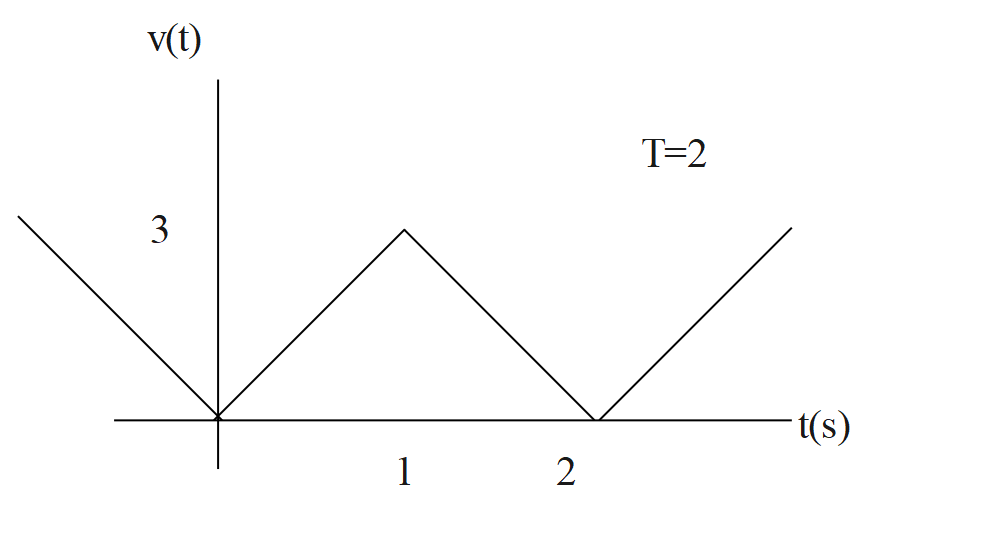
The voltage shown in the figure is known as a triangular waveform. Determine the rms value.
Answer
 Verified
594k+ views
Hint: Write the formula for the rms value of the wave form. The time taken for one complete cycle is given and the maximum voltages reached by the waveform will be taken from the graph. Also, the cycle is repeating, therefore, the rms value can be calculated for one cycle and it is the same and constant for all the other cycles.
Formula used:
${{V}_{rms}}=\sqrt{\dfrac{\int{{{v}^{2}}dt}}{\int{dt}}}$
Complete step by step answer:
Let us write down the given terms and quantities form the graph,
$\begin{align}
& {{V}_{\max }}=3V \\
& T=2\sec \\
\end{align}$
Now, the term in the formula $\int{{{v}^{2}}dt}$can be found by finding the area of one cycle
Therefore, let's find the area of one cycle in the waveform,
$\begin{align}
& \int{{{v}^{2}}dt}=2\times \dfrac{1}{2}\times 2\times 3 \\
& \Rightarrow \int{{{v}^{2}}dt}=9 \\
\end{align}$
The time period of the cycle can be obtained from the graph as t=2sec.
Therefore, substituting these into the formula we get,
$\begin{align}
& {{V}_{rms}}=\sqrt{\dfrac{9}{2}} \\
& \Rightarrow {{V}_{rms}}=\dfrac{3}{\sqrt{2}} \\
\end{align}$
Therefore, we can find the rms value of the waveform in this way.
Additional information:
The term “rms” stands for “root-mean-squared”. Most books define this as the “amount of ac power that produces the same heating effect as an equivalent dc power”, or something similar along these lines, but an rms value is more than just that. The rms value is the square root of the mean (average) value of the squared function of the instantaneous values. The symbols used for defining an rms value are ${{V}_{rms}}$ or ${{I}_{rms}}$. Rms (root mean square) value is defined based on the heating effect of wave-forms. The value at which heat dissipated in the ac circuit is the same as the heat dissipated in the dc circuit is called rms value, provided both ac and dc circuits have equal value of resistance and operate for the same time.
Note:
The rms voltage which is also referred to as the effective value depends on the magnitude of the waveform and the rms voltage is not a function of either of the waveform’s frequency nor its phase angle.
Formula used:
${{V}_{rms}}=\sqrt{\dfrac{\int{{{v}^{2}}dt}}{\int{dt}}}$
Complete step by step answer:
Let us write down the given terms and quantities form the graph,
$\begin{align}
& {{V}_{\max }}=3V \\
& T=2\sec \\
\end{align}$
Now, the term in the formula $\int{{{v}^{2}}dt}$can be found by finding the area of one cycle
Therefore, let's find the area of one cycle in the waveform,
$\begin{align}
& \int{{{v}^{2}}dt}=2\times \dfrac{1}{2}\times 2\times 3 \\
& \Rightarrow \int{{{v}^{2}}dt}=9 \\
\end{align}$
The time period of the cycle can be obtained from the graph as t=2sec.
Therefore, substituting these into the formula we get,
$\begin{align}
& {{V}_{rms}}=\sqrt{\dfrac{9}{2}} \\
& \Rightarrow {{V}_{rms}}=\dfrac{3}{\sqrt{2}} \\
\end{align}$
Therefore, we can find the rms value of the waveform in this way.
Additional information:
The term “rms” stands for “root-mean-squared”. Most books define this as the “amount of ac power that produces the same heating effect as an equivalent dc power”, or something similar along these lines, but an rms value is more than just that. The rms value is the square root of the mean (average) value of the squared function of the instantaneous values. The symbols used for defining an rms value are ${{V}_{rms}}$ or ${{I}_{rms}}$. Rms (root mean square) value is defined based on the heating effect of wave-forms. The value at which heat dissipated in the ac circuit is the same as the heat dissipated in the dc circuit is called rms value, provided both ac and dc circuits have equal value of resistance and operate for the same time.
Note:
The rms voltage which is also referred to as the effective value depends on the magnitude of the waveform and the rms voltage is not a function of either of the waveform’s frequency nor its phase angle.
Recently Updated Pages
Three beakers labelled as A B and C each containing 25 mL of water were taken A small amount of NaOH anhydrous CuSO4 and NaCl were added to the beakers A B and C respectively It was observed that there was an increase in the temperature of the solutions contained in beakers A and B whereas in case of beaker C the temperature of the solution falls Which one of the following statements isarecorrect i In beakers A and B exothermic process has occurred ii In beakers A and B endothermic process has occurred iii In beaker C exothermic process has occurred iv In beaker C endothermic process has occurred

Master Class 12 Social Science: Engaging Questions & Answers for Success
Master Class 12 Physics: Engaging Questions & Answers for Success
Master Class 12 Maths: Engaging Questions & Answers for Success
Master Class 12 Economics: Engaging Questions & Answers for Success
Master Class 12 Chemistry: Engaging Questions & Answers for Success
Three beakers labelled as A B and C each containing 25 mL of water were taken A small amount of NaOH anhydrous CuSO4 and NaCl were added to the beakers A B and C respectively It was observed that there was an increase in the temperature of the solutions contained in beakers A and B whereas in case of beaker C the temperature of the solution falls Which one of the following statements isarecorrect i In beakers A and B exothermic process has occurred ii In beakers A and B endothermic process has occurred iii In beaker C exothermic process has occurred iv In beaker C endothermic process has occurred
Master Class 12 Social Science: Engaging Questions & Answers for Success
Master Class 12 Physics: Engaging Questions & Answers for Success
Trending doubts
Which are the Top 10 Largest Countries of the World?
Draw a labelled sketch of the human eye class 12 physics CBSE
Explain the structure of megasporangium class 12 biology CBSE
What are the major means of transport Explain each class 12 social science CBSE
Differentiate between homogeneous and heterogeneous class 12 chemistry CBSE
Sulphuric acid is known as the king of acids State class 12 chemistry CBSE