




The voltage drop across a forward biased diode is $0.7\,V$ In the following circuit, the voltage across the $10\Omega $ resistance in series with the diode and $20\Omega $ resistance are,
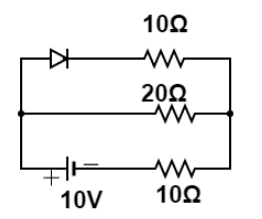
A. $0.70V,4.28V$
B. $3.58V,4.28V$
C. $5.35V,2.14V$
D $3.58V,9.3V$
Answer
 Verified
531k+ views
Hint: In order to solve this question we have to understand diodes. Diodes are actually a combination of two different types of semiconductor, one is p-type and other is n-type semiconductor. Since electrons are the majority charge carrier in n-type semiconductor whereas holes are majority in p-type semiconductor.
Complete step by step answer:
So due to concentration gradient electrons move towards p side and holes move toward n side, hence a region of immobile ions created around junction is known as depletion region in which electric field is from n side to p side. So when diode is forward bias means p side connected to positive side of voltage an n to negative, Electric field starts building from p side to n side and eventually current starts to flow inside diode.
So to solve this circuit, we know an ideal diode in forward bias behaves as a closed circuit so it is replaced by a wire while a non-ideal diode is replaced by some voltage difference generated across it. So in this circuit diode is replaced by $0.7V$ battery and let total current be “i” from $10V$ battery distributed in circuit as shown
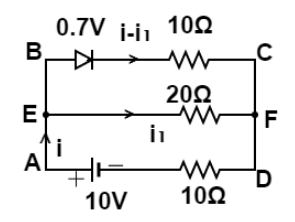
So applying Kirchhoff’s law in loop ABCDA we get,
$0.7 + 10(i - {i_1}) + 10i - 10 = 0$
$\Rightarrow 20i - 10{i_1} = 9.3$
$\Rightarrow 2i - i{{\kern 1pt} _1} = 0.93 \to (i)$
Applying Kirchhoff’s law in loop AEFDA we get,
$20{i_1} + 10i - 10 = 0$
$\Rightarrow 20{i_1} + 10i = 10$
$\Rightarrow i + 2{i_1} = 1 \to (ii)$
Now, Multiply first equation by two and add second equation as $(i) \times 2 + (ii)$ we get
$5i = 2.86$
$\Rightarrow i = 0.572A$
Putting the value of “i” in equation (i). We get,
${i_1} = 2(0.572) - 0.93$
$\Rightarrow {i_1} = 0.214A$
So Voltage drop across $10\Omega $ resistance in series with diode is,
${V_1} = 10 \times (i - {i_1})$
Putting values we get,
${V_1} = 10 \times (0.572 - 0.214)$
$\Rightarrow {V_1} = 3.58V$
Similarly voltage across $20\Omega $ resistance is, ${V_2} = 20{i_i}$
Putting values we get, ${V_2} = 20 \times 0.214$
$\therefore {V_2} = 4.28V$
So, the correct option is B.
Note: It should be remembered that Kirchhoff’s law is conservation law. First law states that there should not be accumulation of charges at the junction so at the junction current remains continuous and this is supported by the equation of continuity. Second law states that total voltage drop across the loop is zero so as to verify tellangan’s theorem of power dissipation.
Complete step by step answer:
So due to concentration gradient electrons move towards p side and holes move toward n side, hence a region of immobile ions created around junction is known as depletion region in which electric field is from n side to p side. So when diode is forward bias means p side connected to positive side of voltage an n to negative, Electric field starts building from p side to n side and eventually current starts to flow inside diode.
So to solve this circuit, we know an ideal diode in forward bias behaves as a closed circuit so it is replaced by a wire while a non-ideal diode is replaced by some voltage difference generated across it. So in this circuit diode is replaced by $0.7V$ battery and let total current be “i” from $10V$ battery distributed in circuit as shown
So applying Kirchhoff’s law in loop ABCDA we get,
$0.7 + 10(i - {i_1}) + 10i - 10 = 0$
$\Rightarrow 20i - 10{i_1} = 9.3$
$\Rightarrow 2i - i{{\kern 1pt} _1} = 0.93 \to (i)$
Applying Kirchhoff’s law in loop AEFDA we get,
$20{i_1} + 10i - 10 = 0$
$\Rightarrow 20{i_1} + 10i = 10$
$\Rightarrow i + 2{i_1} = 1 \to (ii)$
Now, Multiply first equation by two and add second equation as $(i) \times 2 + (ii)$ we get
$5i = 2.86$
$\Rightarrow i = 0.572A$
Putting the value of “i” in equation (i). We get,
${i_1} = 2(0.572) - 0.93$
$\Rightarrow {i_1} = 0.214A$
So Voltage drop across $10\Omega $ resistance in series with diode is,
${V_1} = 10 \times (i - {i_1})$
Putting values we get,
${V_1} = 10 \times (0.572 - 0.214)$
$\Rightarrow {V_1} = 3.58V$
Similarly voltage across $20\Omega $ resistance is, ${V_2} = 20{i_i}$
Putting values we get, ${V_2} = 20 \times 0.214$
$\therefore {V_2} = 4.28V$
So, the correct option is B.
Note: It should be remembered that Kirchhoff’s law is conservation law. First law states that there should not be accumulation of charges at the junction so at the junction current remains continuous and this is supported by the equation of continuity. Second law states that total voltage drop across the loop is zero so as to verify tellangan’s theorem of power dissipation.
Recently Updated Pages
Master Class 12 Business Studies: Engaging Questions & Answers for Success

Master Class 12 Biology: Engaging Questions & Answers for Success
Master Class 12 Chemistry: Engaging Questions & Answers for Success
Class 12 Question and Answer - Your Ultimate Solutions Guide
Master Class 11 Social Science: Engaging Questions & Answers for Success
Master Class 11 English: Engaging Questions & Answers for Success
Trending doubts
Ribosomal RNA is actively synthesised in A Nucleoplasm class 12 biology CBSE
In a transcription unit the promoter is said to be class 12 biology CBSE
Verhulst Pearl logistic growth described by the equation class 12 biology CBSE
Give reasons for the following Aquatic animals are class 12 chemistry CBSE
A foreign DNA is inserted and lighted at BamHI site class 12 biology CBSE
A human protein that is obtained from transgenic animals class 12 biology CBSE