




The vectors, vector AB = 3i + 4k and vector AC = 5i - 2j + 4k are the sides of a triangle ABC. The length of the median through A is
(a) \[\sqrt {72} \]
(b) \[\sqrt {33} \]
(c) \[\sqrt {288} \]
(d) \[\sqrt {18} \]
Answer
 Verified
528k+ views
Hint: Here, we will draw the figure and take point D as the mid-point between point B and point C of the given triangle ABC where we take A as the origin. Since, a median of the triangle divides the opposite side into two equal parts. Thus, using this formula we will find the median i.e. AD value. Lastly, by substituting the values in the formula of the length of the median to get the final output.
Complete step by step solution:
Given that, we have a triangle ABC.
Let us take point A as the origin i.e. A (0, 0)
The vectors given are as below:
First, the \[\overrightarrow {AB} \] is equal to the position vector of \[\overrightarrow B \].
\[\therefore \overrightarrow {AB} = 3i + 4k\]
So, the coordinate of B is (3, 0, 4).
Next, the \[\overrightarrow {AC} \] is equal to the position vector of \[\overrightarrow C \].
\[\therefore \overrightarrow {AC} = 5i - 2j + 4k\]
So, the coordinate of C is (5, -2, 4).
Since, a line segment that joins any vertex of the triangle and the mid-point of its opposite side is called a median.
According to the given information, the figure is drawn as below:
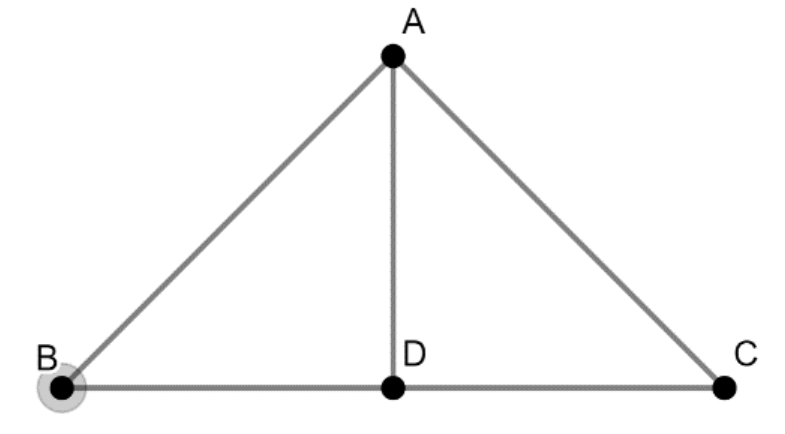
Thus, the position vector of midpoint of \[\overrightarrow B \] and \[\overrightarrow C \] is \[\overrightarrow D \].
\[\therefore \overrightarrow D = \dfrac{{\overrightarrow {AB} + \overrightarrow {AC} }}{2}\]
Substituting the given values, we will get,
\[ \Rightarrow \overrightarrow D = (\dfrac{{3 + 5}}{2})\widehat i + (\dfrac{{0 - 2}}{2})\widehat j + (\dfrac{{4 + 4}}{2})\widehat k\]
On evaluating this, we will get,
\[ \Rightarrow \overrightarrow D = 4\widehat i - \widehat j + 4\widehat k\]
So, the midpoint of BC can be easily found by the midpoint formula of two points as D (4, -1, 4).
Thus, the value of the median is:
\[\overrightarrow {AD} = 4\widehat i - \widehat j + 4\widehat k\]
Now, the length of the median through A is \[\sqrt {33} \].
\[\left| {AD} \right|\]
\[ = \sqrt {{{(4 - 0)}^2} + {{( - 1 - 0)}^2} + {{(4 - 0)}^2}} \]
Removing the bracket, we will get,
\[ = \sqrt {{4^2} + {{( - 1)}^2} + {4^2}} \]
On evaluating this above expression, we will get,
\[ = \sqrt {16 + 1 + 16} \]
\[ = \sqrt {33} \]
Hence, the length of the median is $\sqrt {33}$. So, option (B) is correct.
Note:
This question would become easy to solve if you notice the similarity between parallelogram law of vector addition and the fact that the diagonal represents the resultant vector and also the diagonals bisects each other. Let us assume the resultant of vector AC and AB is vector AD. As we know diagonals bisect each other. Hence half of the resultant vector AD will be the median for side BC.
Complete step by step solution:
Given that, we have a triangle ABC.
Let us take point A as the origin i.e. A (0, 0)
The vectors given are as below:
First, the \[\overrightarrow {AB} \] is equal to the position vector of \[\overrightarrow B \].
\[\therefore \overrightarrow {AB} = 3i + 4k\]
So, the coordinate of B is (3, 0, 4).
Next, the \[\overrightarrow {AC} \] is equal to the position vector of \[\overrightarrow C \].
\[\therefore \overrightarrow {AC} = 5i - 2j + 4k\]
So, the coordinate of C is (5, -2, 4).
Since, a line segment that joins any vertex of the triangle and the mid-point of its opposite side is called a median.
According to the given information, the figure is drawn as below:
Thus, the position vector of midpoint of \[\overrightarrow B \] and \[\overrightarrow C \] is \[\overrightarrow D \].
\[\therefore \overrightarrow D = \dfrac{{\overrightarrow {AB} + \overrightarrow {AC} }}{2}\]
Substituting the given values, we will get,
\[ \Rightarrow \overrightarrow D = (\dfrac{{3 + 5}}{2})\widehat i + (\dfrac{{0 - 2}}{2})\widehat j + (\dfrac{{4 + 4}}{2})\widehat k\]
On evaluating this, we will get,
\[ \Rightarrow \overrightarrow D = 4\widehat i - \widehat j + 4\widehat k\]
So, the midpoint of BC can be easily found by the midpoint formula of two points as D (4, -1, 4).
Thus, the value of the median is:
\[\overrightarrow {AD} = 4\widehat i - \widehat j + 4\widehat k\]
Now, the length of the median through A is \[\sqrt {33} \].
\[\left| {AD} \right|\]
\[ = \sqrt {{{(4 - 0)}^2} + {{( - 1 - 0)}^2} + {{(4 - 0)}^2}} \]
Removing the bracket, we will get,
\[ = \sqrt {{4^2} + {{( - 1)}^2} + {4^2}} \]
On evaluating this above expression, we will get,
\[ = \sqrt {16 + 1 + 16} \]
\[ = \sqrt {33} \]
Hence, the length of the median is $\sqrt {33}$. So, option (B) is correct.
Note:
This question would become easy to solve if you notice the similarity between parallelogram law of vector addition and the fact that the diagonal represents the resultant vector and also the diagonals bisects each other. Let us assume the resultant of vector AC and AB is vector AD. As we know diagonals bisect each other. Hence half of the resultant vector AD will be the median for side BC.
Recently Updated Pages
Master Class 12 Business Studies: Engaging Questions & Answers for Success

Master Class 12 Chemistry: Engaging Questions & Answers for Success
Master Class 12 Biology: Engaging Questions & Answers for Success
Class 12 Question and Answer - Your Ultimate Solutions Guide
Master Class 11 English: Engaging Questions & Answers for Success
Master Class 11 Maths: Engaging Questions & Answers for Success
Trending doubts
Which is more stable and why class 12 chemistry CBSE
Which are the Top 10 Largest Countries of the World?
Draw a labelled sketch of the human eye class 12 physics CBSE
Differentiate between homogeneous and heterogeneous class 12 chemistry CBSE
What are the major means of transport Explain each class 12 social science CBSE
Sulphuric acid is known as the king of acids State class 12 chemistry CBSE