




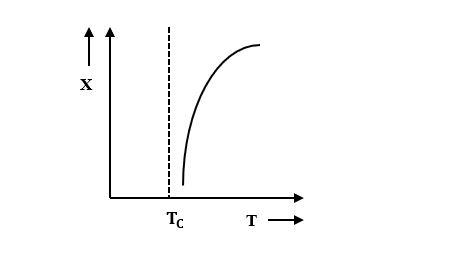
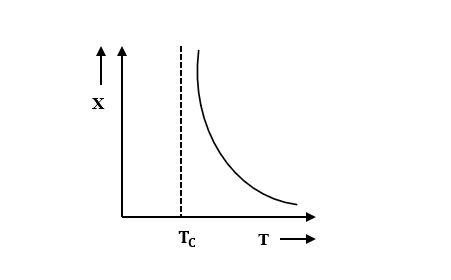
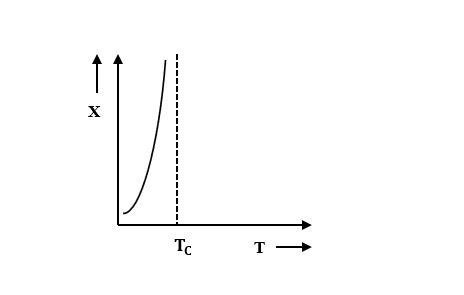
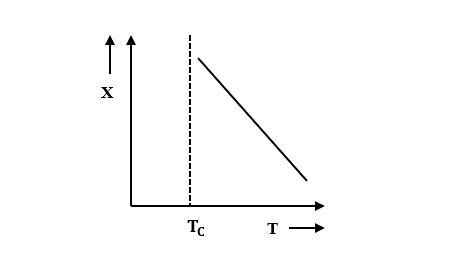
The variation of magnetic susceptibility with the temperature of a ferromagnetic material can be plotted as?
A.
B.
C.
D.
Answer
 Verified
636.3k+ views
Hint: To answer this question, use the Curie-Weiss law, which gives the relationship between magnetic susceptibility, Curie temperature and the absolute temperature. This relationship shows that as the temperature increases, magnetic susceptibility decreases but it does not decrease linearly. Use this information to find the variation in magnetic susceptibility with temperature.
Formula used:
$\chi= \dfrac {C}{T- {T}_{C}}$
Complete step by step answer:
The magnetic susceptibility of a ferromagnetic material in paramagnetic region is given by,
$\chi= \dfrac {C}{T- {T}_{C}}$ …(1)
Where, $\chi$ is the magnetic susceptibility of a material
C is the material-specific Curie constant
T is the absolute temperature measured in Kelvin
${T}_{C}$ is the Curie temperature measured in Kelvin
From the equation. (1), it can be inferred that $\chi$ is inversely proportional to the absolute temperature. This implies as the temperature increases magnetic susceptibility of the material decreases. But it does not decrease linearly. It shows a rectangular hyperbola-like relation. Thus, magnetic $\chi$ vs T forms a hyperbola graph. The law predicts a singularity in the susceptibility at $T={T}_{C}$.
So, the correct answer is “Option B”.
Note:
Students must remember that the diamagnetic materials have negative susceptibility i.e. $\chi < 0$. Whereas the paramagnetic, superparamagnetic and ferromagnetic materials have positive susceptibilities i.e. $\chi > 0$. The temperature above ${T}_{c}$ a ferromagnetic material becomes paramagnetic. Below the Curie temperature, the dipoles of a ferromagnetic material are ordered whereas above the Curie temperature, the dipoles are disordered. Students must keep in mind that the ferromagnetic materials such as iron and cobalt do not have constant susceptibilities. For a diamagnetic material, the magnetic susceptibility is independent of the temperature.
Formula used:
$\chi= \dfrac {C}{T- {T}_{C}}$
Complete step by step answer:
The magnetic susceptibility of a ferromagnetic material in paramagnetic region is given by,
$\chi= \dfrac {C}{T- {T}_{C}}$ …(1)
Where, $\chi$ is the magnetic susceptibility of a material
C is the material-specific Curie constant
T is the absolute temperature measured in Kelvin
${T}_{C}$ is the Curie temperature measured in Kelvin
From the equation. (1), it can be inferred that $\chi$ is inversely proportional to the absolute temperature. This implies as the temperature increases magnetic susceptibility of the material decreases. But it does not decrease linearly. It shows a rectangular hyperbola-like relation. Thus, magnetic $\chi$ vs T forms a hyperbola graph. The law predicts a singularity in the susceptibility at $T={T}_{C}$.
So, the correct answer is “Option B”.
Note:
Students must remember that the diamagnetic materials have negative susceptibility i.e. $\chi < 0$. Whereas the paramagnetic, superparamagnetic and ferromagnetic materials have positive susceptibilities i.e. $\chi > 0$. The temperature above ${T}_{c}$ a ferromagnetic material becomes paramagnetic. Below the Curie temperature, the dipoles of a ferromagnetic material are ordered whereas above the Curie temperature, the dipoles are disordered. Students must keep in mind that the ferromagnetic materials such as iron and cobalt do not have constant susceptibilities. For a diamagnetic material, the magnetic susceptibility is independent of the temperature.
Recently Updated Pages
Explain the structure of megasporangium class 12 biology CBSE

Why is chloroform kept in dark coloured bottles class 12 chemistry CBSE
Derive the balancing condition of a Wheatstone bri class 12 physics CBSE
Draw VI characteristics of a pn junction diode Explain class 12 physics CBSE
Is it possible to carry pride in ones language too class 12 english CBSE
In a population at Hardy Weinberg equilibrium the allele class 12 biology CBSE
Trending doubts
Draw a labelled sketch of the human eye class 12 physics CBSE
Which are the Top 10 Largest Countries of the World?
Draw ray diagrams each showing i myopic eye and ii class 12 physics CBSE
Which is the correct genotypic ratio of mendel dihybrid class 12 biology CBSE
Differentiate between homogeneous and heterogeneous class 12 chemistry CBSE
Which animal never drinks water in its entire life class 12 biology CBSE