




The values of $\alpha $ for which the point $\left( {\alpha - 1,\alpha + 1} \right)$ lies in the larger segment of the circle ${x^2} + {y^2} - x - y - 6 = 0$ made by the chord whose equation is x + y - 2 = 0 is
(a). -1 < $\alpha $ < 1
(b). 1 < $\alpha $< $\infty $
(c). -$\infty $ < $\alpha $< -1
(d). $\alpha \leqslant 0$
Answer
 Verified
595.2k+ views
Hint: Using the given information from the question we can find the range of$\alpha $. That is substituting the given point in the equation of the circle, as the point lies on the circle. Using the condition that the point and the centre of the circle must have the same sign, we can get the values of $\alpha $. Using the inequalities we get, together we can form the value of $\alpha $.
Complete step-by-step answer:
The given circle S(x, y)$ \equiv $ ${x^2} + {y^2} - x - y - 6 = 0$
On comparing the given equation with ${x^2} + {y^2} + 2gx + 2fy + c = 0$
We can decide 2g = -1 and 2f = -1 and c =-6
$ \Rightarrow g = - \dfrac{1}{2}$
$ \Rightarrow f = - \dfrac{1}{2}$
To find the centre of the circle, we have C = (-g, -f)
Centre at C$ \equiv $$\left( { - \left( { - \dfrac{1}{2}} \right), - \left( { - \dfrac{1}{2}} \right)} \right)$$ = \left( {\dfrac{1}{2},\dfrac{1}{2}} \right)$
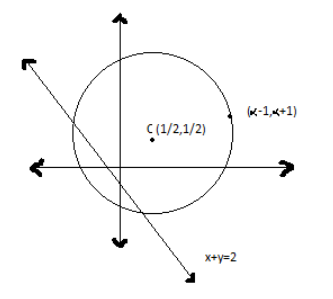
According to the given conditions, the given point P $\left( {\alpha - 1,\alpha + 1} \right)$ must lie inside the given circle.
i.e., S $\left( {\alpha - 1,\alpha + 1} \right) < 0$
That is, substitute the point in the given equation of circle ${x^2} + {y^2} - x - y - 6 = 0$
$ \Rightarrow {\left( {\alpha - 1} \right)^2} + {\left( {\alpha + 1} \right)^2} - \left( {\alpha - 1} \right) - \left( {\alpha + 1} \right) - 6 < 0$
$ \Rightarrow {\alpha ^2} - \alpha - 2 < 0$
$ \Rightarrow \left( {\alpha - 2} \right)\left( {\alpha + 1} \right) < 0$
$ \Rightarrow - 1 < \alpha < 2$… (2)
[Using sign-scheme from algebra]
And also Point P and Centre C must lie on the same side of the line.
Locus L(x, y) = x + y -2 = 0 … (3)
Locus: A shape created by the set of points whose points satisfies a given set of rules.
i.e., L $\left( {\dfrac{1}{2},\dfrac{1}{2}} \right)$and L$\left( {\alpha - 2} \right)\left( {\alpha + 1} \right)$ must have same sign.
Now, since L $\left( {\dfrac{1}{2},\dfrac{1}{2}} \right)$=$\dfrac{1}{2}$+$\dfrac{1}{2}$- 2 < 0
Therefore, we have
L$\left( {\alpha - 2} \right)\left( {\alpha + 1} \right)$=$\left( {\alpha - 1} \right) + (\alpha + 1) - 2 < 0$
$ \Rightarrow \alpha < 1$… (4)
Inequalities (2) and (4) together give the permissible values of $\alpha $ as -1 < $\alpha $< 1
Note: Instead of asking the value of $\alpha $, we might be asked to find the number of integrals of $\alpha $. Then the solution or the integral value will be 0 and 1. Therefore the number of integral values will be 2. We can solve this by using graphical methods. We can plot and separate the integral points satisfying both the equations.
Complete step-by-step answer:
The given circle S(x, y)$ \equiv $ ${x^2} + {y^2} - x - y - 6 = 0$
On comparing the given equation with ${x^2} + {y^2} + 2gx + 2fy + c = 0$
We can decide 2g = -1 and 2f = -1 and c =-6
$ \Rightarrow g = - \dfrac{1}{2}$
$ \Rightarrow f = - \dfrac{1}{2}$
To find the centre of the circle, we have C = (-g, -f)
Centre at C$ \equiv $$\left( { - \left( { - \dfrac{1}{2}} \right), - \left( { - \dfrac{1}{2}} \right)} \right)$$ = \left( {\dfrac{1}{2},\dfrac{1}{2}} \right)$
According to the given conditions, the given point P $\left( {\alpha - 1,\alpha + 1} \right)$ must lie inside the given circle.
i.e., S $\left( {\alpha - 1,\alpha + 1} \right) < 0$
That is, substitute the point in the given equation of circle ${x^2} + {y^2} - x - y - 6 = 0$
$ \Rightarrow {\left( {\alpha - 1} \right)^2} + {\left( {\alpha + 1} \right)^2} - \left( {\alpha - 1} \right) - \left( {\alpha + 1} \right) - 6 < 0$
$ \Rightarrow {\alpha ^2} - \alpha - 2 < 0$
$ \Rightarrow \left( {\alpha - 2} \right)\left( {\alpha + 1} \right) < 0$
$ \Rightarrow - 1 < \alpha < 2$… (2)
[Using sign-scheme from algebra]
And also Point P and Centre C must lie on the same side of the line.
Locus L(x, y) = x + y -2 = 0 … (3)
Locus: A shape created by the set of points whose points satisfies a given set of rules.
i.e., L $\left( {\dfrac{1}{2},\dfrac{1}{2}} \right)$and L$\left( {\alpha - 2} \right)\left( {\alpha + 1} \right)$ must have same sign.
Now, since L $\left( {\dfrac{1}{2},\dfrac{1}{2}} \right)$=$\dfrac{1}{2}$+$\dfrac{1}{2}$- 2 < 0
Therefore, we have
L$\left( {\alpha - 2} \right)\left( {\alpha + 1} \right)$=$\left( {\alpha - 1} \right) + (\alpha + 1) - 2 < 0$
$ \Rightarrow \alpha < 1$… (4)
Inequalities (2) and (4) together give the permissible values of $\alpha $ as -1 < $\alpha $< 1
Note: Instead of asking the value of $\alpha $, we might be asked to find the number of integrals of $\alpha $. Then the solution or the integral value will be 0 and 1. Therefore the number of integral values will be 2. We can solve this by using graphical methods. We can plot and separate the integral points satisfying both the equations.
Recently Updated Pages
Master Class 12 Economics: Engaging Questions & Answers for Success

Master Class 12 Physics: Engaging Questions & Answers for Success
Master Class 12 English: Engaging Questions & Answers for Success
Master Class 12 Social Science: Engaging Questions & Answers for Success
Master Class 12 Maths: Engaging Questions & Answers for Success
Master Class 12 Business Studies: Engaging Questions & Answers for Success
Trending doubts
Which are the Top 10 Largest Countries of the World?
What are the major means of transport Explain each class 12 social science CBSE
Draw a labelled sketch of the human eye class 12 physics CBSE
Why cannot DNA pass through cell membranes class 12 biology CBSE
Differentiate between insitu conservation and exsitu class 12 biology CBSE
Draw a neat and well labeled diagram of TS of ovary class 12 biology CBSE