




The value of the given expression $\sin \left( {{\tan }^{-1}}x \right)\,,\,\left| \left. x \right|<1 \right.$ is equal to
(a) $\dfrac{x}{\sqrt{1-{{x}^{2}}}}$
(b) $\dfrac{1}{\sqrt{1-{{x}^{2}}}}$
(c) $\dfrac{1}{\sqrt{1+{{x}^{2}}}}$
(d) $\dfrac{x}{\sqrt{1+{{x}^{2}}}}$
Answer
 Verified
609.3k+ views
Hint: First, we will consider a right angled triangle with base as 1 unit, perpendicular of x units and hypotenuse of y units. We will then apply the Pythagoras theorem to find the third side of the triangle and we will also apply the trigonometric formula given by $\sin \left( {{\sin }^{-1}}\left( q \right) \right)=q$.
Complete step-by-step answer:
We will first consider the expression given as $\sin \left( {{\tan }^{-1}}x \right)\,,\,\left| \left. x \right|<1 \right.$. We will convert the inverse tan term into inverse sine term. For that we will substitute ${{\tan }^{-1}}x=a$. Now we will place inverse tan to the right side of the equation. Therefore, we have $x=\tan \left( a \right)$.
At this step we will apply the formula $\tan \left( p \right)=\dfrac{\text{perpendicular}}{\text{Base}}$. By comparing $x=\tan \left( a \right)$ and $\tan \left( p \right)=\dfrac{\text{perpendicular}}{\text{Base}}$ we come to know that perpendicular is x units and base is 1 unit. This is because $x=\tan \left( a \right)$ can also be written as $\dfrac{x}{1}=\tan \left( a \right)$. Therefore, the diagram for the given question is shown below.
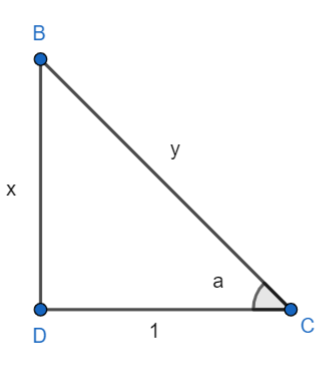
Now we will apply Pythagoras theorem to the right angled triangle at D. This results into $\begin{align}
& {{y}^{2}}={{x}^{2}}+{{\left( 1 \right)}^{2}} \\
& \Rightarrow {{y}^{2}}={{x}^{2}}+1 \\
\end{align}$
By taking square roots on both the sides of the equation we will have ${{y}^{2}}={{x}^{2}}+1$ as $y=\pm \sqrt{{{x}^{2}}+1}$. As we know that the side of the triangle cannot be negative so we get the value of $y=\sqrt{{{x}^{2}}+1}$ which is the hypotenuse of the triangle.
Now we will apply the formula $\sin \left( p \right)=\dfrac{\text{Perpendicular}}{\text{Hypotenuse}}$. As we can clearly see that the perpendicular of the triangle is x units and we know that the value of hypotenuse is $\sqrt{{{x}^{2}}+1}$.
Therefore, we have $\sin \left( a \right)=\dfrac{x}{\sqrt{{{x}^{2}}+1}}$. By placing the sine operation to the right side of the equation we will get $a={{\sin }^{-1}}\left( \dfrac{x}{\sqrt{{{x}^{2}}+1}} \right)$.
As we know that ${{\tan }^{-1}}x=a$ so, by comparing it to the term $a={{\sin }^{-1}}\left( \dfrac{x}{\sqrt{{{x}^{2}}+1}} \right)$ will result into ${{\tan }^{-1}}x={{\sin }^{-1}}\left( \dfrac{x}{\sqrt{{{x}^{2}}+1}} \right)$. Now we will substitute this in expression $\sin \left( {{\tan }^{-1}}x \right)\,,\,\left| \left. x \right|<1 \right.$.
Therefore, we have $\sin \left( {{\tan }^{-1}}x \right)\,=\sin \left( {{\sin }^{-1}}\left( \dfrac{x}{\sqrt{{{x}^{2}}+1}} \right) \right)$. Now we will apply the formula $\sin \left( {{\sin }^{-1}}\left( q \right) \right)=q$ therefore, we get $\sin \left( {{\tan }^{-1}}x \right)\,=\dfrac{x}{\sqrt{{{x}^{2}}+1}}$ which is the required value.
Hence, the correct option is (d).
Note: The value of the expression that we have got has a restriction of x as $\left| \left. x \right|<1 \right.$. Alternative method for this question is that we can also use the formula $\cos \left( p \right)=\dfrac{\text{Base}}{\text{Hypotenuse}}$ and after that apply the formula ${{\sin }^{2}}\left( p \right)+{{\cos }^{2}}\left( p \right)=1$ to find the value of $\sin \left( a \right)=\dfrac{x}{\sqrt{{{x}^{2}}+1}}$.
Complete step-by-step answer:
We will first consider the expression given as $\sin \left( {{\tan }^{-1}}x \right)\,,\,\left| \left. x \right|<1 \right.$. We will convert the inverse tan term into inverse sine term. For that we will substitute ${{\tan }^{-1}}x=a$. Now we will place inverse tan to the right side of the equation. Therefore, we have $x=\tan \left( a \right)$.
At this step we will apply the formula $\tan \left( p \right)=\dfrac{\text{perpendicular}}{\text{Base}}$. By comparing $x=\tan \left( a \right)$ and $\tan \left( p \right)=\dfrac{\text{perpendicular}}{\text{Base}}$ we come to know that perpendicular is x units and base is 1 unit. This is because $x=\tan \left( a \right)$ can also be written as $\dfrac{x}{1}=\tan \left( a \right)$. Therefore, the diagram for the given question is shown below.
Now we will apply Pythagoras theorem to the right angled triangle at D. This results into $\begin{align}
& {{y}^{2}}={{x}^{2}}+{{\left( 1 \right)}^{2}} \\
& \Rightarrow {{y}^{2}}={{x}^{2}}+1 \\
\end{align}$
By taking square roots on both the sides of the equation we will have ${{y}^{2}}={{x}^{2}}+1$ as $y=\pm \sqrt{{{x}^{2}}+1}$. As we know that the side of the triangle cannot be negative so we get the value of $y=\sqrt{{{x}^{2}}+1}$ which is the hypotenuse of the triangle.
Now we will apply the formula $\sin \left( p \right)=\dfrac{\text{Perpendicular}}{\text{Hypotenuse}}$. As we can clearly see that the perpendicular of the triangle is x units and we know that the value of hypotenuse is $\sqrt{{{x}^{2}}+1}$.
Therefore, we have $\sin \left( a \right)=\dfrac{x}{\sqrt{{{x}^{2}}+1}}$. By placing the sine operation to the right side of the equation we will get $a={{\sin }^{-1}}\left( \dfrac{x}{\sqrt{{{x}^{2}}+1}} \right)$.
As we know that ${{\tan }^{-1}}x=a$ so, by comparing it to the term $a={{\sin }^{-1}}\left( \dfrac{x}{\sqrt{{{x}^{2}}+1}} \right)$ will result into ${{\tan }^{-1}}x={{\sin }^{-1}}\left( \dfrac{x}{\sqrt{{{x}^{2}}+1}} \right)$. Now we will substitute this in expression $\sin \left( {{\tan }^{-1}}x \right)\,,\,\left| \left. x \right|<1 \right.$.
Therefore, we have $\sin \left( {{\tan }^{-1}}x \right)\,=\sin \left( {{\sin }^{-1}}\left( \dfrac{x}{\sqrt{{{x}^{2}}+1}} \right) \right)$. Now we will apply the formula $\sin \left( {{\sin }^{-1}}\left( q \right) \right)=q$ therefore, we get $\sin \left( {{\tan }^{-1}}x \right)\,=\dfrac{x}{\sqrt{{{x}^{2}}+1}}$ which is the required value.
Hence, the correct option is (d).
Note: The value of the expression that we have got has a restriction of x as $\left| \left. x \right|<1 \right.$. Alternative method for this question is that we can also use the formula $\cos \left( p \right)=\dfrac{\text{Base}}{\text{Hypotenuse}}$ and after that apply the formula ${{\sin }^{2}}\left( p \right)+{{\cos }^{2}}\left( p \right)=1$ to find the value of $\sin \left( a \right)=\dfrac{x}{\sqrt{{{x}^{2}}+1}}$.
Recently Updated Pages
Master Class 12 Economics: Engaging Questions & Answers for Success

Master Class 12 Physics: Engaging Questions & Answers for Success
Master Class 12 English: Engaging Questions & Answers for Success
Master Class 12 Social Science: Engaging Questions & Answers for Success
Master Class 12 Maths: Engaging Questions & Answers for Success
Master Class 12 Business Studies: Engaging Questions & Answers for Success
Trending doubts
Which are the Top 10 Largest Countries of the World?
What are the major means of transport Explain each class 12 social science CBSE
Draw a labelled sketch of the human eye class 12 physics CBSE
Why cannot DNA pass through cell membranes class 12 biology CBSE
Differentiate between insitu conservation and exsitu class 12 biology CBSE
Draw a neat and well labeled diagram of TS of ovary class 12 biology CBSE