




The value of the focal length of the lens is equal to the value of the image distance when rays are
(A) Passing through optical center
(B) Parallel to the principal axis.
(C) Passing through focus.
(D) Over the mirror
Answer
 Verified
629.1k+ views
Hint
Distance of focus from the optical center is equal to the distance of the image from the optical center. We have to find the situation then this condition is possible. We will draw a ray diagram and use lens formula to find the behavior of rays for this image formation.
Complete step by step answer
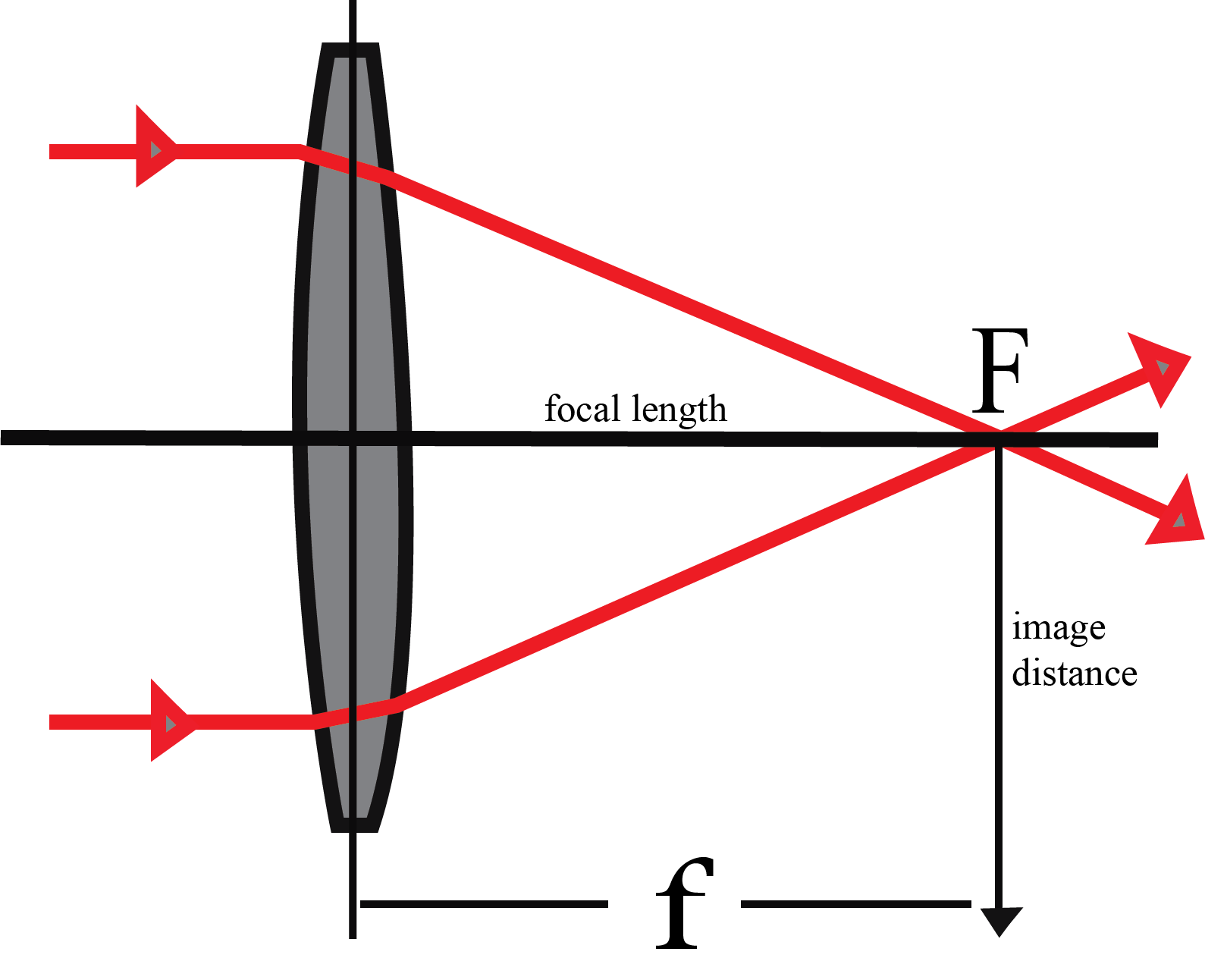
Focal length: distance between focus and optical center.
Image distance: distance between image and optical center.
Optical center: central point of spherical surface is the center of the lens both in concave as well as convex lens.
Len’s formula
$\Rightarrow \dfrac{1}{f} = \dfrac{1}{v} + \dfrac{1}{u}$ …(1)
Where f = focal length of lens
v= image distance
o= object distance
Lens formula is the same for concave lenses as well as for convex lenses.
It is mention in question that focal length = image distance or f=v …(2)
Using equation (2) in (1), we get
$\Rightarrow \dfrac{1}{f} = \dfrac{1}{f} + \dfrac{1}{u} $
$\Rightarrow \dfrac{1}{f} - \dfrac{1}{f} = \dfrac{1}{u} $
$\Rightarrow \dfrac{1}{u} = 0 $
$\Rightarrow u = \infty $
Rays are coming from infinity and will pass through focus. This shows that the object is placed at infinity.
Let us draw a ray diagram of image formation by convex lens.
When an object is placed at infinity, a parallel beam strikes the lens and will pass through focus. Rays coming from center will follow the same path. Hence an inverted image is formed.
Option (B) is correct.
Note
If the object is placed at focus then no image is obtained. But in our case the image formed at a distance which is equal to focal length. So, we cannot place an object anywhere because it is at some point in infinity.
Distance of focus from the optical center is equal to the distance of the image from the optical center. We have to find the situation then this condition is possible. We will draw a ray diagram and use lens formula to find the behavior of rays for this image formation.
Complete step by step answer
Focal length: distance between focus and optical center.
Image distance: distance between image and optical center.
Optical center: central point of spherical surface is the center of the lens both in concave as well as convex lens.
Len’s formula
$\Rightarrow \dfrac{1}{f} = \dfrac{1}{v} + \dfrac{1}{u}$ …(1)
Where f = focal length of lens
v= image distance
o= object distance
Lens formula is the same for concave lenses as well as for convex lenses.
It is mention in question that focal length = image distance or f=v …(2)
Using equation (2) in (1), we get
$\Rightarrow \dfrac{1}{f} = \dfrac{1}{f} + \dfrac{1}{u} $
$\Rightarrow \dfrac{1}{f} - \dfrac{1}{f} = \dfrac{1}{u} $
$\Rightarrow \dfrac{1}{u} = 0 $
$\Rightarrow u = \infty $
Rays are coming from infinity and will pass through focus. This shows that the object is placed at infinity.
Let us draw a ray diagram of image formation by convex lens.
When an object is placed at infinity, a parallel beam strikes the lens and will pass through focus. Rays coming from center will follow the same path. Hence an inverted image is formed.
Option (B) is correct.
Note
If the object is placed at focus then no image is obtained. But in our case the image formed at a distance which is equal to focal length. So, we cannot place an object anywhere because it is at some point in infinity.
Recently Updated Pages
Match columnI with columnII and choose the correct class 12 biology NEET_UG

Match columnI with columnII and choose the correct class 12 biology NEET_UG
Match columnI with columnII and choose the correct class 12 biology NEET_UG
Which plant will lose its economic value if its fruits class 12 biology NEET_UG
Human insulin is being commercially produced from a class 12 biology NEET_UG
Match columnI with columnII and choose the correct class 12 biology NEET_UG
Trending doubts
Which are the Top 10 Largest Countries of the World?
Draw a labelled sketch of the human eye class 12 physics CBSE
Why is the cell called the structural and functional class 12 biology CBSE
Draw ray diagrams each showing i myopic eye and ii class 12 physics CBSE
Differentiate between homogeneous and heterogeneous class 12 chemistry CBSE
Which is the correct genotypic ratio of mendel dihybrid class 12 biology CBSE