




The value of $\int\limits_{0}^{1}{\left| \sin (2\pi x) \right|dx}$ is equal to
A. 0
B. $\dfrac{-1}{\pi }$
C. $\dfrac{1}{\pi }$
D. $\dfrac{2}{\pi }$
Answer
 Verified
636.3k+ views
Hint: According to definition of absolute value function $f(x)=\left| x \right|$ we can write
$f(x)=x$ when $x\ge 0$
$f(x)=-x$ when $x<0$
And also we can use$\int{\sin (x)dx=-\cos (x)}$
Complete step-by-step answer:
Given integral is $\int\limits_{0}^{1}{\left| \sin (2\pi x) \right|dx}$
For \[0\le x\le \dfrac{1}{2}\] , \[\sin (2\pi x)>0\]
For \[\dfrac{1}{2}\le x\le 1\], \[\sin (2\pi x)<0\]
Hence we can write integral as
$\int\limits_{0}^{1}{\sin (2\pi x)dx=\int\limits_{0}^{{}^{1}/{}_{2}}{\sin (2\pi x)dx}}+\int\limits_{{}^{1}/{}_{2}}^{1}{-\sin (2\pi x)dx}$
Now calculate $\int{\sin (2\pi x)dx}$
Let $2\pi x=t$
On differentiating
$2\pi dx=dt$
$dx=\dfrac{dt}{2\pi }$
Hence integral is
$\Rightarrow \int{\sin (2\pi x)dx}=\dfrac{1}{2\pi }\int{\sin (t)dt}$
$\Rightarrow \int{\sin (2\pi x)dx}=\dfrac{-\cos (t)}{2\pi }$
On substituting $2\pi x=t$
$\Rightarrow \int{\sin (2\pi x)dx}=\dfrac{-\cos (2\pi x)}{2\pi }$
As we have $\int\limits_{0}^{1}{\sin (2\pi x)dx=\int\limits_{0}^{{}^{1}/{}_{2}}{\sin (2\pi x)dx}}+\int\limits_{{}^{1}/{}_{2}}^{1}{-\sin (2\pi x)dx}$
After substituting value of $\int{\sin (2\pi x)dx}$
\[\Rightarrow \int\limits_{0}^{1}{\sin (2\pi x)dx=\left[ \dfrac{-\cos (2\pi x)}{2\pi } \right]_{0}^{{}^{1}/{}_{2}}}+\left[ \dfrac{\cos (2\pi x)}{2\pi } \right]_{{}^{1}/{}_{2}}^{1}\]
\[\Rightarrow \int\limits_{0}^{1}{\sin (2\pi x)dx=\left[ \dfrac{-\cos (\pi )}{2\pi }+\dfrac{\cos (0)}{2\pi } \right]}+\left[ \dfrac{\cos (2\pi )}{2\pi }-\dfrac{\cos (\pi )}{2\pi } \right]\]
\[\Rightarrow \int\limits_{0}^{1}{\sin (2\pi x)dx=\left[ \dfrac{-(-1)}{2\pi }+\dfrac{1}{2\pi } \right]}+\left[ \dfrac{1}{2\pi }-\dfrac{(-1)}{2\pi } \right]\].
\[\Rightarrow \int\limits_{0}^{1}{\sin (2\pi x)dx=\left[ \dfrac{1}{2\pi }+\dfrac{1}{2\pi } \right]}+\left[ \dfrac{1}{2\pi }+\dfrac{1}{2\pi } \right]\]
\[\Rightarrow \int\limits_{0}^{1}{\sin (2\pi x)dx=\dfrac{2}{2\pi }+}\dfrac{2}{2\pi }\]
\[\Rightarrow \int\limits_{0}^{1}{\sin (2\pi x)dx=\dfrac{4}{2\pi }}\]
\[\Rightarrow \int\limits_{0}^{1}{\sin (2\pi x)dx=\dfrac{2}{\pi }}\]
Hence option D is correct.
Note: In above question we need to classify range of x very carefully.
We can understand it from graph of sin(x) as below:
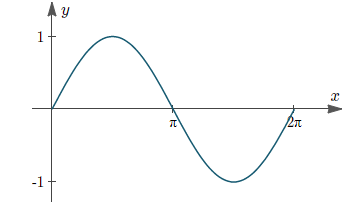
As from 0 to $\pi $ , sin(x) is positive and from $\pi $ to $2\pi $
That’s we classify range as below:
For \[0\le x\le \dfrac{1}{2}\] , \[\sin (2\pi x)>0\]
$f(x)=x$ when $x\ge 0$
$f(x)=-x$ when $x<0$
And also we can use$\int{\sin (x)dx=-\cos (x)}$
Complete step-by-step answer:
Given integral is $\int\limits_{0}^{1}{\left| \sin (2\pi x) \right|dx}$
For \[0\le x\le \dfrac{1}{2}\] , \[\sin (2\pi x)>0\]
For \[\dfrac{1}{2}\le x\le 1\], \[\sin (2\pi x)<0\]
Hence we can write integral as
$\int\limits_{0}^{1}{\sin (2\pi x)dx=\int\limits_{0}^{{}^{1}/{}_{2}}{\sin (2\pi x)dx}}+\int\limits_{{}^{1}/{}_{2}}^{1}{-\sin (2\pi x)dx}$
Now calculate $\int{\sin (2\pi x)dx}$
Let $2\pi x=t$
On differentiating
$2\pi dx=dt$
$dx=\dfrac{dt}{2\pi }$
Hence integral is
$\Rightarrow \int{\sin (2\pi x)dx}=\dfrac{1}{2\pi }\int{\sin (t)dt}$
$\Rightarrow \int{\sin (2\pi x)dx}=\dfrac{-\cos (t)}{2\pi }$
On substituting $2\pi x=t$
$\Rightarrow \int{\sin (2\pi x)dx}=\dfrac{-\cos (2\pi x)}{2\pi }$
As we have $\int\limits_{0}^{1}{\sin (2\pi x)dx=\int\limits_{0}^{{}^{1}/{}_{2}}{\sin (2\pi x)dx}}+\int\limits_{{}^{1}/{}_{2}}^{1}{-\sin (2\pi x)dx}$
After substituting value of $\int{\sin (2\pi x)dx}$
\[\Rightarrow \int\limits_{0}^{1}{\sin (2\pi x)dx=\left[ \dfrac{-\cos (2\pi x)}{2\pi } \right]_{0}^{{}^{1}/{}_{2}}}+\left[ \dfrac{\cos (2\pi x)}{2\pi } \right]_{{}^{1}/{}_{2}}^{1}\]
\[\Rightarrow \int\limits_{0}^{1}{\sin (2\pi x)dx=\left[ \dfrac{-\cos (\pi )}{2\pi }+\dfrac{\cos (0)}{2\pi } \right]}+\left[ \dfrac{\cos (2\pi )}{2\pi }-\dfrac{\cos (\pi )}{2\pi } \right]\]
\[\Rightarrow \int\limits_{0}^{1}{\sin (2\pi x)dx=\left[ \dfrac{-(-1)}{2\pi }+\dfrac{1}{2\pi } \right]}+\left[ \dfrac{1}{2\pi }-\dfrac{(-1)}{2\pi } \right]\].
\[\Rightarrow \int\limits_{0}^{1}{\sin (2\pi x)dx=\left[ \dfrac{1}{2\pi }+\dfrac{1}{2\pi } \right]}+\left[ \dfrac{1}{2\pi }+\dfrac{1}{2\pi } \right]\]
\[\Rightarrow \int\limits_{0}^{1}{\sin (2\pi x)dx=\dfrac{2}{2\pi }+}\dfrac{2}{2\pi }\]
\[\Rightarrow \int\limits_{0}^{1}{\sin (2\pi x)dx=\dfrac{4}{2\pi }}\]
\[\Rightarrow \int\limits_{0}^{1}{\sin (2\pi x)dx=\dfrac{2}{\pi }}\]
Hence option D is correct.
Note: In above question we need to classify range of x very carefully.
We can understand it from graph of sin(x) as below:
As from 0 to $\pi $ , sin(x) is positive and from $\pi $ to $2\pi $
That’s we classify range as below:
For \[0\le x\le \dfrac{1}{2}\] , \[\sin (2\pi x)>0\]
Recently Updated Pages
Master Class 12 Economics: Engaging Questions & Answers for Success

Master Class 12 English: Engaging Questions & Answers for Success
Master Class 12 Social Science: Engaging Questions & Answers for Success
Master Class 12 Maths: Engaging Questions & Answers for Success
Master Class 12 Physics: Engaging Questions & Answers for Success
Master Class 12 Business Studies: Engaging Questions & Answers for Success
Trending doubts
The ratio of E to B in electromagnetic waves is equal class 12 physics CBSE
Which of the following is referred to as the Evil Quartet class 12 biology CBSE
What causes instant death by hanging class 12 biology CBSE
Percentage of photosynthetically active radiation PAR class 12 biology CBSE
The electric field due to a uniformly charged nonconducting class 12 physics CBSE
One megawatt is equal to how many units of electri class 12 physics CBSE