




The value of impedance in parallel LC circuit at resonance is:
Answer
 Verified
597.3k+ views
Hint: In DC circuit, the total opposition offered by a load is called resistance and in AC circuit, the total opposition offered by a load is called its reactance. In DC, the resistance of the load is fixed whereas in AC it is the function of time and it depends upon the frequency of the source.
Formula used:
$\chi_{L} = \omega L, \ \chi_{C} = \dfrac{1}{\omega C}, \ \dfrac1Z = \dfrac{1}{\chi_L} - \dfrac{1}{\chi_C}$
Complete step by step answer:
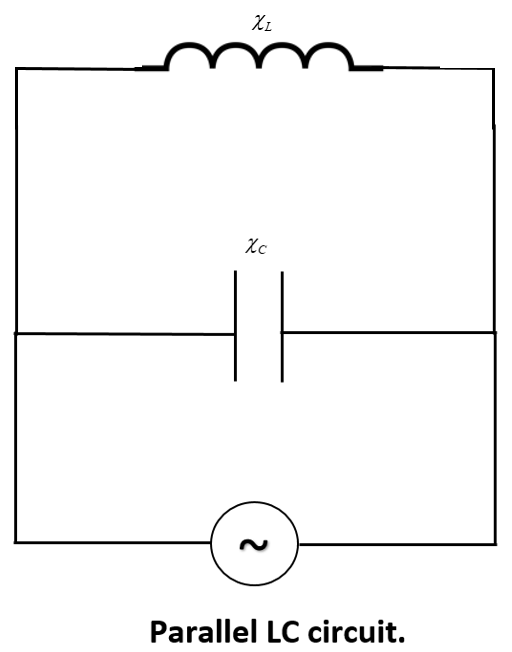
First of all, we need to understand what resonance is.
Resonating frequency – It is a special type of frequency at which, the inductive reactance and capacitive reactance of the circuit becomes numerically equal. At this frequency, the graph of both reactance cut each other and maximum current is flown in the circuit and the circuit is said to be at resonance.
Now, since at resonance, $\chi_L = \chi_C$;
$\dfrac{1}{\chi_L} = \dfrac{1}{\chi_C}$
$\implies \dfrac{1}{\chi_L}-\dfrac{1}{\chi_C}= 0$
$or \ \dfrac{1}{Z} = 0$
Thus, $Z \rightarrow \infty$
Hence, at resonance, the impedance of the circuit becomes infinite.
Additional information:
The condition of resonance is very important in circuit electronics. We often use this condition in our daily life. For example, when we tune or adjust the frequency of radio in order to get maximum and clear output of the audio, we adjust the frequency of radio at a particular frequency, known as resonant frequency. Hence one can say that this is the frequency at which maximum current is drawn from the source and hence maximum output is given by an element (like a speaker in radio).
Note:
This is a special type of angular frequency which is called ‘Resonating frequency’. At this frequency, the current in the circuit achieves its maximum value in the circuit. Mathematically it is equal to$\omega = \dfrac{1}{\sqrt{LC}}$.
Formula used:
$\chi_{L} = \omega L, \ \chi_{C} = \dfrac{1}{\omega C}, \ \dfrac1Z = \dfrac{1}{\chi_L} - \dfrac{1}{\chi_C}$
Complete step by step answer:
First of all, we need to understand what resonance is.
Resonating frequency – It is a special type of frequency at which, the inductive reactance and capacitive reactance of the circuit becomes numerically equal. At this frequency, the graph of both reactance cut each other and maximum current is flown in the circuit and the circuit is said to be at resonance.
Now, since at resonance, $\chi_L = \chi_C$;
$\dfrac{1}{\chi_L} = \dfrac{1}{\chi_C}$
$\implies \dfrac{1}{\chi_L}-\dfrac{1}{\chi_C}= 0$
$or \ \dfrac{1}{Z} = 0$
Thus, $Z \rightarrow \infty$
Hence, at resonance, the impedance of the circuit becomes infinite.
Additional information:
The condition of resonance is very important in circuit electronics. We often use this condition in our daily life. For example, when we tune or adjust the frequency of radio in order to get maximum and clear output of the audio, we adjust the frequency of radio at a particular frequency, known as resonant frequency. Hence one can say that this is the frequency at which maximum current is drawn from the source and hence maximum output is given by an element (like a speaker in radio).
Note:
This is a special type of angular frequency which is called ‘Resonating frequency’. At this frequency, the current in the circuit achieves its maximum value in the circuit. Mathematically it is equal to$\omega = \dfrac{1}{\sqrt{LC}}$.
Recently Updated Pages
Master Class 12 Business Studies: Engaging Questions & Answers for Success

Master Class 12 Chemistry: Engaging Questions & Answers for Success
Master Class 12 Biology: Engaging Questions & Answers for Success
Class 12 Question and Answer - Your Ultimate Solutions Guide
Master Class 11 English: Engaging Questions & Answers for Success
Master Class 11 Maths: Engaging Questions & Answers for Success
Trending doubts
Which is more stable and why class 12 chemistry CBSE
Which are the Top 10 Largest Countries of the World?
Draw a labelled sketch of the human eye class 12 physics CBSE
Differentiate between homogeneous and heterogeneous class 12 chemistry CBSE
What are the major means of transport Explain each class 12 social science CBSE
Sulphuric acid is known as the king of acids State class 12 chemistry CBSE