




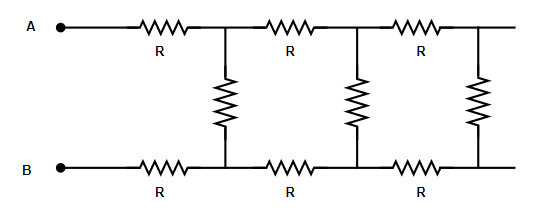
The value of effective resistance between $A$ and $B$ is? $\left( {Given\,\,R = 2k\Omega } \right)$
\[\left( a \right)\,\,(1 + \sqrt 3 )k\Omega \]
\[\left( b \right)\,\,2(1 + \sqrt 3 )k\Omega \]
\[\left( c \right)\,\,(1 - \sqrt 3 )k\Omega \]
\[\left( d \right)\,\,2(1 - \sqrt 3 )k\Omega \]
Answer
 Verified
599.4k+ views
Hint: Whenever you are given with a question where resistances or capacitances are connected in a similar pattern up to $'n'$ number of times, firstly find unit cell of the network then assume x or y as the combined resistance for the rest of pattern $\left( {n - 1} \right)$ number of times. This pattern is also known as the infinite ladder network.
Formula used:
(A) \[r = {r_1} + {r_2} + {r_3} + ........... + {r_n}\] (when resistance are connected in series)
(B) \[\dfrac{1}{r} = \dfrac{1}{{{r_1}}} + \dfrac{1}{{{r_2}}} + \dfrac{1}{{{r_3}}} + ............. + \dfrac{1}{{{r_n}}}\] (when resistance are connected in parallel)
Complete step by step answer:
Let us assume that equivalent resistance or effective resistance for this network is \[{R_{eq}}\] . Here, in this problem, the unit cell of network is shown in below picture as follows:
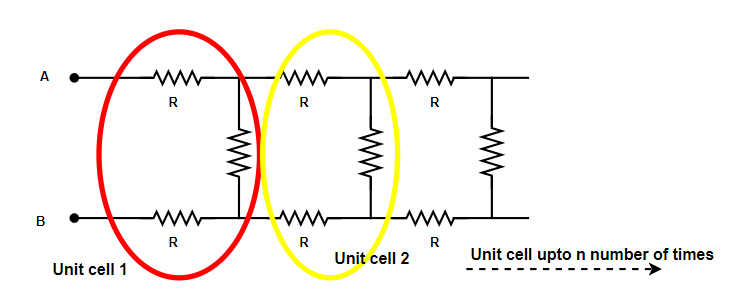
Thus, your first basic step in the question is to find a unit cell of the network in circuit.
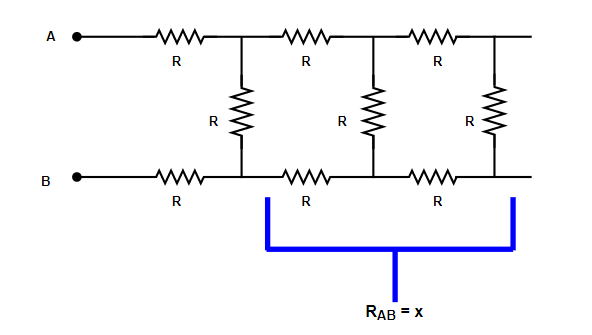
Let the combined resistance for the rest of the network (except the resistance of unit cell 1) be $x$ .
\[ \Rightarrow {R_{AB}} = x\]
Where, \[{R_{AB}}\] is equal to the combined resistance of $\left( {n - 1} \right)$ unit cells.
Then,
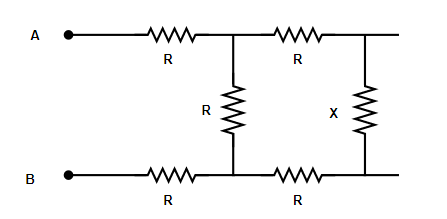
Also,
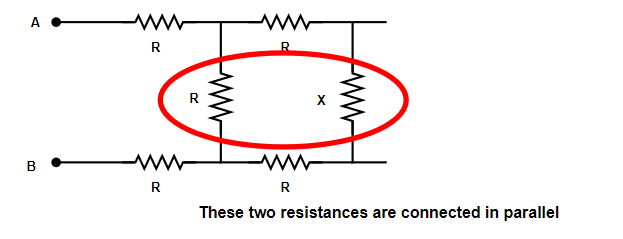
From the figure, the combined resistance $r$ for parallel combination is given by
\[\dfrac{1}{r} = \dfrac{1}{{{r_1}}} + \dfrac{1}{{{r_2}}} + \dfrac{1}{{{r_3}}} + ............. + \dfrac{1}{{{r_n}}}\] (When resistance are connected in parallel)
And it can be written as
\[ \Rightarrow \dfrac{1}{r} = \dfrac{1}{R} + \dfrac{1}{x}\]
Now on solving it, we get
\[ \Rightarrow \dfrac{1}{r} = \dfrac{{x + R}}{{xR}}\]
Solving it, we get
\[ \Rightarrow r = \dfrac{{xR}}{{x + R}}\] and we will let it eq. $1$
Next, from the below shown figure, it’s clear that all the three resistances are in connected in series,
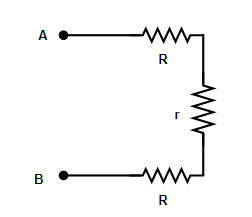
\[\therefore \] By applying, \[r = {r_1} + {r_2} + {r_3} + ........... + {r_n}\] (when resistance are connected in series) we get,${R_{eq}} = R + r + R$ and we will let it eq. $2$
Also, given in question that, $R = 2K\Omega $ and from above eq. $1$ , substituting values in eq. $2$ , we get as follows:
\[ \Rightarrow {R_{eq}} = 2 + \dfrac{{2x}}{{2 + x}} + 2\]
And on solving it, we get
\[ \Rightarrow {R_{eq}} = 4 + \dfrac{{2x}}{{2 + x}}\]
Now, \[{R_{eq}} \approx {R_{AB}}\]
\[ \Rightarrow {R_{eq}} = x\] , thus
\[ \Rightarrow x = 4 + \dfrac{{2x}}{{2 + x}}\]
Now on doing the cross multiplication, we get
\[ \Rightarrow x\left( {2 + x} \right) = 4\left( {2 + x} \right) + 2x\]
And on solving it, we get
\[ \Rightarrow 2x + {x^2} = 8 + 4x + 2x\]
Further doing the solution,
\[ \Rightarrow {x^2} = 8 + 4x\]
Or it can be written as
\[ \Rightarrow {x^2} - 4x - 8 = 0\]
By applying the formula for finding roots of a quadratic equation, \[\dfrac{{ - b \pm \sqrt {{b^2} - 4ac} }}{{2a}}\] , We get,
\[ \Rightarrow \dfrac{{4 \pm \sqrt {16 + 32} }}{2}\]
On solving it,
\[ \Rightarrow \dfrac{{4 \pm \sqrt {48} }}{2}\]
And it will be equal to
\[ \Rightarrow 2(1 \pm \sqrt 3 )\]
Now the value of \[\sqrt 3 = 1.7320\], so \[1 - \sqrt 3 \] have negative value, and resistance can’t have a negative value.
\[\therefore x = 2(1 + \sqrt 3 )\] would be the effective resistance to give an infinite ladder network.
\[ \Rightarrow \] Option $\left( b \right)$ is correct.
Note: Do not confuse yourself with why we put\[{R_{eq}} \approx {R_{AB}}\] , because ladder continues up to infinity, therefore, resistance of $1unit$ cell would be very-very small and can be negligible. Always, consider the positive value of resistance instead a negative value. Try to simplify the network step by step to reduce any error.
Formula used:
(A) \[r = {r_1} + {r_2} + {r_3} + ........... + {r_n}\] (when resistance are connected in series)
(B) \[\dfrac{1}{r} = \dfrac{1}{{{r_1}}} + \dfrac{1}{{{r_2}}} + \dfrac{1}{{{r_3}}} + ............. + \dfrac{1}{{{r_n}}}\] (when resistance are connected in parallel)
Complete step by step answer:
Let us assume that equivalent resistance or effective resistance for this network is \[{R_{eq}}\] . Here, in this problem, the unit cell of network is shown in below picture as follows:
Thus, your first basic step in the question is to find a unit cell of the network in circuit.
Let the combined resistance for the rest of the network (except the resistance of unit cell 1) be $x$ .
\[ \Rightarrow {R_{AB}} = x\]
Where, \[{R_{AB}}\] is equal to the combined resistance of $\left( {n - 1} \right)$ unit cells.
Then,
Also,
From the figure, the combined resistance $r$ for parallel combination is given by
\[\dfrac{1}{r} = \dfrac{1}{{{r_1}}} + \dfrac{1}{{{r_2}}} + \dfrac{1}{{{r_3}}} + ............. + \dfrac{1}{{{r_n}}}\] (When resistance are connected in parallel)
And it can be written as
\[ \Rightarrow \dfrac{1}{r} = \dfrac{1}{R} + \dfrac{1}{x}\]
Now on solving it, we get
\[ \Rightarrow \dfrac{1}{r} = \dfrac{{x + R}}{{xR}}\]
Solving it, we get
\[ \Rightarrow r = \dfrac{{xR}}{{x + R}}\] and we will let it eq. $1$
Next, from the below shown figure, it’s clear that all the three resistances are in connected in series,
\[\therefore \] By applying, \[r = {r_1} + {r_2} + {r_3} + ........... + {r_n}\] (when resistance are connected in series) we get,${R_{eq}} = R + r + R$ and we will let it eq. $2$
Also, given in question that, $R = 2K\Omega $ and from above eq. $1$ , substituting values in eq. $2$ , we get as follows:
\[ \Rightarrow {R_{eq}} = 2 + \dfrac{{2x}}{{2 + x}} + 2\]
And on solving it, we get
\[ \Rightarrow {R_{eq}} = 4 + \dfrac{{2x}}{{2 + x}}\]
Now, \[{R_{eq}} \approx {R_{AB}}\]
\[ \Rightarrow {R_{eq}} = x\] , thus
\[ \Rightarrow x = 4 + \dfrac{{2x}}{{2 + x}}\]
Now on doing the cross multiplication, we get
\[ \Rightarrow x\left( {2 + x} \right) = 4\left( {2 + x} \right) + 2x\]
And on solving it, we get
\[ \Rightarrow 2x + {x^2} = 8 + 4x + 2x\]
Further doing the solution,
\[ \Rightarrow {x^2} = 8 + 4x\]
Or it can be written as
\[ \Rightarrow {x^2} - 4x - 8 = 0\]
By applying the formula for finding roots of a quadratic equation, \[\dfrac{{ - b \pm \sqrt {{b^2} - 4ac} }}{{2a}}\] , We get,
\[ \Rightarrow \dfrac{{4 \pm \sqrt {16 + 32} }}{2}\]
On solving it,
\[ \Rightarrow \dfrac{{4 \pm \sqrt {48} }}{2}\]
And it will be equal to
\[ \Rightarrow 2(1 \pm \sqrt 3 )\]
Now the value of \[\sqrt 3 = 1.7320\], so \[1 - \sqrt 3 \] have negative value, and resistance can’t have a negative value.
\[\therefore x = 2(1 + \sqrt 3 )\] would be the effective resistance to give an infinite ladder network.
\[ \Rightarrow \] Option $\left( b \right)$ is correct.
Note: Do not confuse yourself with why we put\[{R_{eq}} \approx {R_{AB}}\] , because ladder continues up to infinity, therefore, resistance of $1unit$ cell would be very-very small and can be negligible. Always, consider the positive value of resistance instead a negative value. Try to simplify the network step by step to reduce any error.
Recently Updated Pages
Basicity of sulphurous acid and sulphuric acid are

Master Class 12 Economics: Engaging Questions & Answers for Success
Master Class 12 Biology: Engaging Questions & Answers for Success
Master Class 11 English: Engaging Questions & Answers for Success
Master Class 11 Physics: Engaging Questions & Answers for Success
Master Class 11 Computer Science: Engaging Questions & Answers for Success
Trending doubts
Draw a labelled sketch of the human eye class 12 physics CBSE
The chemical formula of tear gas is A CO Cl 2 B C 10 class 12 chemistry CBSE
Draw ray diagrams each showing i myopic eye and ii class 12 physics CBSE
Which are the Top 10 Largest Countries of the World?
Differentiate between homogeneous and heterogeneous class 12 chemistry CBSE
Which is the correct genotypic ratio of mendel dihybrid class 12 biology CBSE