




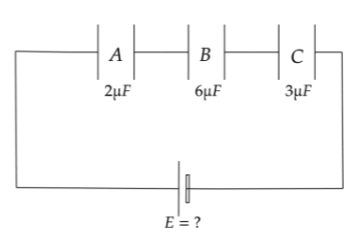
What should be the value of applied voltage (E) so all the capacitors can work properly. Also find out the value of applied voltage if only Capacitor B is replaced by a capacitor having $ V_B = 1.5KV $ and Capacitance $ 6\mu F $
$ V_A = 4KV $ $ V_B = 3KV $ $ V_C = 3KV $
 $ V_B \to $ Breaking voltage
$ \left( A \right)8KV,8KV $
$ \left( B \right)6KV,8KV $
$ \left( C \right)8KV,6KV $
$ \left( D \right)6KV,6KV $
Answer
 Verified
560.4k+ views
Hint: First we will find the charge on each of the capacitors. Then we will find the total voltage present in the circuit with the help of the charge and capacitance of each capacitor. Now if we replace the capacitor B by a capacitor of $ V_B = 1.5KV $ and $ 6\mu F $ then the net voltage changes hence similarly with the help of previous formula we can find the new applied village.
Complete answer:
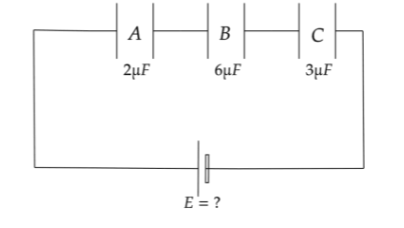
As per the figure given we need to calculate the applied voltage so that all the capacitors can work properly.
We know,
$ V_A = 4KV,C_A = 2\mu F $
$ V_B = 3KV,C_B = 6\mu F $
$ V_C = 3KV,C_C = 3\mu F $
Now with the help of the given values we can calculate the change on each of the capacitors.
$ Q = V_C $
Where,
Q is the change on the capacitor.
V is the voltage across the capacitor.
C is the capacitance.
So we can write,
$ Q_A = V_AC_A $
Now putting the known values we will get,
$ Q_A = 4KV \times 2\mu F $
Convert the term in its SI unit we will get,
$ Q_A = 4 \times {10^3}V \times 2 \times {10^{ - 6}}F $
$ Q_A = 8 \times {10^{ - 3}}C $
Similarly,
$ Q_B = V_BC_B $
Now putting the known values we will get,
$ Q_B = 3KV \times 6\mu F $
Convert the term in its SI unit we will get,
$ Q_B = 3 \times {10^3}V \times 6 \times {10^{ - 6}}F $
$ Q_B = 18 \times {10^{ - 3}}C $
For C,
$ Q_C = V_CC_C $
Now putting the known values we will get,
$ Q_C = 3KV \times 3\mu F $
Convert the term in its SI unit we will get,
$ Q_C = 3 \times {10^3}V \times 3 \times {10^{ - 6}}F $
$ Q_C = 9 \times {10^{ - 3}}C $
Hence $ Q_A $ is lower.
Now the total voltage applied will be,
$ V = V_1 + V_2 + V_3 $
We know,
$ V = \dfrac{Q}{C} $
Now putting this,
$ V = \dfrac{{Q_A}}{{C_A}} + \dfrac{{Q_A}}{{C_B}} + \dfrac{{Q_A}}{{C_C}} $
Putting the respective values we will get,
$ V = \dfrac{{8 \times {{10}^{ - 3}}C}}{{2 \times {{10}^{ - 6}}F}} + \dfrac{{8 \times {{10}^{ - 3}}C}}{{6 \times {{10}^{ - 6}}F}} + \dfrac{{8 \times {{10}^{ - 3}}C}}{{3 \times {{10}^{ - 6}}F}} $
$ \Rightarrow V = 4 \times {10^3}V + \dfrac{4}{3} \times {10^3}V + \dfrac{8}{3} \times {10^3}V $
On further solving we will get,
$ V = 4 \times {10^3}V + \dfrac{{4 + 8}}{3} \times {10^3}V $
$ \Rightarrow V = 4 \times {10^3}V + 4 \times {10^3}V = 8 \times {10^3}V $
Hene the applied voltage will be,
$ V = 8KV $
Now if we replace the capacitor B by a capacitor of $ V_B = 1.5KV $ and $ 6\mu F $ then the net voltage will be,
$ Q_B = V_BC_B $
Now putting the known values we will get,
$ Q_B = 1.5KV \times 6\mu F $
Convert the term in its SI unit we will get,
$ Q_B = 1.5 \times {10^3}V \times 6 \times {10^{ - 6}}F $
$ Q_B = 9 \times {10^{ - 3}}C $
Now also $ Q_A $ is lower.
Now the total voltage applied will be,
$ V = V_1 + V_2 + V_3 $
We know,
$ V = \dfrac{Q}{C} $
Now putting this,
$ V = \dfrac{{Q_A}}{{C_A}} + \dfrac{{Q_A}}{{C_B}} + \dfrac{{Q_A}}{{C_C}} $
Putting the respective values we will get,
$ V = \dfrac{{8 \times {{10}^{ - 3}}C}}{{2 \times {{10}^{ - 6}}F}} + \dfrac{{8 \times {{10}^{ - 3}}C}}{{6 \times {{10}^{ - 6}}F}} + \dfrac{{8 \times {{10}^{ - 3}}C}}{{3 \times {{10}^{ - 6}}F}} $
$ \Rightarrow V = 4 \times {10^3}V + \dfrac{4}{3} \times {10^3}V + \dfrac{8}{3} \times {10^3}V $
On further solving we will get,
$ V = 4 \times {10^3}V + \dfrac{{4 + 8}}{3} \times {10^3}V $
$ \Rightarrow V = 4 \times {10^3}V + 4 \times {10^3}V = 8 \times {10^3}V $
Hene the applied voltage will be,
$ V = 8KV $
Therefore the correct option is $ \left( A \right) $ .
Note:
Here keep in mind we have to choose such a capacitor whose charge is lower than the other so as to get the maximum applied voltage which must be greater than the breakdown voltage so that all the capacitors present in circuit should work properly. To check if our solution is current or not we can check it by comparing the breakdown voltage and the applied voltage.
Complete answer:
As per the figure given we need to calculate the applied voltage so that all the capacitors can work properly.
We know,
$ V_A = 4KV,C_A = 2\mu F $
$ V_B = 3KV,C_B = 6\mu F $
$ V_C = 3KV,C_C = 3\mu F $
Now with the help of the given values we can calculate the change on each of the capacitors.
$ Q = V_C $
Where,
Q is the change on the capacitor.
V is the voltage across the capacitor.
C is the capacitance.
So we can write,
$ Q_A = V_AC_A $
Now putting the known values we will get,
$ Q_A = 4KV \times 2\mu F $
Convert the term in its SI unit we will get,
$ Q_A = 4 \times {10^3}V \times 2 \times {10^{ - 6}}F $
$ Q_A = 8 \times {10^{ - 3}}C $
Similarly,
$ Q_B = V_BC_B $
Now putting the known values we will get,
$ Q_B = 3KV \times 6\mu F $
Convert the term in its SI unit we will get,
$ Q_B = 3 \times {10^3}V \times 6 \times {10^{ - 6}}F $
$ Q_B = 18 \times {10^{ - 3}}C $
For C,
$ Q_C = V_CC_C $
Now putting the known values we will get,
$ Q_C = 3KV \times 3\mu F $
Convert the term in its SI unit we will get,
$ Q_C = 3 \times {10^3}V \times 3 \times {10^{ - 6}}F $
$ Q_C = 9 \times {10^{ - 3}}C $
Hence $ Q_A $ is lower.
Now the total voltage applied will be,
$ V = V_1 + V_2 + V_3 $
We know,
$ V = \dfrac{Q}{C} $
Now putting this,
$ V = \dfrac{{Q_A}}{{C_A}} + \dfrac{{Q_A}}{{C_B}} + \dfrac{{Q_A}}{{C_C}} $
Putting the respective values we will get,
$ V = \dfrac{{8 \times {{10}^{ - 3}}C}}{{2 \times {{10}^{ - 6}}F}} + \dfrac{{8 \times {{10}^{ - 3}}C}}{{6 \times {{10}^{ - 6}}F}} + \dfrac{{8 \times {{10}^{ - 3}}C}}{{3 \times {{10}^{ - 6}}F}} $
$ \Rightarrow V = 4 \times {10^3}V + \dfrac{4}{3} \times {10^3}V + \dfrac{8}{3} \times {10^3}V $
On further solving we will get,
$ V = 4 \times {10^3}V + \dfrac{{4 + 8}}{3} \times {10^3}V $
$ \Rightarrow V = 4 \times {10^3}V + 4 \times {10^3}V = 8 \times {10^3}V $
Hene the applied voltage will be,
$ V = 8KV $
Now if we replace the capacitor B by a capacitor of $ V_B = 1.5KV $ and $ 6\mu F $ then the net voltage will be,
$ Q_B = V_BC_B $
Now putting the known values we will get,
$ Q_B = 1.5KV \times 6\mu F $
Convert the term in its SI unit we will get,
$ Q_B = 1.5 \times {10^3}V \times 6 \times {10^{ - 6}}F $
$ Q_B = 9 \times {10^{ - 3}}C $
Now also $ Q_A $ is lower.
Now the total voltage applied will be,
$ V = V_1 + V_2 + V_3 $
We know,
$ V = \dfrac{Q}{C} $
Now putting this,
$ V = \dfrac{{Q_A}}{{C_A}} + \dfrac{{Q_A}}{{C_B}} + \dfrac{{Q_A}}{{C_C}} $
Putting the respective values we will get,
$ V = \dfrac{{8 \times {{10}^{ - 3}}C}}{{2 \times {{10}^{ - 6}}F}} + \dfrac{{8 \times {{10}^{ - 3}}C}}{{6 \times {{10}^{ - 6}}F}} + \dfrac{{8 \times {{10}^{ - 3}}C}}{{3 \times {{10}^{ - 6}}F}} $
$ \Rightarrow V = 4 \times {10^3}V + \dfrac{4}{3} \times {10^3}V + \dfrac{8}{3} \times {10^3}V $
On further solving we will get,
$ V = 4 \times {10^3}V + \dfrac{{4 + 8}}{3} \times {10^3}V $
$ \Rightarrow V = 4 \times {10^3}V + 4 \times {10^3}V = 8 \times {10^3}V $
Hene the applied voltage will be,
$ V = 8KV $
Therefore the correct option is $ \left( A \right) $ .
Note:
Here keep in mind we have to choose such a capacitor whose charge is lower than the other so as to get the maximum applied voltage which must be greater than the breakdown voltage so that all the capacitors present in circuit should work properly. To check if our solution is current or not we can check it by comparing the breakdown voltage and the applied voltage.
Recently Updated Pages
Which of the following graphs shows the variation of class 12 physics CBSE

Draw a labelled diagram of the human male reproductive class 12 biology CBSE
Describe the experiment to compare the emf of two cells class 12 physics CBSE
What is standard hydrogen electrode
What is conventional current and electric current class 12 physics CBSE
2Bromopentane is treated with an alcoholic KOH solution class 12 chemistry CBSE
Trending doubts
Draw a labelled sketch of the human eye class 12 physics CBSE
Which are the Top 10 Largest Countries of the World?
Differentiate between homogeneous and heterogeneous class 12 chemistry CBSE
Draw ray diagrams each showing i myopic eye and ii class 12 physics CBSE
Which is the correct genotypic ratio of mendel dihybrid class 12 biology CBSE
What is the Full Form of PVC, PET, HDPE, LDPE, PP and PS ?