




The tube arising from the notch of the kidney on the median side and connecting behind with the urinary bladder is.
Answer
 Verified
589.2k+ views
Hint: The urinary system, also known as the renal system, consists of the kidneys, ureters, bladder, and urethra. The purpose of the urinary system is to eliminate waste from the body, regulate blood volume and blood pressure, control levels of electrolytes and metabolites, and regulate blood pH.
.
Complete answer: The urinary system refers to the structures that produce and transport urine to the point of excretion. In the human urinary system, there are two kidneys that are located between the dorsal body wall and parietal peritoneum on both the left and right sides.
The ureters are muscular ducts that propel urine from the kidneys to the urinary bladder. In the human adult, the ureters are usually 25–30 cm long. In humans, the ureters arise from the renal pelvis on the medial aspect of each kidney before descending towards the bladder on the front of the psoas major muscle. The ureters cross the pelvic brim near the bifurcation of the iliac arteries. This "pelvic ureteric junction" is a common site for the impaction of kidney stones. The ureters run posteriorly on the lateral walls of the pelvis. They then curve anteromedially to enter the bladder through the back, at the vesicoureteral junction, running within the wall of the bladder for a few centimeters. The backflow of urine is prevented by valves known as ureterovesical valves.
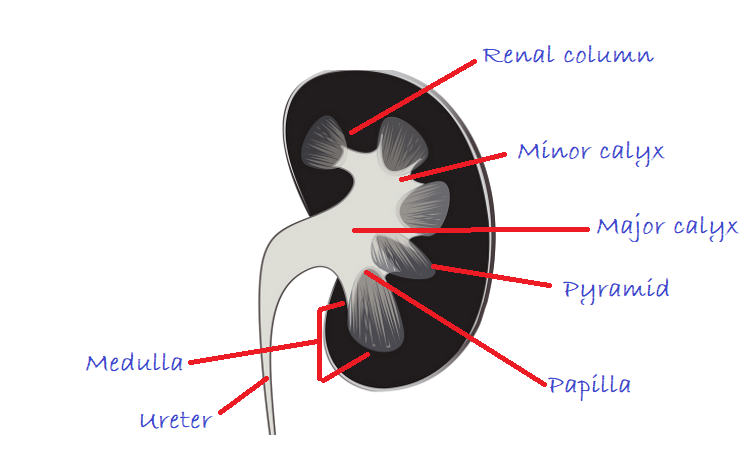
Hence, the tube arising from the notch of the kidney on the median side and connecting behind with the urinary bladder is ureters.
Note: The formation of urine begins within the functional unit of the kidney, the nephrons. Urine then flows through the nephrons, through a system of converging tubules called collecting ducts. These collecting ducts then join together to form the minor calyces, followed by the major calyces that ultimately join the renal pelvis. From here, urine continues its flow from the renal pelvis into the ureter, transporting urine into the urinary bladder.
.
Complete answer: The urinary system refers to the structures that produce and transport urine to the point of excretion. In the human urinary system, there are two kidneys that are located between the dorsal body wall and parietal peritoneum on both the left and right sides.
The ureters are muscular ducts that propel urine from the kidneys to the urinary bladder. In the human adult, the ureters are usually 25–30 cm long. In humans, the ureters arise from the renal pelvis on the medial aspect of each kidney before descending towards the bladder on the front of the psoas major muscle. The ureters cross the pelvic brim near the bifurcation of the iliac arteries. This "pelvic ureteric junction" is a common site for the impaction of kidney stones. The ureters run posteriorly on the lateral walls of the pelvis. They then curve anteromedially to enter the bladder through the back, at the vesicoureteral junction, running within the wall of the bladder for a few centimeters. The backflow of urine is prevented by valves known as ureterovesical valves.
Hence, the tube arising from the notch of the kidney on the median side and connecting behind with the urinary bladder is ureters.
Note: The formation of urine begins within the functional unit of the kidney, the nephrons. Urine then flows through the nephrons, through a system of converging tubules called collecting ducts. These collecting ducts then join together to form the minor calyces, followed by the major calyces that ultimately join the renal pelvis. From here, urine continues its flow from the renal pelvis into the ureter, transporting urine into the urinary bladder.
Recently Updated Pages
Master Class 11 Social Science: Engaging Questions & Answers for Success

Master Class 11 English: Engaging Questions & Answers for Success
Master Class 11 Maths: Engaging Questions & Answers for Success
Master Class 11 Chemistry: Engaging Questions & Answers for Success
Master Class 11 Biology: Engaging Questions & Answers for Success
Master Class 11 Physics: Engaging Questions & Answers for Success
Trending doubts
Differentiate between an exothermic and an endothermic class 11 chemistry CBSE
One Metric ton is equal to kg A 10000 B 1000 C 100 class 11 physics CBSE
Difference Between Prokaryotic Cells and Eukaryotic Cells
There are 720 permutations of the digits 1 2 3 4 5 class 11 maths CBSE
Draw a diagram of a plant cell and label at least eight class 11 biology CBSE
Which chemical is known as king of chemicals A H 2 class 11 chemistry CBSE