




The transverse nature of light is shown by
A. interference of light
B. refraction of light
C. polarization of light
D. dispersion of light
Answer
 Verified
593.7k+ views
Hint: You may recall the definition of all the given properties of light. Also, recall all the requirements to be satisfied for the light to show these properties. Thus, understand which among the given options is the best proof and justification of the transverse nature of light.
Complete answer:
In the question, we are given a number of properties of light and are asked to find which among them proves the transverse nature of light.
It is actually the polarization of light that shows that light is transverse in nature. Let us understand the property of polarization of light better.
By definition polarized waves are the waves that have vibrations in only one plane and the process by which we convert an unpolarized light to polarized light is polarization.
Consider an un-polarized source from which the light is passed through a tourmaline crystal to make it polarized or in other words, to make its vibration restricted to one plane.
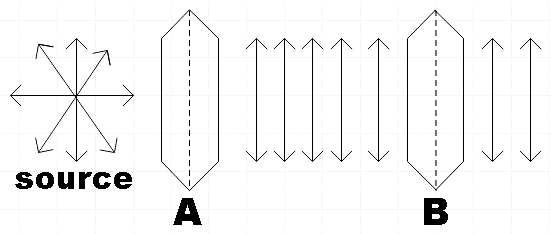
Here, after the un-polarized light from the source is passed through A the light is restricted to vibrate in the plane parallel to the transmission axis of A. Then, when we keep B parallel to A, the intensity of light remains the same meaning that the same amount transmitted by A is also transmitted by B.
When we rotate B, we see that the intensity of light is reduced meaning that the amount transmitted by it is reduced and when B is kept perpendicular to A the intensity of light transmitted by it is zero meaning no light now passes through it.
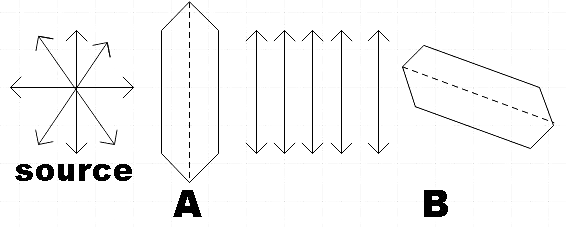
Nothing could explain such an observation other than the transverse nature of light. So, we could say that the electric field vectors vibrate in the direction that is perpendicular to the propagation direction. Therefore, we found that the transverse nature of light is shown by polarization of light.
Hence, option C is the right answer.
Note:
When light falls on a tourmaline plate, not only the waves with electric fields parallel to the optic axis pass through it but also all those components of other waves which are in the same direction as the pass axis of the plate pass through it. Natural light in general is considered un-polarized. Also, a sound wave which is a longitudinal wave cannot be polarized.
Complete answer:
In the question, we are given a number of properties of light and are asked to find which among them proves the transverse nature of light.
It is actually the polarization of light that shows that light is transverse in nature. Let us understand the property of polarization of light better.
By definition polarized waves are the waves that have vibrations in only one plane and the process by which we convert an unpolarized light to polarized light is polarization.
Consider an un-polarized source from which the light is passed through a tourmaline crystal to make it polarized or in other words, to make its vibration restricted to one plane.
Here, after the un-polarized light from the source is passed through A the light is restricted to vibrate in the plane parallel to the transmission axis of A. Then, when we keep B parallel to A, the intensity of light remains the same meaning that the same amount transmitted by A is also transmitted by B.
When we rotate B, we see that the intensity of light is reduced meaning that the amount transmitted by it is reduced and when B is kept perpendicular to A the intensity of light transmitted by it is zero meaning no light now passes through it.
Nothing could explain such an observation other than the transverse nature of light. So, we could say that the electric field vectors vibrate in the direction that is perpendicular to the propagation direction. Therefore, we found that the transverse nature of light is shown by polarization of light.
Hence, option C is the right answer.
Note:
When light falls on a tourmaline plate, not only the waves with electric fields parallel to the optic axis pass through it but also all those components of other waves which are in the same direction as the pass axis of the plate pass through it. Natural light in general is considered un-polarized. Also, a sound wave which is a longitudinal wave cannot be polarized.
Recently Updated Pages
Master Class 12 Business Studies: Engaging Questions & Answers for Success

Master Class 12 Biology: Engaging Questions & Answers for Success
Master Class 12 Chemistry: Engaging Questions & Answers for Success
Class 12 Question and Answer - Your Ultimate Solutions Guide
Master Class 11 Social Science: Engaging Questions & Answers for Success
Master Class 11 English: Engaging Questions & Answers for Success
Trending doubts
Which is more stable and why class 12 chemistry CBSE
Which are the Top 10 Largest Countries of the World?
Draw a labelled sketch of the human eye class 12 physics CBSE
Differentiate between homogeneous and heterogeneous class 12 chemistry CBSE
What are the major means of transport Explain each class 12 social science CBSE
Sulphuric acid is known as the king of acids State class 12 chemistry CBSE