




The total number of lone-pairs of electrons in melamine is:
Answer
 Verified
675.6k+ views
Hint: These questions can be solved if you know the structure of the following given compound and the catenation power of the elements forming the given compound and you should know about the valency of the elements to determine whether it will gain electrons or lose electrons to complete its octet.
Complete step by step solution:
> A lone pair is that pair of electrons which are not shared in another atom by covalent bond .They are found in the outermost shell of the atom. In other words, lone pairs are simply the pairs of electrons which do not participate in bond formation or bonding. They can also be called an unshared pair of electrons. If we have to identify these lone pairs we can simply use Lewis dot structure. According to the question we are asked to find out the total number of lone pairs in melamine, so let us first discuss melamine and its structure. Melamine has molecular formula ${C_3}{H_6}{N_6}$ or ${C_3}{N_3}{(N{H_2})_3}$ , and its IUPAC naming is 1,3,5-triazine
The structure is as follows:
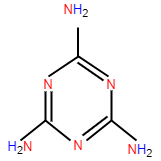
> As we know, nitrogen has 5 electrons in its outermost valence shell and hydrogen has 1 electron in its outermost valence shell and carbon has 4 electrons in its outermost shell. As we can see in the above structure of melamine nitrogen has bonding with both carbon and hydrogen. As nitrogen has shared its three electrons out of 5 electrons with one carbon and two hydrogen atoms , which means nitrogen has 2 electrons left in its outermost shell which are not shared by any other atom. From this conclusion we can say that now nitrogen has only one pair of electrons left in its outermost shell and as we have discussed above about lone pairs which are those pairs that do not participate in bonding. Thus, we can say that nitrogen has 1 lone pair left. Now, in the structure above we can see that there are 6 nitrogen which means it will form a bond with hydrogen and carbon with 3 bonds , similar as we have discussed before.
Hence, we can say that nitrogen has a total 6 lone pairs of electrons.
Note: We can prepare melamine by breaking down urea into cyanuric acid which then can be reacted to form melamine. Melamine can be used in industrial uses, as glues, as dinnerware, and as flame retardants. In daily life melamine is added to milk to increase the nitrogen content in milk and consequently increasing the protein content.
Complete step by step solution:
> A lone pair is that pair of electrons which are not shared in another atom by covalent bond .They are found in the outermost shell of the atom. In other words, lone pairs are simply the pairs of electrons which do not participate in bond formation or bonding. They can also be called an unshared pair of electrons. If we have to identify these lone pairs we can simply use Lewis dot structure. According to the question we are asked to find out the total number of lone pairs in melamine, so let us first discuss melamine and its structure. Melamine has molecular formula ${C_3}{H_6}{N_6}$ or ${C_3}{N_3}{(N{H_2})_3}$ , and its IUPAC naming is 1,3,5-triazine
The structure is as follows:
> As we know, nitrogen has 5 electrons in its outermost valence shell and hydrogen has 1 electron in its outermost valence shell and carbon has 4 electrons in its outermost shell. As we can see in the above structure of melamine nitrogen has bonding with both carbon and hydrogen. As nitrogen has shared its three electrons out of 5 electrons with one carbon and two hydrogen atoms , which means nitrogen has 2 electrons left in its outermost shell which are not shared by any other atom. From this conclusion we can say that now nitrogen has only one pair of electrons left in its outermost shell and as we have discussed above about lone pairs which are those pairs that do not participate in bonding. Thus, we can say that nitrogen has 1 lone pair left. Now, in the structure above we can see that there are 6 nitrogen which means it will form a bond with hydrogen and carbon with 3 bonds , similar as we have discussed before.
Hence, we can say that nitrogen has a total 6 lone pairs of electrons.
Note: We can prepare melamine by breaking down urea into cyanuric acid which then can be reacted to form melamine. Melamine can be used in industrial uses, as glues, as dinnerware, and as flame retardants. In daily life melamine is added to milk to increase the nitrogen content in milk and consequently increasing the protein content.
Recently Updated Pages
Explain the structure of megasporangium class 12 biology CBSE

Why is chloroform kept in dark coloured bottles class 12 chemistry CBSE
Derive the balancing condition of a Wheatstone bri class 12 physics CBSE
Draw VI characteristics of a pn junction diode Explain class 12 physics CBSE
Is it possible to carry pride in ones language too class 12 english CBSE
In a population at Hardy Weinberg equilibrium the allele class 12 biology CBSE
Trending doubts
Draw a labelled sketch of the human eye class 12 physics CBSE
Which are the Top 10 Largest Countries of the World?
Draw ray diagrams each showing i myopic eye and ii class 12 physics CBSE
One megawatt is equal to how many units of electri class 12 physics CBSE
Which is the correct genotypic ratio of mendel dihybrid class 12 biology CBSE
Give 10 examples of unisexual and bisexual flowers