




The total boundary length of a circle is called:
A. area
B. volume
C. circumference
D. diameter
Answer
 Verified
604.5k+ views
Hint: We here have been asked in the question what the total length of the boundary of a circle is called. For this, we will first draw a diagram of a circle to understand it completely. Then we will explain that the meaning of the total length of the boundary of a circle means the perimeter of the circle. Then we will tell what is the specific word for the perimeter of a circle. Hence, we will get our answer.
Complete step by step answer:
We have been asked about the total boundary length of a circle. A circle is shown as follows:
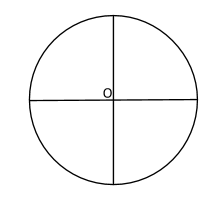
Now, we can see a circle with centre ‘O’.
The total length of the boundary of a circle is equal to its perimeter.
Now, we know that the perimeter of a circle is known as its diameter. Thus, the total length of the boundary of a circle is called its circumference.
The options A and B, i.e area and volume cannot be the right answers. They do not represent the length. Area is obtained by multiplying the length twice, i.e the unit is sq. length. Volume is obtained by multiplying the length thrice, i.e the unit is cubic length.
Diameter is the length of the chord that passes through the centre of the circle. So, it doesn’t represent the entire boundary length.
Thus, circumference is the required answer.
So, the correct answer is “Option C”.
Note: We should know the different terms related to a circle. They are given as follows:
1. Chord: a line joining any two pints on the boundary of a circle is called its chord.
2. Diameter: that chord of a circle which passes through its centre is called its diameter. It is the longest chord of the circle.
3. Radius: the line joining any point on the boundary of the circle to its centre is known as its radius. It is equal to half the diameter in length.
4. Circumference: the total boundary length, i.e. the perimeter of the circle is known as its circumference.
Complete step by step answer:
We have been asked about the total boundary length of a circle. A circle is shown as follows:
Now, we can see a circle with centre ‘O’.
The total length of the boundary of a circle is equal to its perimeter.
Now, we know that the perimeter of a circle is known as its diameter. Thus, the total length of the boundary of a circle is called its circumference.
The options A and B, i.e area and volume cannot be the right answers. They do not represent the length. Area is obtained by multiplying the length twice, i.e the unit is sq. length. Volume is obtained by multiplying the length thrice, i.e the unit is cubic length.
Diameter is the length of the chord that passes through the centre of the circle. So, it doesn’t represent the entire boundary length.
Thus, circumference is the required answer.
So, the correct answer is “Option C”.
Note: We should know the different terms related to a circle. They are given as follows:
1. Chord: a line joining any two pints on the boundary of a circle is called its chord.
2. Diameter: that chord of a circle which passes through its centre is called its diameter. It is the longest chord of the circle.
3. Radius: the line joining any point on the boundary of the circle to its centre is known as its radius. It is equal to half the diameter in length.
4. Circumference: the total boundary length, i.e. the perimeter of the circle is known as its circumference.
Recently Updated Pages
Master Class 12 Business Studies: Engaging Questions & Answers for Success

Master Class 12 Biology: Engaging Questions & Answers for Success
Master Class 12 Chemistry: Engaging Questions & Answers for Success
Class 12 Question and Answer - Your Ultimate Solutions Guide
Master Class 11 Social Science: Engaging Questions & Answers for Success
Master Class 11 English: Engaging Questions & Answers for Success
Trending doubts
Fill the blanks with the suitable prepositions 1 The class 9 english CBSE
Difference Between Plant Cell and Animal Cell
How many hours before the closure of election must class 9 social science CBSE
What is pollution? How many types of pollution? Define it
What is the Full Form of ICSE / ISC ?
Name 10 Living and Non living things class 9 biology CBSE