




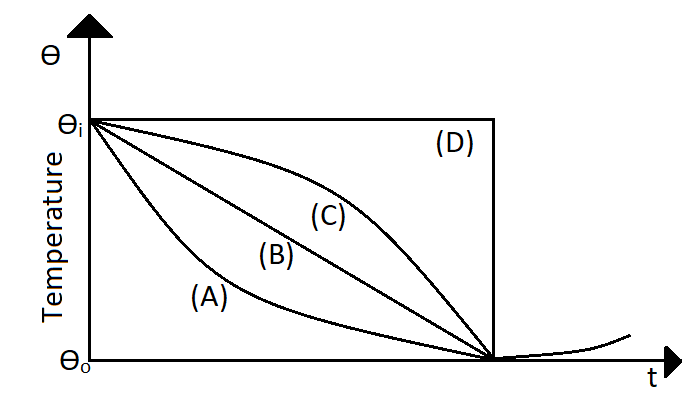
The temperature $\left( \theta \right)$ of “cup of coffee” in a BARISTA restaurant was plotted as a function of time. Which of the following curves may represent the plot?
Answer
 Verified
569.4k+ views
Hint
According to Newton’s law of cooling, we can state that the rate of heat loss of a body is directly proportional to the difference in temperature between the body and its surroundings and decays exponentially. So the graph will be of exponential decay.
Complete step by step answer
In the question, it is said that the temperature of a cup of coffee was plotted as a function of time. Now as time increases the temperature of the coffee decreases. This will be given by Newton’s law of cooling. According to the law, the rate of the decrease in temperature of a body is directly proportional to the difference between its temperature and the temperature of the environment. So the mathematical form of the law will be,
$\dfrac{{dT\left( t \right)}}{{dt}} \propto \left( {T - {T_{env}}} \right)$ where $T\left( t \right)$ is the temperature of the coffee in time $t$ and ${T_{env}}$ is the temperature of the surrounding environment.
Therefore removing the proportionality, $\dfrac{{dT\left( t \right)}}{{dt}} = - k\left[ {T\left( t \right) - {T_{env}}} \right]$ where $k$ is the constant of proportionality.
Now let us consider the initial temperature of the coffee as, ${T_o}$. So the difference in the temperature of the coffee and the surroundings initially is,
${y_o} = {T_o} - {T_{env}}$
And the difference between the temperatures at the time $t$ is,
$y\left( t \right) = T\left( t \right) - {T_{env}}$
By differentiating this equation on both sides with respect to $t$ we get,
$\dfrac{{dy\left( t \right)}}{{dt}} = \dfrac{d}{{dt}}\left[ {T\left( t \right) - {T_{env}}} \right]$
Since the temperature of the environment is almost constant with time, so differentiating it gives 0.
$\therefore \dfrac{{dy\left( t \right)}}{{dt}} = \dfrac{{dT\left( t \right)}}{{dt}}$
From Newton’s law of cooling, we can write,
$\dfrac{{dy\left( t \right)}}{{dt}} = - k\left[ {T\left( t \right) - {T_{env}}} \right]$
Now since, $y\left( t \right) = T\left( t \right) - {T_{env}}$, so
$\dfrac{{dy\left( t \right)}}{{dt}} = - ky\left( t \right)$
The solution of these type of differential equations are given as,
$y\left( t \right) = {y_o}{e^{ - kt}}$
So substituting the values we have,
$T\left( t \right) - {T_{env}} = \left( {{T_o} - {T_{env}}} \right){e^{ - kt}}$
Therefore we get,
$T\left( t \right) = {T_{env}} + \left( {{T_o} - {T_{env}}} \right){e^{ - kt}}$
Therefore the temperature is an exponential function of time. So the in the graph the temperature decays exponentially with time and we get,
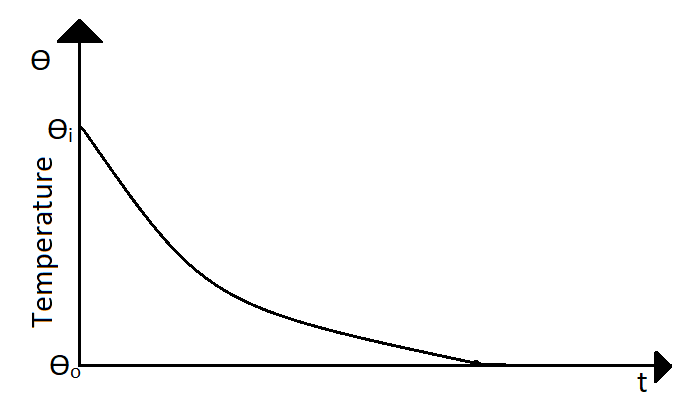
Therefore the correct answer will be option (A).
Note
Newton’s law of cooling can be applied in various cases to find the time with the help of the change in any substance’s temperature. It is specifically very applicable to crime scenes in finding time with a difference in temperature.
According to Newton’s law of cooling, we can state that the rate of heat loss of a body is directly proportional to the difference in temperature between the body and its surroundings and decays exponentially. So the graph will be of exponential decay.
Complete step by step answer
In the question, it is said that the temperature of a cup of coffee was plotted as a function of time. Now as time increases the temperature of the coffee decreases. This will be given by Newton’s law of cooling. According to the law, the rate of the decrease in temperature of a body is directly proportional to the difference between its temperature and the temperature of the environment. So the mathematical form of the law will be,
$\dfrac{{dT\left( t \right)}}{{dt}} \propto \left( {T - {T_{env}}} \right)$ where $T\left( t \right)$ is the temperature of the coffee in time $t$ and ${T_{env}}$ is the temperature of the surrounding environment.
Therefore removing the proportionality, $\dfrac{{dT\left( t \right)}}{{dt}} = - k\left[ {T\left( t \right) - {T_{env}}} \right]$ where $k$ is the constant of proportionality.
Now let us consider the initial temperature of the coffee as, ${T_o}$. So the difference in the temperature of the coffee and the surroundings initially is,
${y_o} = {T_o} - {T_{env}}$
And the difference between the temperatures at the time $t$ is,
$y\left( t \right) = T\left( t \right) - {T_{env}}$
By differentiating this equation on both sides with respect to $t$ we get,
$\dfrac{{dy\left( t \right)}}{{dt}} = \dfrac{d}{{dt}}\left[ {T\left( t \right) - {T_{env}}} \right]$
Since the temperature of the environment is almost constant with time, so differentiating it gives 0.
$\therefore \dfrac{{dy\left( t \right)}}{{dt}} = \dfrac{{dT\left( t \right)}}{{dt}}$
From Newton’s law of cooling, we can write,
$\dfrac{{dy\left( t \right)}}{{dt}} = - k\left[ {T\left( t \right) - {T_{env}}} \right]$
Now since, $y\left( t \right) = T\left( t \right) - {T_{env}}$, so
$\dfrac{{dy\left( t \right)}}{{dt}} = - ky\left( t \right)$
The solution of these type of differential equations are given as,
$y\left( t \right) = {y_o}{e^{ - kt}}$
So substituting the values we have,
$T\left( t \right) - {T_{env}} = \left( {{T_o} - {T_{env}}} \right){e^{ - kt}}$
Therefore we get,
$T\left( t \right) = {T_{env}} + \left( {{T_o} - {T_{env}}} \right){e^{ - kt}}$
Therefore the temperature is an exponential function of time. So the in the graph the temperature decays exponentially with time and we get,
Therefore the correct answer will be option (A).
Note
Newton’s law of cooling can be applied in various cases to find the time with the help of the change in any substance’s temperature. It is specifically very applicable to crime scenes in finding time with a difference in temperature.
Recently Updated Pages
Master Class 12 Economics: Engaging Questions & Answers for Success

Master Class 12 Physics: Engaging Questions & Answers for Success
Master Class 12 English: Engaging Questions & Answers for Success
Master Class 12 Social Science: Engaging Questions & Answers for Success
Master Class 12 Maths: Engaging Questions & Answers for Success
Master Class 12 Business Studies: Engaging Questions & Answers for Success
Trending doubts
Which are the Top 10 Largest Countries of the World?
What are the major means of transport Explain each class 12 social science CBSE
Draw a labelled sketch of the human eye class 12 physics CBSE
Why cannot DNA pass through cell membranes class 12 biology CBSE
Differentiate between insitu conservation and exsitu class 12 biology CBSE
Draw a neat and well labeled diagram of TS of ovary class 12 biology CBSE