




The tangents drawn from a point P to the ellipse make an angle ${{\theta }_{1}}$ and ${{\theta }_{2}}$ with the major axis; find the locus of P when,
$\tan {{\theta }_{1}}-\tan {{\theta }_{2}}$ is constant $=d$
Answer
 Verified
564.9k+ views
Hint: First write down the general equation of the ellipse and then the standard equation of tangent for ellipse for the tangent $y=mx\pm \sqrt{{{a}^{2}}{{m}^{2}}+{{b}^{2}}}$ , Let there be a point $P\left( h,k \right)$ that lies on that tangent. Now rewrite the tangent equation for the point $P\left( h,k \right)$ and then evaluate to form a quadratic expression in ‘m’ and proceed further to find the sum of roots, $\tan {{\theta }_{1}}+\tan {{\theta }_{2}}$ and then from there find the value of $\tan {{\theta }_{1}}-\tan {{\theta }_{2}}$
Complete step by step solution:
Let us write the general equation for an ellipse.
It is given by,
$\Rightarrow \dfrac{{{x}^{2}}}{{{a}^{2}}}+\dfrac{{{y}^{2}}}{{{b}^{2}}}=1$ considered that $\left( a>b \right)$
Hence, X-axis is the major axis.
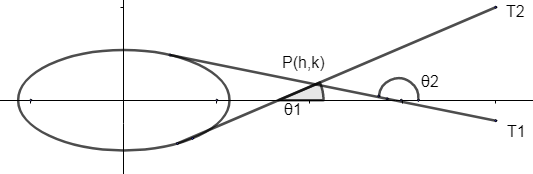
As we have the equation of tangent drawn from an external point with given slope is
$y=mx\pm \sqrt{{{a}^{2}}{{m}^{2}}+{{b}^{2}}}$
The slope of the tangent ${{T}_{1}}=\tan {{\theta }_{1}}$
And the slope of the tangent ${{T}_{2}}=\tan {{\theta }_{2}}$
Let us consider a point $P\left( h,k \right)$ that lies on this tangent.
We can rewrite the tangent equation as,
$\Rightarrow k=mh\pm \sqrt{{{a}^{2}}{{m}^{2}}+{{b}^{2}}}$
$\Rightarrow {{\left( k-mh \right)}^{2}}={{a}^{2}}{{m}^{2}}+{{b}^{2}}$
$\Rightarrow {{k}^{2}}+{{m}^{2}}{{h}^{2}}-2mkh={{a}^{2}}{{m}^{2}}+{{b}^{2}}$
$\Rightarrow {{m}^{2}}\left( {{h}^{2}}-{{a}^{2}} \right)-2mhk+{{k}^{2}}-{{b}^{2}}=0$
As m is a quadratic function, hence it has two roots or two tangents passing through P are there with slopes $\tan {{\theta }_{1}}$ and $\tan {{\theta }_{2}}$
Hence, $\tan {{\theta }_{1}}$ and $\tan {{\theta }_{2}}$ are roots of quadratic obtained.
The sum of roots for the quadratic equation is given by,
The Sum of roots is given by $=\dfrac{-b}{a}$ in $a{{x}^{2}}+bx+c=0$
$\Rightarrow \tan {{\theta }_{1}}+\tan {{\theta }_{2}}=\dfrac{2hk}{{{h}^{2}}-{{a}^{2}}}$
And the product of roots is given by,
Product of roots is given by $\dfrac{c}{a}$ in $a{{x}^{2}}+bx+c=0$
$\Rightarrow \tan {{\theta }_{1}}\tan {{\theta }_{2}}=\dfrac{{{k}^{2}}-{{b}^{2}}}{{{h}^{2}}-{{a}^{2}}}$
We also know that,
$\Rightarrow {{\left( a+b \right)}^{2}}={{\left( a-b \right)}^{2}}+4ab$
Substituting the slopes, we get,
$\Rightarrow {{\left( \tan {{\theta }_{1}}-\tan {{\theta }_{2}} \right)}^{2}}={{\left( \tan {{\theta }_{1}}+\tan {{\theta }_{2}} \right)}^{2}}+4\tan {{\theta }_{1}}\tan {{\theta }_{2}}$
As $\tan {{\theta }_{1}}-\tan {{\theta }_{2}}=d$ (given)
$\Rightarrow {{d}^{2}}={{\left( \dfrac{2hk}{{{h}^{2}}-{{a}^{2}}} \right)}^{2}}+4\left( \dfrac{{{k}^{2}}-{{b}^{2}}}{{{h}^{2}}-{{a}^{2}}} \right)$
On further evaluating we get,
$\Rightarrow {{d}^{2}}=\dfrac{4{{h}^{2}}{{k}^{2}}}{{{\left( {{h}^{2}}-{{a}^{2}} \right)}^{2}}}+4\left( \dfrac{{{k}^{2}}-{{b}^{2}}}{{{h}^{2}}-{{a}^{2}}} \right)$
$\Rightarrow {{d}^{2}}=\dfrac{4{{h}^{2}}{{k}^{2}}-4\left( {{h}^{2}}-{{a}^{2}} \right)\left( {{k}^{2}}-{{b}^{2}} \right)}{{{\left( {{h}^{2}}-{{a}^{2}} \right)}^{2}}}$
$\Rightarrow {{d}^{2}}{{\left( {{h}^{2}}-{{a}^{2}} \right)}^{2}}=4{{h}^{2}}{{k}^{2}}+4\left( {{k}^{2}}-{{b}^{2}} \right)\left( {{h}^{2}}-{{a}^{2}} \right)$
$\Rightarrow {{d}^{2}}{{\left( {{h}^{2}}-{{a}^{2}} \right)}^{2}}=4\left( {{h}^{2}}{{k}^{2}}-{{h}^{2}}{{k}^{2}}+{{a}^{2}}{{k}^{2}}+{{h}^{2}}{{b}^{2}}-{{a}^{2}}{{b}^{2}} \right)$
On simplifying,
$\Rightarrow {{d}^{2}}{{\left( {{h}^{2}}-{{a}^{2}} \right)}^{2}}=4\left( {{a}^{2}}{{k}^{2}}+{{h}^{2}}{{b}^{2}}-{{a}^{2}}{{b}^{2}} \right)$
Replacing (h, k) by (x, y) to get locus: -
$\Rightarrow {{d}^{2}}{{\left( {{x}^{2}}-{{a}^{2}} \right)}^{2}}=4\left( {{x}^{2}}-{{a}^{2}} \right)\left( {{y}^{2}}-{{b}^{2}} \right)+4{{x}^{2}}{{y}^{2}}$
Now the required locus is ${{d}^{2}}{{\left( {{x}^{2}}-{{a}^{2}} \right)}^{2}}=4\left( {{x}^{2}}-{{a}^{2}} \right)\left( {{y}^{2}}-{{b}^{2}} \right)+4{{x}^{2}}{{y}^{2}}$
Note: Eliminating ${{\theta }_{1}}\And {{\theta }_{2}}$ by using the given relation ${{\tan }^{2}}{{\theta }_{1}}+{{\tan }^{2}}{{\theta }_{1}}=\lambda$ with the help of quadratic formed in ‘m’ i.e. $y=mx\pm \sqrt{{{a}^{2}}{{m}^{2}}+{{b}^{2}}}$ or ${{\left( y-mx \right)}^{2}}={{a}^{2}}{{m}^{2}}+{{b}^{2}}$ by using properties of roots is the key point of this equation.
Complete step by step solution:
Let us write the general equation for an ellipse.
It is given by,
$\Rightarrow \dfrac{{{x}^{2}}}{{{a}^{2}}}+\dfrac{{{y}^{2}}}{{{b}^{2}}}=1$ considered that $\left( a>b \right)$
Hence, X-axis is the major axis.
As we have the equation of tangent drawn from an external point with given slope is
$y=mx\pm \sqrt{{{a}^{2}}{{m}^{2}}+{{b}^{2}}}$
The slope of the tangent ${{T}_{1}}=\tan {{\theta }_{1}}$
And the slope of the tangent ${{T}_{2}}=\tan {{\theta }_{2}}$
Let us consider a point $P\left( h,k \right)$ that lies on this tangent.
We can rewrite the tangent equation as,
$\Rightarrow k=mh\pm \sqrt{{{a}^{2}}{{m}^{2}}+{{b}^{2}}}$
$\Rightarrow {{\left( k-mh \right)}^{2}}={{a}^{2}}{{m}^{2}}+{{b}^{2}}$
$\Rightarrow {{k}^{2}}+{{m}^{2}}{{h}^{2}}-2mkh={{a}^{2}}{{m}^{2}}+{{b}^{2}}$
$\Rightarrow {{m}^{2}}\left( {{h}^{2}}-{{a}^{2}} \right)-2mhk+{{k}^{2}}-{{b}^{2}}=0$
As m is a quadratic function, hence it has two roots or two tangents passing through P are there with slopes $\tan {{\theta }_{1}}$ and $\tan {{\theta }_{2}}$
Hence, $\tan {{\theta }_{1}}$ and $\tan {{\theta }_{2}}$ are roots of quadratic obtained.
The sum of roots for the quadratic equation is given by,
The Sum of roots is given by $=\dfrac{-b}{a}$ in $a{{x}^{2}}+bx+c=0$
$\Rightarrow \tan {{\theta }_{1}}+\tan {{\theta }_{2}}=\dfrac{2hk}{{{h}^{2}}-{{a}^{2}}}$
And the product of roots is given by,
Product of roots is given by $\dfrac{c}{a}$ in $a{{x}^{2}}+bx+c=0$
$\Rightarrow \tan {{\theta }_{1}}\tan {{\theta }_{2}}=\dfrac{{{k}^{2}}-{{b}^{2}}}{{{h}^{2}}-{{a}^{2}}}$
We also know that,
$\Rightarrow {{\left( a+b \right)}^{2}}={{\left( a-b \right)}^{2}}+4ab$
Substituting the slopes, we get,
$\Rightarrow {{\left( \tan {{\theta }_{1}}-\tan {{\theta }_{2}} \right)}^{2}}={{\left( \tan {{\theta }_{1}}+\tan {{\theta }_{2}} \right)}^{2}}+4\tan {{\theta }_{1}}\tan {{\theta }_{2}}$
As $\tan {{\theta }_{1}}-\tan {{\theta }_{2}}=d$ (given)
$\Rightarrow {{d}^{2}}={{\left( \dfrac{2hk}{{{h}^{2}}-{{a}^{2}}} \right)}^{2}}+4\left( \dfrac{{{k}^{2}}-{{b}^{2}}}{{{h}^{2}}-{{a}^{2}}} \right)$
On further evaluating we get,
$\Rightarrow {{d}^{2}}=\dfrac{4{{h}^{2}}{{k}^{2}}}{{{\left( {{h}^{2}}-{{a}^{2}} \right)}^{2}}}+4\left( \dfrac{{{k}^{2}}-{{b}^{2}}}{{{h}^{2}}-{{a}^{2}}} \right)$
$\Rightarrow {{d}^{2}}=\dfrac{4{{h}^{2}}{{k}^{2}}-4\left( {{h}^{2}}-{{a}^{2}} \right)\left( {{k}^{2}}-{{b}^{2}} \right)}{{{\left( {{h}^{2}}-{{a}^{2}} \right)}^{2}}}$
$\Rightarrow {{d}^{2}}{{\left( {{h}^{2}}-{{a}^{2}} \right)}^{2}}=4{{h}^{2}}{{k}^{2}}+4\left( {{k}^{2}}-{{b}^{2}} \right)\left( {{h}^{2}}-{{a}^{2}} \right)$
$\Rightarrow {{d}^{2}}{{\left( {{h}^{2}}-{{a}^{2}} \right)}^{2}}=4\left( {{h}^{2}}{{k}^{2}}-{{h}^{2}}{{k}^{2}}+{{a}^{2}}{{k}^{2}}+{{h}^{2}}{{b}^{2}}-{{a}^{2}}{{b}^{2}} \right)$
On simplifying,
$\Rightarrow {{d}^{2}}{{\left( {{h}^{2}}-{{a}^{2}} \right)}^{2}}=4\left( {{a}^{2}}{{k}^{2}}+{{h}^{2}}{{b}^{2}}-{{a}^{2}}{{b}^{2}} \right)$
Replacing (h, k) by (x, y) to get locus: -
$\Rightarrow {{d}^{2}}{{\left( {{x}^{2}}-{{a}^{2}} \right)}^{2}}=4\left( {{x}^{2}}-{{a}^{2}} \right)\left( {{y}^{2}}-{{b}^{2}} \right)+4{{x}^{2}}{{y}^{2}}$
Now the required locus is ${{d}^{2}}{{\left( {{x}^{2}}-{{a}^{2}} \right)}^{2}}=4\left( {{x}^{2}}-{{a}^{2}} \right)\left( {{y}^{2}}-{{b}^{2}} \right)+4{{x}^{2}}{{y}^{2}}$
Note: Eliminating ${{\theta }_{1}}\And {{\theta }_{2}}$ by using the given relation ${{\tan }^{2}}{{\theta }_{1}}+{{\tan }^{2}}{{\theta }_{1}}=\lambda$ with the help of quadratic formed in ‘m’ i.e. $y=mx\pm \sqrt{{{a}^{2}}{{m}^{2}}+{{b}^{2}}}$ or ${{\left( y-mx \right)}^{2}}={{a}^{2}}{{m}^{2}}+{{b}^{2}}$ by using properties of roots is the key point of this equation.
Recently Updated Pages
Master Class 11 Economics: Engaging Questions & Answers for Success

Master Class 11 English: Engaging Questions & Answers for Success
Master Class 11 Maths: Engaging Questions & Answers for Success
Class 11 Question and Answer - Your Ultimate Solutions Guide
Master Class 11 Social Science: Engaging Questions & Answers for Success
Master Class 11 Business Studies: Engaging Questions & Answers for Success
Trending doubts
One Metric ton is equal to kg A 10000 B 1000 C 100 class 11 physics CBSE
There are 720 permutations of the digits 1 2 3 4 5 class 11 maths CBSE
Differentiate between an exothermic and an endothermic class 11 chemistry CBSE
In what year Guru Nanak Dev ji was born A15 April 1469 class 11 social science CBSE
Difference Between Prokaryotic Cells and Eukaryotic Cells
State and prove Bernoullis theorem class 11 physics CBSE