




The Sun subtends an angle of half a degree at the pole of a concave mirror which has a radius of curvature of $15{\text{ }}m$. Then the size (diameter) of the image of the Sun formed by the concave mirror is.
A. $7.5{\text{ }}cm$
B. $6.55{\text{ }}cm$
C. $3.7{\text{ }}cm$
D. $13.1{\text{ }}cm$
Answer
 Verified
560.1k+ views
Hint: We have to first draw a diagram of the problem given. By using the concept that when an object is placed at infinity from the surface of a mirror the image forms at the focus of the mirror, we will find the construction of the diagram. Then by using trigonometric concepts we will find the answer.
Complete answer:
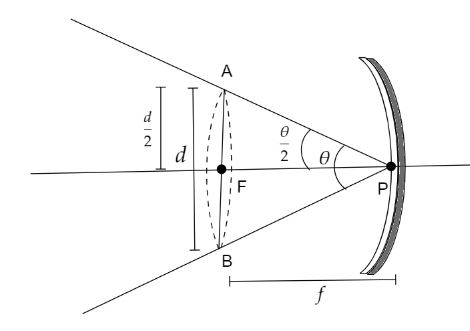
The Sun is at infinity which is the object. When an object is at infinity, the image formed due to a concave mirror after reflection from it is at the focus.The pole of the mirror is given as P and the focus as F. Let $d$ be the diameter of the image of the Sun.In the given, the radius of curvature $r = 15{\text{ }}m$
Let the focal length of the mirror be $f$.The relation between radius of curvature $r$ and focal length $f$ is $f = \dfrac{r}{2}$.
So, the focal length $f$ of the mirror$ = \dfrac{{15}}{2} = 7.5{\text{ }}m$
As per the given question, the sun is subtending ${\dfrac{1}{2}^ \circ }$ at the pole.
So, $\dfrac{\theta }{2} = {\dfrac{1}{2}^ \circ } - - - - - \left( 1 \right)$
Converting the given angle in radian we get,
${\dfrac{1}{2}^ \circ } = \dfrac{\pi }{{180}} \times \dfrac{1}{2} = \dfrac{\pi }{{360}}$ radian$ - - - - - \left( 2 \right)$
Now, from the given triangle AFP we get,
$\tan \dfrac{\theta }{2} = \dfrac{{AF}}{{FP}} = \dfrac{{\dfrac{d}{2}}}{f}$
Now, as $\tan \dfrac{\theta }{2}$ is very small, so we consider $\tan \dfrac{\theta }{2} = \dfrac{\theta }{2}$
Hence, we get,
$\dfrac{\theta }{2} = \dfrac{d}{{2f}}$
From$\left( 1 \right)$we get,
${\dfrac{1}{2}^ \circ } = \dfrac{d}{{2f}}$
Again, from $\left( 2 \right)$ we get,
$\dfrac{\pi }{{360}} = \dfrac{d}{{2f}}$
Substituting the value of $f$ we get,
$\dfrac{\pi }{{360}} = \dfrac{d}{{2 \times 7.5}} = \dfrac{d}{{15}}$
$ \therefore d = \dfrac{{22}}{{7 \times 24}} = 0.131$
The diameter of the image of the Sun$ = 0.131{\text{ }}m = 13.1{\text{ }}cm$
Therefore, the correct option is D.
Note: It must be noted that when an object is placed at infinity to a concave mirror the image will always form at the focus of the mirror. The ray of the light is normally considered to be parallel as it comes from infinity. When the angle subtended is very small, then we can omit the trigonometric identity as the difference in value is almost the same.
Complete answer:
The Sun is at infinity which is the object. When an object is at infinity, the image formed due to a concave mirror after reflection from it is at the focus.The pole of the mirror is given as P and the focus as F. Let $d$ be the diameter of the image of the Sun.In the given, the radius of curvature $r = 15{\text{ }}m$
Let the focal length of the mirror be $f$.The relation between radius of curvature $r$ and focal length $f$ is $f = \dfrac{r}{2}$.
So, the focal length $f$ of the mirror$ = \dfrac{{15}}{2} = 7.5{\text{ }}m$
As per the given question, the sun is subtending ${\dfrac{1}{2}^ \circ }$ at the pole.
So, $\dfrac{\theta }{2} = {\dfrac{1}{2}^ \circ } - - - - - \left( 1 \right)$
Converting the given angle in radian we get,
${\dfrac{1}{2}^ \circ } = \dfrac{\pi }{{180}} \times \dfrac{1}{2} = \dfrac{\pi }{{360}}$ radian$ - - - - - \left( 2 \right)$
Now, from the given triangle AFP we get,
$\tan \dfrac{\theta }{2} = \dfrac{{AF}}{{FP}} = \dfrac{{\dfrac{d}{2}}}{f}$
Now, as $\tan \dfrac{\theta }{2}$ is very small, so we consider $\tan \dfrac{\theta }{2} = \dfrac{\theta }{2}$
Hence, we get,
$\dfrac{\theta }{2} = \dfrac{d}{{2f}}$
From$\left( 1 \right)$we get,
${\dfrac{1}{2}^ \circ } = \dfrac{d}{{2f}}$
Again, from $\left( 2 \right)$ we get,
$\dfrac{\pi }{{360}} = \dfrac{d}{{2f}}$
Substituting the value of $f$ we get,
$\dfrac{\pi }{{360}} = \dfrac{d}{{2 \times 7.5}} = \dfrac{d}{{15}}$
$ \therefore d = \dfrac{{22}}{{7 \times 24}} = 0.131$
The diameter of the image of the Sun$ = 0.131{\text{ }}m = 13.1{\text{ }}cm$
Therefore, the correct option is D.
Note: It must be noted that when an object is placed at infinity to a concave mirror the image will always form at the focus of the mirror. The ray of the light is normally considered to be parallel as it comes from infinity. When the angle subtended is very small, then we can omit the trigonometric identity as the difference in value is almost the same.
Recently Updated Pages
Which of the following graphs shows the variation of class 12 physics CBSE

Draw a labelled diagram of the human male reproductive class 12 biology CBSE
Describe the experiment to compare the emf of two cells class 12 physics CBSE
What is standard hydrogen electrode
What is conventional current and electric current class 12 physics CBSE
2Bromopentane is treated with an alcoholic KOH solution class 12 chemistry CBSE
Trending doubts
Draw a labelled sketch of the human eye class 12 physics CBSE
Which are the Top 10 Largest Countries of the World?
A member of Simon commission later became Prime Minister class 12 social science CBSE
Differentiate between homogeneous and heterogeneous class 12 chemistry CBSE
Draw ray diagrams each showing i myopic eye and ii class 12 physics CBSE
Which is the correct genotypic ratio of mendel dihybrid class 12 biology CBSE