




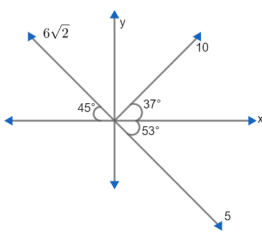
The sum of these three vectors is:
\[\begin{align}
& A.4i+4j \\
& B.5i-2j \\
& C.4i+3j \\
& D.5i+8j \\
\end{align}\]
Answer
 Verified
635.1k+ views
Hint: As we can see in the given figure that, there are a total three vectors. So, first of all we will write each vector in their x-component and y-component and then we will add all the x-component and y-component to get the x, y component of the resultant vector of sum of these three vectors.
Complete step-by-step answer:
We have been asked to find the sum of three vectors as shown below,
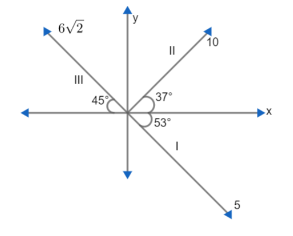
Let, the vectors name as I, II and III as shown in the figure.
Now, we will write each vector in their x-component and y-component as below,
For vector I, we have
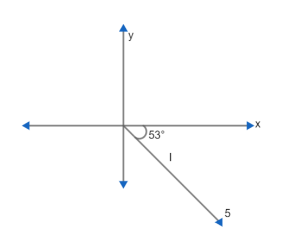
x-component \[\Rightarrow 5\cos {{53}^{\circ }}\]
Since, we know that \[\cos {{53}^{\circ }}=\dfrac{3}{5}\]
\[\Rightarrow \text{x-component=5}\times \dfrac{3}{5}=3\]
y-component \[\Rightarrow -5\sin {{53}^{\circ }}\]
Using the value of \[\sin {{53}^{\circ }}=\dfrac{4}{5}\]
\[\Rightarrow y\text{-component=-5}\times \dfrac{4}{5}=-4\]
For vector II, we have
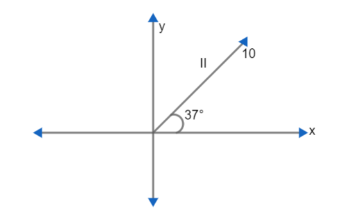
x-component \[\Rightarrow \text{10cos3}{{\text{7}}^{\circ }}\]
Using the value of \[\text{cos3}{{\text{7}}^{\circ }}=\dfrac{4}{5}\]
\[\Rightarrow \text{x-component=10}\times \dfrac{4}{5}=8\]
y-component \[\Rightarrow 10\sin {{37}^{\circ }}\]
Using the value of \[\sin {{37}^{\circ }}=\dfrac{3}{5}\]
\[\Rightarrow y\text{-component=10}\times \dfrac{3}{5}=6\]
For vector III, we have
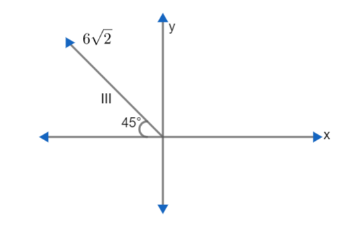
x-component \[\Rightarrow -6\sqrt{2}\cos {{45}^{\circ }}\]
Using the value of \[\cos {{45}^{\circ }}=\dfrac{1}{\sqrt{2}}\]
\[\Rightarrow \text{x-component=-6}\sqrt{2}\times \dfrac{1}{\sqrt{2}}=-6\]
y-component \[\Rightarrow 6\sqrt{2}\sin {{45}^{\circ }}\]
Using the value of \[\sin {{45}^{\circ }}=\dfrac{1}{\sqrt{2}}\]
\[\Rightarrow y\text{-component=6}\sqrt{2}\times \dfrac{1}{\sqrt{2}}=6\]
Now, the x-component of the sum of all the three vectors is equal to the sum of the x-component of each vector.
x-component of resultant vector \[\Rightarrow 3+8-6=5\]
Similarly, y-component of resultant vector \[\Rightarrow -4+6+6=8\]
Hence, the resultant vector will be \[5i+8j\]
So, the correct answer is “Option D”.
Note: Be careful while finding the x and y components of the vector, as there is a chance that you might make a sign mistake. So, take care of the quadrant in which the vector lies. Also, you can use another method in which you add the two vectors first and the resultant will be added with the third resultant.
Complete step-by-step answer:
We have been asked to find the sum of three vectors as shown below,
Let, the vectors name as I, II and III as shown in the figure.
Now, we will write each vector in their x-component and y-component as below,
For vector I, we have
x-component \[\Rightarrow 5\cos {{53}^{\circ }}\]
Since, we know that \[\cos {{53}^{\circ }}=\dfrac{3}{5}\]
\[\Rightarrow \text{x-component=5}\times \dfrac{3}{5}=3\]
y-component \[\Rightarrow -5\sin {{53}^{\circ }}\]
Using the value of \[\sin {{53}^{\circ }}=\dfrac{4}{5}\]
\[\Rightarrow y\text{-component=-5}\times \dfrac{4}{5}=-4\]
For vector II, we have
x-component \[\Rightarrow \text{10cos3}{{\text{7}}^{\circ }}\]
Using the value of \[\text{cos3}{{\text{7}}^{\circ }}=\dfrac{4}{5}\]
\[\Rightarrow \text{x-component=10}\times \dfrac{4}{5}=8\]
y-component \[\Rightarrow 10\sin {{37}^{\circ }}\]
Using the value of \[\sin {{37}^{\circ }}=\dfrac{3}{5}\]
\[\Rightarrow y\text{-component=10}\times \dfrac{3}{5}=6\]
For vector III, we have
x-component \[\Rightarrow -6\sqrt{2}\cos {{45}^{\circ }}\]
Using the value of \[\cos {{45}^{\circ }}=\dfrac{1}{\sqrt{2}}\]
\[\Rightarrow \text{x-component=-6}\sqrt{2}\times \dfrac{1}{\sqrt{2}}=-6\]
y-component \[\Rightarrow 6\sqrt{2}\sin {{45}^{\circ }}\]
Using the value of \[\sin {{45}^{\circ }}=\dfrac{1}{\sqrt{2}}\]
\[\Rightarrow y\text{-component=6}\sqrt{2}\times \dfrac{1}{\sqrt{2}}=6\]
Now, the x-component of the sum of all the three vectors is equal to the sum of the x-component of each vector.
x-component of resultant vector \[\Rightarrow 3+8-6=5\]
Similarly, y-component of resultant vector \[\Rightarrow -4+6+6=8\]
Hence, the resultant vector will be \[5i+8j\]
So, the correct answer is “Option D”.
Note: Be careful while finding the x and y components of the vector, as there is a chance that you might make a sign mistake. So, take care of the quadrant in which the vector lies. Also, you can use another method in which you add the two vectors first and the resultant will be added with the third resultant.
Recently Updated Pages
Master Class 12 Business Studies: Engaging Questions & Answers for Success

Master Class 12 Chemistry: Engaging Questions & Answers for Success
Master Class 12 Biology: Engaging Questions & Answers for Success
Class 12 Question and Answer - Your Ultimate Solutions Guide
Master Class 11 English: Engaging Questions & Answers for Success
Master Class 11 Social Science: Engaging Questions & Answers for Success
Trending doubts
Which are the Top 10 Largest Countries of the World?
The total number of vertebrae in man is a30 b31 c32 class 12 biology CBSE
Draw a labelled sketch of the human eye class 12 physics CBSE
The number of cranial nerves in a frog is A 10 pairs class 12 biology CBSE
Differentiate between homogeneous and heterogeneous class 12 chemistry CBSE
Differentiate between Pyramid of energy and pyramid class 12 biology CBSE