




The structure of diborane $({B_2}{H_6})$ contains:
A.Four 2C-2e bonds and two 3C-2e bonds
B.Two 2C-2e bonds and 3C-2e bonds
C.Two 2C-2e bonds and four 3C-2e bonds
D.Four 2C-2e bonds and four 3C-2e bonds.
Answer
 Verified
621.6k+ views
Hint: Diborane is a chemical compound that consists of boron and hydrogen atoms. Its molecular formula is $({B_2}{H_6})$. The structure of diborane is based on hybridization.
Complete step by step answer:
Since the atomic number of boron is 5 and the electronic configuration of boron is in the ground state is $1{s^2},2{s^2},2{p^1}$. In the excited state, the electron from 2s orbital jumps in 2p orbital hence in the excited state the electronic configuration is $1{s^2},2{s^1},2p{}_x^1,2p_y^1,2p_z^0$ and it undergoes $s{p^3}$ hybridization.
The two half-filled hybrid orbitals of each boron atom overlap with the half-filled orbitals of hydrogen atom forming a normal covalent bond whereas third half-filled hybrid orbital of boron atom and vacant hybrid orbital of second boron atom overlap simultaneously with the half-filled orbital of H- atom, thus the electron cloud contain two electrons but spread over three atoms that why this bond is called three centres electron-pair bond. The structure of diborane.
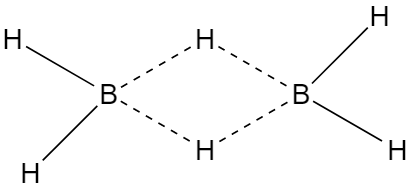
The bond length of terminal B-H bond is 119pm. And the distance between two boron atoms is 178pm.
Hence the correct answer is option A.
Note:
Alternatively, according to X-ray diffraction studies, there are two types of hydrogen atoms i.e., four-terminal hydrogen atoms and two bridge hydrogen atoms. The four-terminal hydrogen atom forms a normal covalent bond with boron hence it is quite strong whereas each bridge hydrogen atom is bonded to two boron atoms by a pair of electrons. In other words there are three centre electron-pair bonds and due to resemblance with bananas, it is also known as a banana bond. The three centre electron-pair bond is quite different from the normal covalent bond hence it is a weak bond.
Complete step by step answer:
Since the atomic number of boron is 5 and the electronic configuration of boron is in the ground state is $1{s^2},2{s^2},2{p^1}$. In the excited state, the electron from 2s orbital jumps in 2p orbital hence in the excited state the electronic configuration is $1{s^2},2{s^1},2p{}_x^1,2p_y^1,2p_z^0$ and it undergoes $s{p^3}$ hybridization.
The two half-filled hybrid orbitals of each boron atom overlap with the half-filled orbitals of hydrogen atom forming a normal covalent bond whereas third half-filled hybrid orbital of boron atom and vacant hybrid orbital of second boron atom overlap simultaneously with the half-filled orbital of H- atom, thus the electron cloud contain two electrons but spread over three atoms that why this bond is called three centres electron-pair bond. The structure of diborane.
The bond length of terminal B-H bond is 119pm. And the distance between two boron atoms is 178pm.
Hence the correct answer is option A.
Note:
Alternatively, according to X-ray diffraction studies, there are two types of hydrogen atoms i.e., four-terminal hydrogen atoms and two bridge hydrogen atoms. The four-terminal hydrogen atom forms a normal covalent bond with boron hence it is quite strong whereas each bridge hydrogen atom is bonded to two boron atoms by a pair of electrons. In other words there are three centre electron-pair bonds and due to resemblance with bananas, it is also known as a banana bond. The three centre electron-pair bond is quite different from the normal covalent bond hence it is a weak bond.
Recently Updated Pages
Master Class 11 English: Engaging Questions & Answers for Success

Master Class 11 Social Science: Engaging Questions & Answers for Success
Master Class 11 Maths: Engaging Questions & Answers for Success
Master Class 11 Biology: Engaging Questions & Answers for Success
Master Class 11 Physics: Engaging Questions & Answers for Success
Master Class 11 Chemistry: Engaging Questions & Answers for Success
Trending doubts
One Metric ton is equal to kg A 10000 B 1000 C 100 class 11 physics CBSE
Difference Between Prokaryotic Cells and Eukaryotic Cells
Find the value of the expression given below sin 30circ class 11 maths CBSE
1 ton equals to A 100 kg B 1000 kg C 10 kg D 10000 class 11 physics CBSE
Two of the body parts which do not appear in MRI are class 11 biology CBSE
What are hard magnetic materials class 11 physics CBSE