




The stem of Turmeric is
(a)Corm
(b)Bulb
(c)Rhizome
(d)Tuber
Answer
 Verified
662.7k+ views
Hint: It is an underground stem, which bears nodes and internodes and is fleshy due to the storage of food. It shows branching and is placed horizontally into the soil.
Complete answer:
Turmeric stem is an example of a rhizome. These give the appearance of sympodial axis rhizome, which means the lateral branches appear opposite to the leaves. The rhizome is also known as rootstock. Edible canna, ginger, and water lily are also rhizomes. The branching of rhizomes may be monopodial or sympodial.
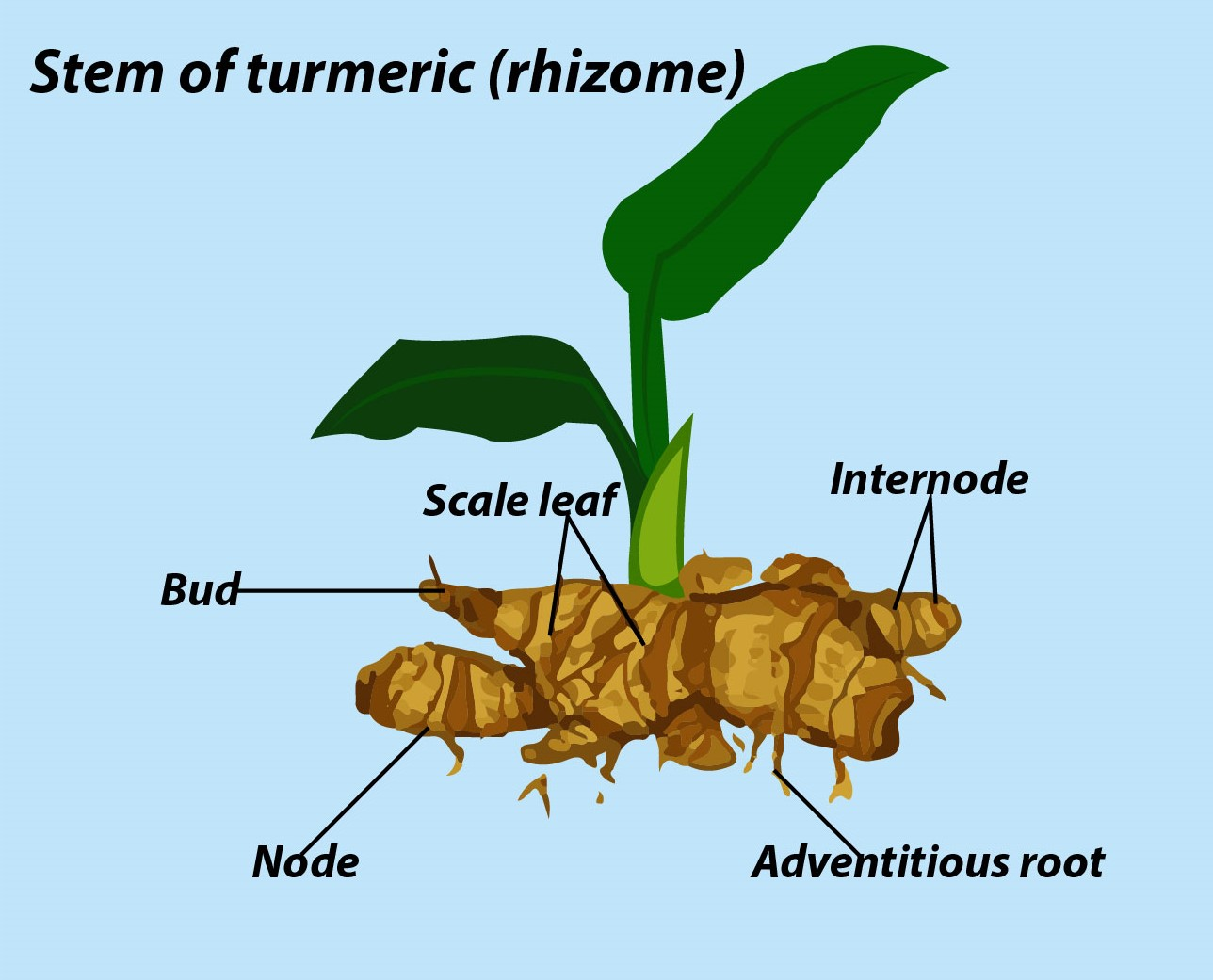
Additional Information:
-A corm is short, thick, and unbranched. The corm bears buds at its nodes. Alocasia, Gladiolus, Colocasia, Crocus, Colchicum, and Freesia are examples of the corm. A Corm is covered by thin sheathing leaves called scales.
-A bulb may be regarded as a short underground with a fleshy leaf base called scales. A bulb contains a reduced and disc-like stem. The discoidal shape of the bulb is convex or conical in shape that bears highly compressed internodes.
-Potato is an example of a tuber. When the underground stem becomes enlarged at the growing tips by the accumulation of stored food, commonly starch, it is called a tuber. In potato, several lenticels are present for gaseous exchange. Cyperus, Helianthus, Stachys are examples of tubers. In tubers, eye buds develop into small shoots, and from its base, adventitious roots develop.
So, the correct answer is, ‘Rhizome.’
Note: -Turmeric is yellow colored due to the presence of a compound called curcumin. It is a common Indian spice. The scientific name of turmeric is Curcuma longa.
-A bulb is of two types: tunicated and scaly. In the tunicated type, concentric layers are present and in scaly type, a series of angular scales are present.
Complete answer:
Turmeric stem is an example of a rhizome. These give the appearance of sympodial axis rhizome, which means the lateral branches appear opposite to the leaves. The rhizome is also known as rootstock. Edible canna, ginger, and water lily are also rhizomes. The branching of rhizomes may be monopodial or sympodial.
Additional Information:
-A corm is short, thick, and unbranched. The corm bears buds at its nodes. Alocasia, Gladiolus, Colocasia, Crocus, Colchicum, and Freesia are examples of the corm. A Corm is covered by thin sheathing leaves called scales.
-A bulb may be regarded as a short underground with a fleshy leaf base called scales. A bulb contains a reduced and disc-like stem. The discoidal shape of the bulb is convex or conical in shape that bears highly compressed internodes.
-Potato is an example of a tuber. When the underground stem becomes enlarged at the growing tips by the accumulation of stored food, commonly starch, it is called a tuber. In potato, several lenticels are present for gaseous exchange. Cyperus, Helianthus, Stachys are examples of tubers. In tubers, eye buds develop into small shoots, and from its base, adventitious roots develop.
So, the correct answer is, ‘Rhizome.’
Note: -Turmeric is yellow colored due to the presence of a compound called curcumin. It is a common Indian spice. The scientific name of turmeric is Curcuma longa.
-A bulb is of two types: tunicated and scaly. In the tunicated type, concentric layers are present and in scaly type, a series of angular scales are present.
Recently Updated Pages
If x a + bt + ct2 where x is in meters and t is in class 11 physics CBSE

A car covers the first half distance between two places class 11 physics CBSE
The resultant of two vectors overrightarrow P and overrightarrow class 11 physics CBSE
Find the value of cos 135 class 11 maths CBSE
A mass M is held in place by an applied force F and class 11 physics CBSE
A solution of glucose in water is labelled as 10 dfracwv class 11 chemistry CBSE
Trending doubts
One Metric ton is equal to kg A 10000 B 1000 C 100 class 11 physics CBSE
Find the value of the expression given below sin 30circ class 11 maths CBSE
What do you mean by retardation What is its SI uni class 11 physics CBSE
Draw a diagram of nephron and explain its structur class 11 biology CBSE
10 examples of friction in our daily life
Difference between physical and chemical change class 11 chemistry CBSE