




The ‘spin only’ magnetic moment of $N{i^{2 + }}$ in aqueous solution would be:
A. $\sqrt 6 BM$
B. $\sqrt {15} BM$
C. $\sqrt 2 BM$
D. $\sqrt 8 BM$
Answer
 Verified
662.1k+ views
Hint: The net magnetic moment of an atom/ion is the vector sum of its orbital and spin magnetic moments. We can easily calculate the spin only magnetic moment using the formula ${u_{spin}} = \sqrt {n(n + 2)} $ where n is the number of unpaired electrons present in an atom or ion. Bohr magneton or BM is the unit of magnetic moment.
Complete step by step answer:
$Ni$ is present in $N{i^{2 + }}$ oxidation state as ${\left[ {Ni{{({H_2}O)}_6}} \right]^{2 + }}$
First of all, we know that Ni is a d-block element and ${H_2}O$ being an electron rich species (due to presence of two lone pairs on oxygen atoms) can easily form a coordinate compound.
We look, into the electronic configuration of $N{i^{2 + }}$ ion ${\left[ {Ni{{({H_2}O)}_6}} \right]^{2 + }}$
$Ni = {16^2}2{s^2}2{p^6}3{s^2}3{p^6}3{d^8}4{s^0}$
$N{i^{2 + }} = 1{s^2}2{s^2}2{p^6}3{s^2}3{p^6}3{d^8}4{s^0}$
Thus, according to valence and theory (VB+) water being a ligand form of a high spin complex with $N{i^{2 + }}$ and this can be as show below
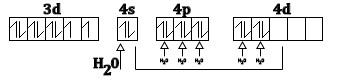
The electrons are filled according to Hund’s rule. Thus, the spin only magnetic moment can be easily calculated using the data given above. As we have seen there are two unpaired electrons in the complex compound so
${u_{spin}} = \sqrt {n(n + 2)} \,BM$
$ = \,\sqrt {2(2 + 2)} \,BM$
\[ = \,\sqrt 8 \,BM\]
Where, BM= Bohr magneton
Hence, option (d) is the correct option.
Note:
Student can also use an alternative method to calculate the spin only magnetic moment of the atom or ion by using a formula
${u_{spin}} = \,\sqrt {4s(s + 1)} \,BM$
Where, s= angular spin moment quantum number.
For $N{i^{2 + }}$ with two unpaired electrons
$s = \dfrac{1}{2} + \dfrac{1}{2} = 1$
Therefore, ${u_{spin}} = \sqrt {4 \times 1(1 + 1)} \,BM$
$ \Rightarrow \,\sqrt 8 \,BM$ which is the required solution.
Complete step by step answer:
$Ni$ is present in $N{i^{2 + }}$ oxidation state as ${\left[ {Ni{{({H_2}O)}_6}} \right]^{2 + }}$
First of all, we know that Ni is a d-block element and ${H_2}O$ being an electron rich species (due to presence of two lone pairs on oxygen atoms) can easily form a coordinate compound.
We look, into the electronic configuration of $N{i^{2 + }}$ ion ${\left[ {Ni{{({H_2}O)}_6}} \right]^{2 + }}$
$Ni = {16^2}2{s^2}2{p^6}3{s^2}3{p^6}3{d^8}4{s^0}$
$N{i^{2 + }} = 1{s^2}2{s^2}2{p^6}3{s^2}3{p^6}3{d^8}4{s^0}$
Thus, according to valence and theory (VB+) water being a ligand form of a high spin complex with $N{i^{2 + }}$ and this can be as show below
The electrons are filled according to Hund’s rule. Thus, the spin only magnetic moment can be easily calculated using the data given above. As we have seen there are two unpaired electrons in the complex compound so
${u_{spin}} = \sqrt {n(n + 2)} \,BM$
$ = \,\sqrt {2(2 + 2)} \,BM$
\[ = \,\sqrt 8 \,BM\]
Where, BM= Bohr magneton
Hence, option (d) is the correct option.
Note:
Student can also use an alternative method to calculate the spin only magnetic moment of the atom or ion by using a formula
${u_{spin}} = \,\sqrt {4s(s + 1)} \,BM$
Where, s= angular spin moment quantum number.
For $N{i^{2 + }}$ with two unpaired electrons
$s = \dfrac{1}{2} + \dfrac{1}{2} = 1$
Therefore, ${u_{spin}} = \sqrt {4 \times 1(1 + 1)} \,BM$
$ \Rightarrow \,\sqrt 8 \,BM$ which is the required solution.
Recently Updated Pages
Explain the structure of megasporangium class 12 biology CBSE

Why is chloroform kept in dark coloured bottles class 12 chemistry CBSE
Derive the balancing condition of a Wheatstone bri class 12 physics CBSE
Draw VI characteristics of a pn junction diode Explain class 12 physics CBSE
Is it possible to carry pride in ones language too class 12 english CBSE
In a population at Hardy Weinberg equilibrium the allele class 12 biology CBSE
Trending doubts
Draw a labelled sketch of the human eye class 12 physics CBSE
Which are the Top 10 Largest Countries of the World?
Draw ray diagrams each showing i myopic eye and ii class 12 physics CBSE
One megawatt is equal to how many units of electri class 12 physics CBSE
Which is the correct genotypic ratio of mendel dihybrid class 12 biology CBSE
Give 10 examples of unisexual and bisexual flowers