




The spectrum obtained from the chromosphere of the sun at the time of the total solar eclipse is:
A. line emission spectrum
B. band emission spectrum
C. continuous emission spectrum
D. line absorption spectrum
Answer
 Verified
651.3k+ views
Hint: To get the answer to this question first of all we have to understand the meaning of the chromosphere of the sun. In order to do so, we have to go through with the information regarding the structure (layers) of the sun and the effects of the solar eclipse on the emission spectrum of the sun.
Complete step by step solution:
The chromosphere which is also known as the color of the sphere is the layer above the photosphere with a thickness of 2000 km and has the density of gases 10-4 times the density of the photosphere so it is not that brighter.
The photosphere emits a continuous spectrum which when passes through the chromosphere layer, absorption takes place and these absorption lines are observed as dark lines appear in the solar spectrum. But during the process of the total eclipse, the light coming from the photosphere is completely cut off this results in the visibility of the chromosphere to us. It appears just as the line absorption spectrum of hydrogen-alpha of reddish color with wavelength 656.3 nm.
$\therefore$ The spectrum obtained from the chromosphere of the sun at the time of the total solar eclipse is the line absorption spectrum. Option (D) is the correct answer.
Note: In order to solve and get the in-depth concept behind the solution to this question we have to understand the structure of the sun.
Layers of the sun:
The structure of the sun can be broadly classified as-
(i) The Core
(ii) The Radiative Zone
(iii) The Photosphere
(iv) The chromosphere and
(v) The Corona
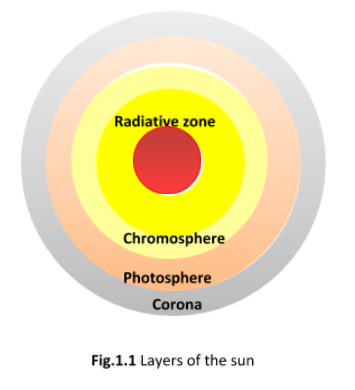
(i) The Core: The interior or central region of the sun with radius 150,000 km where the nuclear reaction takes place by consuming hydrogen and forming helium.
(ii) The Radiative Zone: The layer of the sun which is responsible for delivering the photons from the Core to the Radiative layer is called the Radiative zone. The emission and reabsorption of photons are the main reasons for the radiation of energy in the Radiative layer.
Atmosphere. The atmosphere of the sun is classified in the following layers
(iii) The Photosphere: The deepest layer of the sun having a thickness about 300 km from where most of the visible part of the sun can observe directly. The temperature of the Photosphere varies from 4000 K to 6500 K.
(iv) The chromosphere: The layer above the photosphere with a thickness about 2000 km. It is also called a sphere of colour but can only be seen during an eclipse.
(v) The Corona: The outermost layer of the sun’s atmosphere is the corona. It is 10 million times less dense than the Sun’s surface that’s why it appears much less bright.
Complete step by step solution:
The chromosphere which is also known as the color of the sphere is the layer above the photosphere with a thickness of 2000 km and has the density of gases 10-4 times the density of the photosphere so it is not that brighter.
The photosphere emits a continuous spectrum which when passes through the chromosphere layer, absorption takes place and these absorption lines are observed as dark lines appear in the solar spectrum. But during the process of the total eclipse, the light coming from the photosphere is completely cut off this results in the visibility of the chromosphere to us. It appears just as the line absorption spectrum of hydrogen-alpha of reddish color with wavelength 656.3 nm.
$\therefore$ The spectrum obtained from the chromosphere of the sun at the time of the total solar eclipse is the line absorption spectrum. Option (D) is the correct answer.
Note: In order to solve and get the in-depth concept behind the solution to this question we have to understand the structure of the sun.
Layers of the sun:
The structure of the sun can be broadly classified as-
(i) The Core
(ii) The Radiative Zone
(iii) The Photosphere
(iv) The chromosphere and
(v) The Corona
(i) The Core: The interior or central region of the sun with radius 150,000 km where the nuclear reaction takes place by consuming hydrogen and forming helium.
(ii) The Radiative Zone: The layer of the sun which is responsible for delivering the photons from the Core to the Radiative layer is called the Radiative zone. The emission and reabsorption of photons are the main reasons for the radiation of energy in the Radiative layer.
Atmosphere. The atmosphere of the sun is classified in the following layers
(iii) The Photosphere: The deepest layer of the sun having a thickness about 300 km from where most of the visible part of the sun can observe directly. The temperature of the Photosphere varies from 4000 K to 6500 K.
(iv) The chromosphere: The layer above the photosphere with a thickness about 2000 km. It is also called a sphere of colour but can only be seen during an eclipse.
(v) The Corona: The outermost layer of the sun’s atmosphere is the corona. It is 10 million times less dense than the Sun’s surface that’s why it appears much less bright.
Recently Updated Pages
Master Class 12 Economics: Engaging Questions & Answers for Success

Master Class 12 Social Science: Engaging Questions & Answers for Success
Master Class 12 English: Engaging Questions & Answers for Success
Master Class 12 Maths: Engaging Questions & Answers for Success
Master Class 12 Physics: Engaging Questions & Answers for Success
Master Class 12 Biology: Engaging Questions & Answers for Success
Trending doubts
Draw a labelled sketch of the human eye class 12 physics CBSE
Which are the Top 10 Largest Countries of the World?
Draw ray diagrams each showing i myopic eye and ii class 12 physics CBSE
Which is the correct genotypic ratio of mendel dihybrid class 12 biology CBSE
Differentiate between homogeneous and heterogeneous class 12 chemistry CBSE
Which animal never drinks water in its entire life class 12 biology CBSE