




The source of non-edible oil used in several industries is
A. Arachis hypogea
B. Cocos nucifera
C. Sesamum indicum
D. Ricinus communis
Answer
 Verified
635.1k+ views
Hint:Ricinus communis, or castor oil plant, is a species of perennial flowering plant in the spurge family, Euphorbiaceae. It reproduces with a mixed pollination system which favors selfing by geitonogamy but at the same time can be an out-crosser by anemophily (wind pollination) or entomophily.
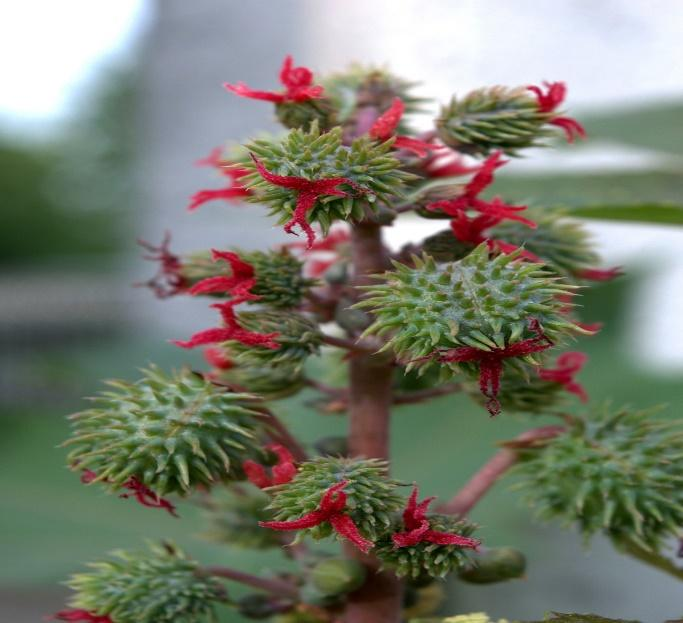
Complete answer:Castor seed is the source of castor oil, which has a wide variety of uses. The seeds contain between \[40\% \] and \[60\% \] oil that is rich in triglycerides, mainly ricinolein. The seed also contains ricin, a water-soluble toxin, which is also present in lower concentrations throughout the plant. Ricinus communis can vary greatly in its growth habit and appearance. The variability has been increased by breeders who have selected a range of cultivars for leaf and flower colors, and oil production. It is a fast-growing, suckering shrub that can reach the size of a small tree, around 12 m, but it is not cold hardy. The fruit is a spiny, greenish (to reddish-purple) capsule containing large, oval, shiny, bean-like, highly poisonous seeds with variable brownish mottling. Castor seeds have a warty appendage called the caruncle, which is a type of elaiosome. The caruncle promotes the dispersal of the seed by ants.
Hence, the correct option is (D) Ricinus communis.
Note: Castor oil has many uses in medicine and other applications. An alcoholic extract of the leaf was shown, in lab rats, to protect the liver from damage from certain poisons. Methanolic extracts of the leaves of Ricinus communis were used in antimicrobial testing against eight pathogenic bacteria in rats and showed antimicrobial properties. The pericarp of Ricinus showed central nervous system effects in mice at low doses. Antihistamine and anti-inflammatory properties were found in the ethanolic extract of Ricinus communis root bark.
Complete answer:Castor seed is the source of castor oil, which has a wide variety of uses. The seeds contain between \[40\% \] and \[60\% \] oil that is rich in triglycerides, mainly ricinolein. The seed also contains ricin, a water-soluble toxin, which is also present in lower concentrations throughout the plant. Ricinus communis can vary greatly in its growth habit and appearance. The variability has been increased by breeders who have selected a range of cultivars for leaf and flower colors, and oil production. It is a fast-growing, suckering shrub that can reach the size of a small tree, around 12 m, but it is not cold hardy. The fruit is a spiny, greenish (to reddish-purple) capsule containing large, oval, shiny, bean-like, highly poisonous seeds with variable brownish mottling. Castor seeds have a warty appendage called the caruncle, which is a type of elaiosome. The caruncle promotes the dispersal of the seed by ants.
Hence, the correct option is (D) Ricinus communis.
Note: Castor oil has many uses in medicine and other applications. An alcoholic extract of the leaf was shown, in lab rats, to protect the liver from damage from certain poisons. Methanolic extracts of the leaves of Ricinus communis were used in antimicrobial testing against eight pathogenic bacteria in rats and showed antimicrobial properties. The pericarp of Ricinus showed central nervous system effects in mice at low doses. Antihistamine and anti-inflammatory properties were found in the ethanolic extract of Ricinus communis root bark.
Recently Updated Pages
If x a + bt + ct2 where x is in meters and t is in class 11 physics CBSE

A car covers the first half distance between two places class 11 physics CBSE
The resultant of two vectors overrightarrow P and overrightarrow class 11 physics CBSE
Find the value of cos 135 class 11 maths CBSE
A mass M is held in place by an applied force F and class 11 physics CBSE
A solution of glucose in water is labelled as 10 dfracwv class 11 chemistry CBSE
Trending doubts
One Metric ton is equal to kg A 10000 B 1000 C 100 class 11 physics CBSE
Find the value of the expression given below sin 30circ class 11 maths CBSE
What do you mean by retardation What is its SI uni class 11 physics CBSE
Draw a diagram of nephron and explain its structur class 11 biology CBSE
10 examples of friction in our daily life
Difference between physical and chemical change class 11 chemistry CBSE