




The sides BC, CA and AB of a triangle ABC are of lengths a, b, c respectively. If D is the mid – point of BC and AD is perpendicular to AC, then the value of \[\cos A\cos C\] is
(a) \[\dfrac{3\left( {{a}^{2}}-{{c}^{2}} \right)}{2ac}\]
(b) \[\dfrac{2\left( {{a}^{2}}-{{c}^{2}} \right)}{3ac}\]
(c) \[\dfrac{\left( {{a}^{2}}-{{c}^{2}} \right)}{3ac}\]
(d) \[\dfrac{2\left( {{c}^{2}}-{{a}^{2}} \right)}{3ac}\]
Answer
 Verified
611.1k+ views
Hint: Draw the \[\Delta ABC\], as mentioned. \[AD\bot AC\] and D is mid – point of BC. i.e. BD = DC. Consider, \[\Delta ADC\] formed find \[\cos C\]. Apply cosine law to the \[\Delta ABC\] and find \[\cos C\]. Thus, form a relation connecting both \[\cos C\]. i.e. for \[{{b}^{2}}\]. Now, find \[\cos A\] using the cosine formula, find \[\cos A\cos C\] and simplify it.
Complete step-by-step answer:
Consider the \[\Delta ABC\]. D is the mid – point of the side BC. Now AD is the perpendicular to AC. i.e. \[AD\bot AC\].
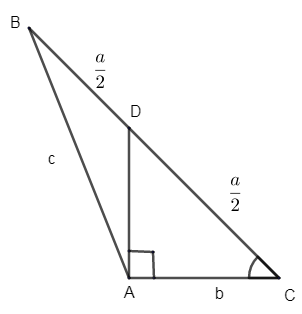
Let us first consider the right angled triangle DAC.
Let us consider C as the angle.
\[\therefore \cos C\] = adjacent side / hypotenuse \[=\dfrac{AC}{DC}\] [from the figure]
i.e. \[\cos C=\dfrac{b}{\dfrac{a}{2}}=\dfrac{2a}{b}\]
\[\therefore \cos C=\dfrac{2a}{b} \to (1)\]
Now, cosine rule of triangle states that the square of the length of any side of a triangle equals the sum of the squares of the length of the other sides minus twice their product multiplied by the cosine of their included angle. Hence, by cosine rule we can write,
\[{{c}^{2}}={{a}^{2}}+{{b}^{2}}-2ab\cos C\]
i.e. \[2ab\cos C={{a}^{2}}+{{b}^{2}}-{{c}^{2}}\]
\[\therefore \cos C=\dfrac{{{a}^{2}}+{{b}^{2}}-{{c}^{2}}}{2ab} \to (2)\]
Let us equate (1) and (2).
\[\dfrac{2a}{b}=\dfrac{{{a}^{2}}+{{b}^{2}}-{{c}^{2}}}{2ab}\]
\[\dfrac{4a{{b}^{2}}}{a}={{a}^{2}}+{{b}^{2}}-{{c}^{2}}\], Simplify the expression,
\[\begin{align}
& 4{{b}^{2}}={{a}^{2}}+{{b}^{2}}-{{c}^{2}} \\
& \left( 4-1 \right){{b}^{2}}={{a}^{2}}-{{c}^{2}} \\
& {{b}^{2}}=\dfrac{{{a}^{2}}-{{c}^{2}}}{3} \to (3) \\
\end{align}\]
Similarly, from cosine formula, we can write,
\[\begin{align}
& {{a}^{2}}={{b}^{2}}+{{c}^{2}}-2ab\cos A \\
& 2cb\cos A={{b}^{2}}+{{c}^{2}}-{{a}^{2}} \\
& \cos A=\dfrac{{{b}^{2}}+{{c}^{2}}-{{a}^{2}}}{2bc} \to (4) \\
\end{align}\]
Hence, \[\cos A.\cos C=\left( \dfrac{{{b}^{2}}+{{c}^{2}}-{{a}^{2}}}{2bc} \right)\left( \dfrac{2b}{a} \right)\]
Put the value of \[{{b}^{2}}\] from equation (3).
\[\therefore \cos A.\cos C=\left( \dfrac{{{a}^{2}}-{{c}^{2}}}{3}+{{c}^{2}}-{{a}^{2}} \right)\times \left( \dfrac{2b}{2bc\times a} \right)\]
\[\begin{align}
& \cos A.\cos C=\left( \dfrac{{{a}^{2}}-{{c}^{2}}+3{{c}^{2}}-3{{a}^{2}}}{3} \right)\times \left( \dfrac{1}{ca} \right) \\
& \cos A.\cos C=\dfrac{2{{c}^{2}}+2{{a}^{2}}}{3}\times \dfrac{1}{{{a}^{2}}}=\dfrac{2}{3}\left( \dfrac{{{c}^{2}}-{{a}^{2}}}{ca} \right) \\
\end{align}\]
Hence, we got the value of \[\cos A.\cos C=\dfrac{2}{3}\left( \dfrac{{{c}^{2}}-{{a}^{2}}}{ca} \right)\].
\[\therefore \] Option (d) is the correct answer.
Note: Cosine law is useful for solving the missing information in a triangle. If all 3 sides of the triangle are known, the cosine rule allows one to find any angle measure. Similarly, if 2 sides and the angle between them are known, the cosine rule allows to find the \[{{3}^{rd}}\] side length.
Complete step-by-step answer:
Consider the \[\Delta ABC\]. D is the mid – point of the side BC. Now AD is the perpendicular to AC. i.e. \[AD\bot AC\].
Let us first consider the right angled triangle DAC.
Let us consider C as the angle.
\[\therefore \cos C\] = adjacent side / hypotenuse \[=\dfrac{AC}{DC}\] [from the figure]
i.e. \[\cos C=\dfrac{b}{\dfrac{a}{2}}=\dfrac{2a}{b}\]
\[\therefore \cos C=\dfrac{2a}{b} \to (1)\]
Now, cosine rule of triangle states that the square of the length of any side of a triangle equals the sum of the squares of the length of the other sides minus twice their product multiplied by the cosine of their included angle. Hence, by cosine rule we can write,
\[{{c}^{2}}={{a}^{2}}+{{b}^{2}}-2ab\cos C\]
i.e. \[2ab\cos C={{a}^{2}}+{{b}^{2}}-{{c}^{2}}\]
\[\therefore \cos C=\dfrac{{{a}^{2}}+{{b}^{2}}-{{c}^{2}}}{2ab} \to (2)\]
Let us equate (1) and (2).
\[\dfrac{2a}{b}=\dfrac{{{a}^{2}}+{{b}^{2}}-{{c}^{2}}}{2ab}\]
\[\dfrac{4a{{b}^{2}}}{a}={{a}^{2}}+{{b}^{2}}-{{c}^{2}}\], Simplify the expression,
\[\begin{align}
& 4{{b}^{2}}={{a}^{2}}+{{b}^{2}}-{{c}^{2}} \\
& \left( 4-1 \right){{b}^{2}}={{a}^{2}}-{{c}^{2}} \\
& {{b}^{2}}=\dfrac{{{a}^{2}}-{{c}^{2}}}{3} \to (3) \\
\end{align}\]
Similarly, from cosine formula, we can write,
\[\begin{align}
& {{a}^{2}}={{b}^{2}}+{{c}^{2}}-2ab\cos A \\
& 2cb\cos A={{b}^{2}}+{{c}^{2}}-{{a}^{2}} \\
& \cos A=\dfrac{{{b}^{2}}+{{c}^{2}}-{{a}^{2}}}{2bc} \to (4) \\
\end{align}\]
Hence, \[\cos A.\cos C=\left( \dfrac{{{b}^{2}}+{{c}^{2}}-{{a}^{2}}}{2bc} \right)\left( \dfrac{2b}{a} \right)\]
Put the value of \[{{b}^{2}}\] from equation (3).
\[\therefore \cos A.\cos C=\left( \dfrac{{{a}^{2}}-{{c}^{2}}}{3}+{{c}^{2}}-{{a}^{2}} \right)\times \left( \dfrac{2b}{2bc\times a} \right)\]
\[\begin{align}
& \cos A.\cos C=\left( \dfrac{{{a}^{2}}-{{c}^{2}}+3{{c}^{2}}-3{{a}^{2}}}{3} \right)\times \left( \dfrac{1}{ca} \right) \\
& \cos A.\cos C=\dfrac{2{{c}^{2}}+2{{a}^{2}}}{3}\times \dfrac{1}{{{a}^{2}}}=\dfrac{2}{3}\left( \dfrac{{{c}^{2}}-{{a}^{2}}}{ca} \right) \\
\end{align}\]
Hence, we got the value of \[\cos A.\cos C=\dfrac{2}{3}\left( \dfrac{{{c}^{2}}-{{a}^{2}}}{ca} \right)\].
\[\therefore \] Option (d) is the correct answer.
Note: Cosine law is useful for solving the missing information in a triangle. If all 3 sides of the triangle are known, the cosine rule allows one to find any angle measure. Similarly, if 2 sides and the angle between them are known, the cosine rule allows to find the \[{{3}^{rd}}\] side length.
Recently Updated Pages
Master Class 12 Economics: Engaging Questions & Answers for Success

Master Class 12 Physics: Engaging Questions & Answers for Success
Master Class 12 English: Engaging Questions & Answers for Success
Master Class 12 Social Science: Engaging Questions & Answers for Success
Master Class 12 Maths: Engaging Questions & Answers for Success
Master Class 12 Business Studies: Engaging Questions & Answers for Success
Trending doubts
Which are the Top 10 Largest Countries of the World?
What are the major means of transport Explain each class 12 social science CBSE
Draw a labelled sketch of the human eye class 12 physics CBSE
Why cannot DNA pass through cell membranes class 12 biology CBSE
Differentiate between insitu conservation and exsitu class 12 biology CBSE
Draw a neat and well labeled diagram of TS of ovary class 12 biology CBSE