



The SI unit of electric potential is
A.$Kg{m^2}{s^2}C$
B.$Kg{m^2}C{s^{ - 2}}$
C.$Kg{m^2}{A^{ - 1}}{s^{ - 3}}$
D.$Kgm{s^{ - 3}}{C^{ - 1}}$
Answer
 Verified
610.8k+ views
Hint: Substitute the base units of volt by simplifying the SI units of other quantities in it by using the definition of potential, into their base units. For example converting newton into base units of force.
Complete answer:
The electric potential is defined as the amount of work needed to shift a unit charge from a point A to a point B. It is denoted by $V$, and its SI unit is volt.
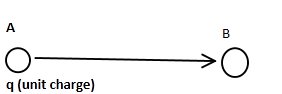
Shifting the charge from point A to B.
Formula of electric potential $V$ is,
$V = kq/r$; …………………..(equation 1)
Where,
$k = $ coulomb constant; and its value is $9 \times {10^9}N{m^2}{C^{ - 2}}$ .
$q = $ charge; its SI unit is coulomb and it is denoted by $C$ .
$r = $distance; its SI unit is meter and it is denoted by $m$ .
Now, by applying all the above SI units to equation 1 we get,
$V = N{m^2}{C^{ - 2}} \times C{m^{ - 1}}$
By adding powers of $m$ and $C$ in above equation we get,
$V = Nm{C^{ - 1}}$; ……………………...(equation 2)
Now, we know that newton denoted as $N$ is the SI unit of force. And formula of force is;
$F = ma$; …………………...(equation 3)
Where, $F = $ force; its SI unit is newton and it is denoted by $N$,
$m = $ mass; its SI unit is kilogram and it is denote by $Kg$,
$a = $ acceleration; its SI unit is meter per second square and it is denoted as $m{s^{ - 2}}$.
Now, by applying all the above SI units to equation 3 we get,
$N = Kgm{s^{ - 2}}$; ………………….. (equation 4)
Now, by substituting equation 4 in equation 2 we get,
$V = Kgm{s^{ - 2}} \times m{C^{ - 1}}$
By adding powers of $m$ we get,
$V = Kg{m^2}{s^{ - 2}}{C^{ - 1}}$; ………………..(equation 5)
Since we know that formula of electric current is
$I = q/t$ ; ………………….(equation 6)
Where,
$I$ is electric current and denoted by $A$ , $q$ is charge denoted by $C$, and $t$ is time denoted by $s$.
By applying all the above SI units to equation 6 we get,
$A = C{s^{ - 1}}$
By converting the equation with respect to $C$ we get,
$C = As$ …………………..(equation7)
Now, by substituting equation 7 in equation 5 we get,
$V = Kg{m^2}{s^{ - 2}}{(As)^{ - 1}}$ ;
By solving powers of $s$ we get,
$V = Kg{m^2}{A^{ - 1}}{s^{ - 3}}$; ……………...(equation 8)
Since we have simplify all the units to simpler units, we get our final answer as
c. $V = Kg{m^2}{A^{ - 1}}{s^{ - 3}}$;
Hence, the correct option is (C).
Note: In such questions try simplifying the SI units into simpler base units, until you get one of the given options. To avoid confusion, always try to solve powers before going to the next step.
Complete answer:
The electric potential is defined as the amount of work needed to shift a unit charge from a point A to a point B. It is denoted by $V$, and its SI unit is volt.
Shifting the charge from point A to B.
Formula of electric potential $V$ is,
$V = kq/r$; …………………..(equation 1)
Where,
$k = $ coulomb constant; and its value is $9 \times {10^9}N{m^2}{C^{ - 2}}$ .
$q = $ charge; its SI unit is coulomb and it is denoted by $C$ .
$r = $distance; its SI unit is meter and it is denoted by $m$ .
Now, by applying all the above SI units to equation 1 we get,
$V = N{m^2}{C^{ - 2}} \times C{m^{ - 1}}$
By adding powers of $m$ and $C$ in above equation we get,
$V = Nm{C^{ - 1}}$; ……………………...(equation 2)
Now, we know that newton denoted as $N$ is the SI unit of force. And formula of force is;
$F = ma$; …………………...(equation 3)
Where, $F = $ force; its SI unit is newton and it is denoted by $N$,
$m = $ mass; its SI unit is kilogram and it is denote by $Kg$,
$a = $ acceleration; its SI unit is meter per second square and it is denoted as $m{s^{ - 2}}$.
Now, by applying all the above SI units to equation 3 we get,
$N = Kgm{s^{ - 2}}$; ………………….. (equation 4)
Now, by substituting equation 4 in equation 2 we get,
$V = Kgm{s^{ - 2}} \times m{C^{ - 1}}$
By adding powers of $m$ we get,
$V = Kg{m^2}{s^{ - 2}}{C^{ - 1}}$; ………………..(equation 5)
Since we know that formula of electric current is
$I = q/t$ ; ………………….(equation 6)
Where,
$I$ is electric current and denoted by $A$ , $q$ is charge denoted by $C$, and $t$ is time denoted by $s$.
By applying all the above SI units to equation 6 we get,
$A = C{s^{ - 1}}$
By converting the equation with respect to $C$ we get,
$C = As$ …………………..(equation7)
Now, by substituting equation 7 in equation 5 we get,
$V = Kg{m^2}{s^{ - 2}}{(As)^{ - 1}}$ ;
By solving powers of $s$ we get,
$V = Kg{m^2}{A^{ - 1}}{s^{ - 3}}$; ……………...(equation 8)
Since we have simplify all the units to simpler units, we get our final answer as
c. $V = Kg{m^2}{A^{ - 1}}{s^{ - 3}}$;
Hence, the correct option is (C).
Note: In such questions try simplifying the SI units into simpler base units, until you get one of the given options. To avoid confusion, always try to solve powers before going to the next step.
Recently Updated Pages
Master Class 12 Business Studies: Engaging Questions & Answers for Success

Master Class 12 Chemistry: Engaging Questions & Answers for Success
Master Class 12 Biology: Engaging Questions & Answers for Success
Class 12 Question and Answer - Your Ultimate Solutions Guide
Master Class 11 English: Engaging Questions & Answers for Success
Master Class 11 Social Science: Engaging Questions & Answers for Success
Trending doubts
Which are the Top 10 Largest Countries of the World?
Draw a labelled sketch of the human eye class 12 physics CBSE
Differentiate between homogeneous and heterogeneous class 12 chemistry CBSE
Differentiate between Pyramid of energy and pyramid class 12 biology CBSE
Why is the cell called the structural and functional class 12 biology CBSE
Draw the diagram of the pyramid of energy Explain In class 12 biology CBSE