




The shunt resistance required to allow \[4\% \] of the main current through the galvanometer of resistance \[48\Omega \] is:
a. \[1\Omega \]
b. \[2\Omega \]
c. \[3\Omega \]
d. \[4\Omega \]
e. \[5\Omega \]
Answer
 Verified
665.7k+ views
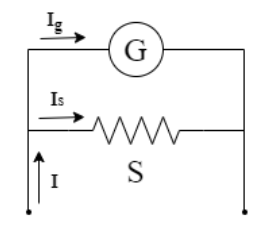
Hint: Shunt resistance is always connected in parallel connection to the galvanometer. Use the condition for parallel connection to get the required value.
Formula Used:
Ohm’s law:
$V = I.R$
Where,
V is voltage across the resistor,
I is current through the resistor,
R is the value of the resistance.
Complete answer:
Given:
Current through the galvanometer is \[4\% \]of main current, i.e. ${i_g} = \dfrac{{4i}}{{100}} = \dfrac{i}{{25}}$, where i is current through main circuit.
Resistance of the galvanometer is $G = 48\Omega $.
To find: The shunt resistance S(say).
> Step 1:
Since, the shunt is connected parallel to the galvanometer hence the voltage drop across them will be the same. Also, the main current will get divided to pass through the galvanometer and the shunt. So, the current through the shunt will be ${i_s} = i - {i_g}$. Now, use ohm’s law both across the galvanometer and the shunt to get the relation:
$
{i_g}.G = {i_s}.S \\
\Rightarrow S = \dfrac{{{i_g}.G}}{{{i_s}}} \\
$
> Step 2:
Now, substitute the values of ${i_g}$, ${i_s}$and G to get:
$
S = \dfrac{{{i_g}.G}}{{{i_s}}} \\
= \dfrac{{\tfrac{i}{{25}}}}{{\left( {1 - \tfrac{i}{{25}}} \right)}} \times 48 = \dfrac{i}{{25}} \times \dfrac{{25}}{{24i}} \times 48 = 2\Omega \\
$
Hence, Required shunt resistance is (b) $2\Omega $..
Note: A galvanometer is shunted with a small resistance to make it an ammeter. It makes the effective resistance of the ammeter very low. Since, galvanometer is a very sensitive instrument, it can’t measure a large current. Using a low resistance shunt makes the current through the galvanometer very less.
Formula Used:
Ohm’s law:
$V = I.R$
Where,
V is voltage across the resistor,
I is current through the resistor,
R is the value of the resistance.
Complete answer:
Given:
Current through the galvanometer is \[4\% \]of main current, i.e. ${i_g} = \dfrac{{4i}}{{100}} = \dfrac{i}{{25}}$, where i is current through main circuit.
Resistance of the galvanometer is $G = 48\Omega $.
To find: The shunt resistance S(say).
> Step 1:
Since, the shunt is connected parallel to the galvanometer hence the voltage drop across them will be the same. Also, the main current will get divided to pass through the galvanometer and the shunt. So, the current through the shunt will be ${i_s} = i - {i_g}$. Now, use ohm’s law both across the galvanometer and the shunt to get the relation:
$
{i_g}.G = {i_s}.S \\
\Rightarrow S = \dfrac{{{i_g}.G}}{{{i_s}}} \\
$
> Step 2:
Now, substitute the values of ${i_g}$, ${i_s}$and G to get:
$
S = \dfrac{{{i_g}.G}}{{{i_s}}} \\
= \dfrac{{\tfrac{i}{{25}}}}{{\left( {1 - \tfrac{i}{{25}}} \right)}} \times 48 = \dfrac{i}{{25}} \times \dfrac{{25}}{{24i}} \times 48 = 2\Omega \\
$
Hence, Required shunt resistance is (b) $2\Omega $..
Note: A galvanometer is shunted with a small resistance to make it an ammeter. It makes the effective resistance of the ammeter very low. Since, galvanometer is a very sensitive instrument, it can’t measure a large current. Using a low resistance shunt makes the current through the galvanometer very less.
Recently Updated Pages
Explain the structure of megasporangium class 12 biology CBSE

Why is chloroform kept in dark coloured bottles class 12 chemistry CBSE
Derive the balancing condition of a Wheatstone bri class 12 physics CBSE
Draw VI characteristics of a pn junction diode Explain class 12 physics CBSE
Is it possible to carry pride in ones language too class 12 english CBSE
In a population at Hardy Weinberg equilibrium the allele class 12 biology CBSE
Trending doubts
Draw a labelled sketch of the human eye class 12 physics CBSE
Which are the Top 10 Largest Countries of the World?
Draw ray diagrams each showing i myopic eye and ii class 12 physics CBSE
One megawatt is equal to how many units of electri class 12 physics CBSE
Which is the correct genotypic ratio of mendel dihybrid class 12 biology CBSE
Give 10 examples of unisexual and bisexual flowers