



The set of points on the axis of the parabola $2\left\{ {{\left( x-1 \right)}^{2}}+{{\left( y-1 \right)}^{2}} \right\}={{\left( x+y \right)}^{2}}$ from which three distinct normals can be drawn is the set of points $\left( h,k \right)$ lying on the axis of the parabola, such that\[\]
A.$h>\dfrac{3}{2}$\[\]
B. $h>2$\[\]
C. $h>4$\[\]
D. $k<\dfrac{3}{2}$\[\]
Answer
 Verified
598.5k+ views
Hint: We know that if the coordinate of the vertex is given by $V\left( m,n \right)$ then we can only draw the there normals on a point $\left( x,y \right)$ the axis when $x>3m,y>1.5n$. We compare the equation of parabola with standard equation of parabola in focus-directrix form to get the vertex and then find condition on $h.$\[\]
Complete step-by-step solution
We know that parabola is the locus of a point which moves such that its distance from a fixed point is equal to its distance from a fixed line. The fixed line is called directrix and the fixed point is called focus. We know that if the focus of the parabola is $F\left( a,b \right)$ and the equation of directrix is $lx+my+n=0$ then we can write the equation of the parabola in focus-directrix form as
\[{{\left( x-a \right)}^{2}}+{{\left( y-b \right)}^{2}}={{\dfrac{\left( lx+my+c \right)}{{{l}^{2}}+{{m}^{2}}}}^{2}}\]
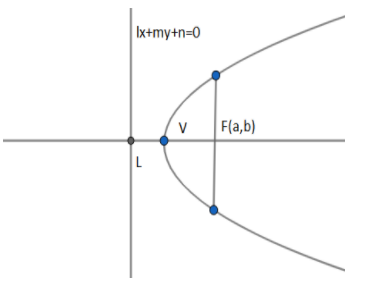
The line perpendicular to directrix is called axis and the midpoint of $L\left( c,d \right)$ and the focus F is called vertex $V\left( \dfrac{a+c}{2},\dfrac{b+d}{2} \right)$. The line perpendicular to the axis passing through the focus is called latus rectum . We know that we can only draw three only normals to the parabola form the axis on a point $\left( {{x}_{1}},{{y}_{2}} \right)$ beyond twice the latus rectum from vertex which in this case is,
\[{{x}_{1}}>3\left( \dfrac{a+c}{2} \right),{{y}_{1}}>\dfrac{3}{2}\left( \dfrac{b+d}{2} \right)\]
The given equation of the parabola is
\[2\left\{ {{\left( x-1 \right)}^{2}}+{{\left( y-1 \right)}^{2}} \right\}={{\left( x+y \right)}^{2}}\]
Let us convert the above equation to the standard form and to the focus-directrix form and have,
\[\left\{ {{\left( x-1 \right)}^{2}}+{{\left( y-1 \right)}^{2}} \right\}=\dfrac{{{\left( x+y \right)}^{2}}}{2}\]
We compare the above equation with standard equation with focus and directrix and have coordinates of focus as $\left( a,b \right)=\left( 1,1 \right)$ where the equation of the directrix is $x+y=0\Rightarrow x=-y$ . The directrix passes through the origin at an angle ${{\tan }^{-1}}\left( \dfrac{-1}{1} \right)={{135}^{\circ }}$ with a positive $x-$axis. The coordinate of L is $L\left( 0,0 \right)=L\left( c,d \right)$. So the vertex is
\[V\left( \dfrac{c+a}{2},\dfrac{d+b}{2} \right)=V\left( \dfrac{0+1}{2},\dfrac{0+1}{2} \right)=V\left( \dfrac{1}{2},\dfrac{1}{2} \right)\]
We have any point on the axis as $\left( h,k \right)$, hence the condition is
\[h>3\left( \dfrac{a+c}{2} \right)=3\left( \dfrac{1+0}{2} \right)=\dfrac{3}{2}\]
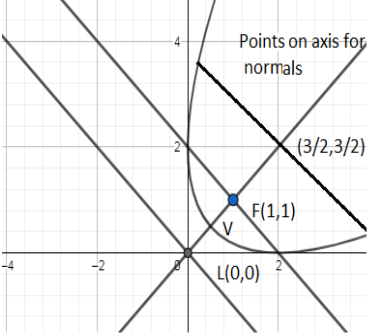
So the correct option is A.
Note: The condition for $k$ is $k>\dfrac{3}{4}$. We can alternatively solve by shifting the standard parabola ${{y}^{2}}=4ax$ by ${{45}^{\circ }}$ in an anti-clockwise direction. The equation of normals to the parabola ${{y}^{2}}=4ax$ with slope $m$ is given by $y=mx-2m-{{m}^{3}}$.
Complete step-by-step solution
We know that parabola is the locus of a point which moves such that its distance from a fixed point is equal to its distance from a fixed line. The fixed line is called directrix and the fixed point is called focus. We know that if the focus of the parabola is $F\left( a,b \right)$ and the equation of directrix is $lx+my+n=0$ then we can write the equation of the parabola in focus-directrix form as
\[{{\left( x-a \right)}^{2}}+{{\left( y-b \right)}^{2}}={{\dfrac{\left( lx+my+c \right)}{{{l}^{2}}+{{m}^{2}}}}^{2}}\]
The line perpendicular to directrix is called axis and the midpoint of $L\left( c,d \right)$ and the focus F is called vertex $V\left( \dfrac{a+c}{2},\dfrac{b+d}{2} \right)$. The line perpendicular to the axis passing through the focus is called latus rectum . We know that we can only draw three only normals to the parabola form the axis on a point $\left( {{x}_{1}},{{y}_{2}} \right)$ beyond twice the latus rectum from vertex which in this case is,
\[{{x}_{1}}>3\left( \dfrac{a+c}{2} \right),{{y}_{1}}>\dfrac{3}{2}\left( \dfrac{b+d}{2} \right)\]
The given equation of the parabola is
\[2\left\{ {{\left( x-1 \right)}^{2}}+{{\left( y-1 \right)}^{2}} \right\}={{\left( x+y \right)}^{2}}\]
Let us convert the above equation to the standard form and to the focus-directrix form and have,
\[\left\{ {{\left( x-1 \right)}^{2}}+{{\left( y-1 \right)}^{2}} \right\}=\dfrac{{{\left( x+y \right)}^{2}}}{2}\]
We compare the above equation with standard equation with focus and directrix and have coordinates of focus as $\left( a,b \right)=\left( 1,1 \right)$ where the equation of the directrix is $x+y=0\Rightarrow x=-y$ . The directrix passes through the origin at an angle ${{\tan }^{-1}}\left( \dfrac{-1}{1} \right)={{135}^{\circ }}$ with a positive $x-$axis. The coordinate of L is $L\left( 0,0 \right)=L\left( c,d \right)$. So the vertex is
\[V\left( \dfrac{c+a}{2},\dfrac{d+b}{2} \right)=V\left( \dfrac{0+1}{2},\dfrac{0+1}{2} \right)=V\left( \dfrac{1}{2},\dfrac{1}{2} \right)\]
We have any point on the axis as $\left( h,k \right)$, hence the condition is
\[h>3\left( \dfrac{a+c}{2} \right)=3\left( \dfrac{1+0}{2} \right)=\dfrac{3}{2}\]
So the correct option is A.
Note: The condition for $k$ is $k>\dfrac{3}{4}$. We can alternatively solve by shifting the standard parabola ${{y}^{2}}=4ax$ by ${{45}^{\circ }}$ in an anti-clockwise direction. The equation of normals to the parabola ${{y}^{2}}=4ax$ with slope $m$ is given by $y=mx-2m-{{m}^{3}}$.
Recently Updated Pages
Master Class 11 Social Science: Engaging Questions & Answers for Success

Master Class 11 Physics: Engaging Questions & Answers for Success
Master Class 11 Maths: Engaging Questions & Answers for Success
Master Class 11 Economics: Engaging Questions & Answers for Success
Master Class 11 Computer Science: Engaging Questions & Answers for Success
Master Class 11 Chemistry: Engaging Questions & Answers for Success
Trending doubts
One Metric ton is equal to kg A 10000 B 1000 C 100 class 11 physics CBSE
There are 720 permutations of the digits 1 2 3 4 5 class 11 maths CBSE
1 Quintal is equal to a 110 kg b 10 kg c 100kg d 1000 class 11 physics CBSE
State and prove Bernoullis theorem class 11 physics CBSE
Difference Between Prokaryotic Cells and Eukaryotic Cells
Discuss the various forms of bacteria class 11 biology CBSE